Shortly after he got arrested, Onoprienko called himself a hostage, who had to be put on trial wrongly. He claimed the police should first track down the unknown force that drove him. He does admit that he looks forward to the gigantic attention of the press. He's been sentenced to death, but as Russia can't perform any capital punishments anymore since it joined the Council of Europe, his punishment was replaced by a life sentence in the Zhytomyr prison, although Onoprienko himself wanted to be executed.
The fact that he killed 52 people is a neglectable detail to Onoprienko. "None of my victims resisted. Armed or not, man or woman, none of them dare to do anything. A human being doesn't mean anything. I've only seen weak people. I compare humans to sand-grains. There are so much of them that they don't mean a thing."
Onoprienko also had a vision of Hitler requesting he start a new world war. He may be sociopathic, but he has fantasies that hint more at a psychosis. Probably he was narcissist. Without others to pay attention to him once they found out how much his character had been disturbed his mental balance over the years, he resorted to killing mostly old people.
I bet they were even hospitable to him at first.
Ironically, Zhytomyr prison is located in an area where many Jews died during World War 2.
Originally posted: April 18, 2007 4:37 PM
References:
Anatoly Onoprienko: http://en.wikipedia.org/wiki/Anatoly_Onoprienko
Showing posts with label mass murder. Show all posts
Showing posts with label mass murder. Show all posts

20111119
Marc Lepine and the New Hysteria: A Social Psychoanalysis of Quebecois Society
This is an unauthorized translation from the French of Lise Monette's 14+Un from the CyberTRANS archive. Any embellishments, errors, and omissions in translation is completely mine. Significant editing was done in certain situations where the original word in French had no appropriate phrase, term or word in English. As well, so as to directly state what was subtly hinted at in the French, some sentences were consequently added or edited as needed.
Thus, this translation reflects more of the translater's personal ideology regarding the circumstances of that day on December 6, 1989 in Montreal at the L'ecole Polytechnique.
It's a long read that's worth being closely examined.
In addition, links to appropriate websites concerning persons and people mentioned in the text will be added as may be necessary to aid the reader in researching this political act that arose out of Quebecois society near the end of the 1980s, only to influence both Canadian law (gun control) and its politics in today's post-modern world. - Translator
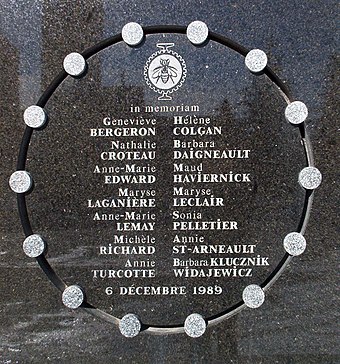
This mathematical calculation - fourteen corpses of women and a male corpse - was followed by abject horror, erudite sideration and considerable indignation. The result: paralysis of thought.
This essay represents the shortest distance required to start the imaginary re-examination of the dimensions and the symbolic system of this equation based on a really good numerical report.
It will again raise the veil on this scene and those which preceded it and followed to emphasize the identifiable parts of its result and better collect the organizing function of feminist rhetoric in its deployment. An assumption will be made about the anchoring of this course; this marked slaughter had the seal of despair, and - without any doubt of hatred - was an immense gesture of love.
Yet - before being able to make credible this reading - several developments and turnings will prove to be necessary. An archaeology of the unconscious desires of whose this family and social trauma emanates will make it possible to bring enlightenment. So hope for it, but do not overlook its significance.
Following Alice Miller is the belief that behind any crime, a tragedy is its hiding place. However the characteristics of violence, even theoretical, consists of stopping at a certain capacity of mental development, at least temporarily. Violence disarms reason and planning to the point where one cannot think of it while acting on such urges. One needs to trick reason in order to get around what precedes and what follows such violence.
Put in perspective in a causal chain, reason is the binding or connection with direction and progress. Force, being disruptive and anarchistic in the beginning, tears apart the social fabric that ties together both community and family. If any violence conceals a subjective dimension in "what it deceives the subject by being unaware of it" according to the Jesuit psychoanalyst Denis Vasse, it is supported in addition to the social dynamics which conditions it, and often determines its outcome.
In the 3-page manifesto of Marc Lépine, this decoding can be done only as from its own affectivity, its conscious and unconscious desires, its values, its culture, its origin of class, its time, etc. It thus represents an external order with its laws, prohibitions and regulations. The mother transmits - more radically imposes on the psyché of the child, through the body care that she manages - to him the marks of her characteristic psyché: "the maternal word pours a carrying and creative flow direction which pre-empts by far the capacity of the child to recognize the significance of it and to take it again on its account". Feminist ideology and the women symbolic of that ideology were the cause of the alienation of men and of himself in particular. The impassioned debate which followed the tragedy centered on the cogency of this charge. In each camp, in turn, defended its particular ideologies and passed on the attack, either it be Lepine as a symbol of patriarchy or the women as a symbol of feminism.
If we wonder about the place and the function of feminist rhetoric regarding this man in his individual history, we will only wear ourselves out. In addition - more importantly and relevant to his case - of this ideology, it appears that any autonomous and independent woman given access to the economic, sociocultural and patriarchal universe was considered in Lepine's eyes feminist. Thus it was with the coeds of L'ecole Polytechique.
The essential function of any ideology is to halt progress just long enough for it to become rooted in a given culture. That ideology must be organized and - in order to be maintained - must challenge the individual as its servant.
In addition to the arguments and political decisions made due to the events of December 6, 1989, one gets the sense that everyone debating it both privately and in Parliament is delirious in their personal and socialist speech about their respective ideologies as much as Lepine was during his rampage, thus borrowing elements as much from the personal history of Lepine which adds to that of the collective history of Quebecois society. Thus in Quebec, for a long time, the delirious women in psychiatric institutions were committed by the agents of the Catholic Church (e.g. the orphans recently authorized by the Duplessis government to be declared mentally retarded because the government paid better if each orphan was considered mentally ill).
The book of Koechlin, Corridor of Safety, is an illustration of that time. (See Ph. et E. Koechlin, Corridor de sécurité,, Paris, Maspero, 1974)
Alice Miller in her deconstruction of the racism of Hitler exemplifies too this bond between religious ecstasy and delirium in political ideologies. (See A. Miller, C’est pour ton bien. Racines de la violence dans l’éducation de l’enfant, Paris, Aubier, 1989.)
In the very field of specific organic disease, degenerative or terminal, the patient clings to the dominating ambient speech - namely the medical speech - to give significance, and to explain what comes to him of violent and incomprehensible urges. When such urges occur - in certain cases - he completely assimilates the medical jargon and blurs, or even hides, any reference to his word over his relation with his pain and his suffering.
As the dominant ideologies or most frequent of a given medium then become speeches of loan which subsume the word of the psychopath and lend direction, they find a coherence in the psyché on the way to delusion. They bind the anguish of the living who are dispossessed, suicidal and alienated.
Let us return to the heart of our subject.
Why does Marc Lépine become obsessed by feminism? Why does he make a scapegoat of it? Feminism rises against a violent symbolic system which made him yet he chose to write of it in his manifesto. So why does feminism grant so much credibility and of effectiveness to these statements?
We now know how the family violence (both child abuse and domestic abuse) in his childhood proceeded. His mother ended it by asking for divorce and for custody of the children. (Lepine had a younger sister, Nadia). Once a passive woman enduring the yoke of her husband, she was freed from this abusive patriarchal law; now an autonomous worker, she eventually rose above her station as wife of an abusive and often violent man. She becomes similar to these women whom Lepine would later denounce in his manifesto.
Let us make the assumption that the absence of convincing subjective significance of the collapse of the family unit became a ground favorable to its invasion by a plausible explanation of its origin, which could only be simultaneously denounced by the child in distress which Lepine remained, both emotionally and psychologically.
In other words, Marc Lépine denounces and shows "feminism" of his/her mother to be responsible for all his misfortunes. His point of view, by identification, which was to be probably that of the father, from his cultural origins which traditionally develop the submission of the woman to the man. By claiming the equality of the sexes, implicit or clarified, Lepine's mother rocked the balance of power in her marriage. Her financial autonomy and professionalism enabled her to escape from the yoke from her husband. As a result, "feminism" becomes guilty of all the evils of which Marc Lépine was afraid of possessing.
Let us introduce at this point a basic distinction between physical violence and the symbolic system of violence. The first door reached with the physical integrity of the person and inevitably with her psychic integrity; however it can be spread to reach the psychic integrity, in which case we are in the presence of a sadistic libido component. It can be also exerted because she forecloses the subjectivity of the other, i.e. she treats the other like an object without interiority: what dominates then is the instinct to master which is not along the sexual line itself, but rather concerns narcissism.
As for the second, the symbolic system of violence, I will define it starting from Bourdieu and Passeron as "any capacity which manages to impose significances and to impose them as legitimate by dissimulating the balance of power which are at the base of his power and thus adds his own power to these balances of power". (See Bourdieu & Passeron, De la Reproduction, Paris, Éditions de Minuit, 1970, p. 18.)
Also included in this category are all the forms of violence legitimated because of their institutionalization, which greatly ensures their ignorance. Family and public education in the name of the good of the child generates this type of violence. The theory, when it becomes doctrinary, also exerts an ideological terrorism. Thus the phallocentrism of the philosophical speech imposes a form on the thought and word which disqualifies and discredits those which escape from its dictates / diktats.
The violence of peace as described by Viviane Forrester constitutes a more subtle and more pernicious method of it. (V. Forrester, La violence du calme, Paris, Seuil, 1980.)
Produced by coercive forces of a violence such that their manifest exercise becomes superfluous and finally passes unperceived, peace ensures the status quo and the social order. Let us add to this rapid overflight the mental cruelty which uses contempt or ridicule to lower the regard of oneself by the interlocutor and thus ensure her domination.
Can one be safe from violence? Is this the postulate which underlies this text? Let us locate this question using the remarks of Piera Aulagnier in the violence of interpretation, which introduces a capital difference between a paramount violence necessary to survival and the advent of the subject and the violence itself which implies an excess, and develops the hypothesis that the child sees his satisfied needs vital only thanks to more or less successful interpretations that the maternal figure assumes from her reading of the vital signs which he emits.
This decoding can be done only as from the child's own affectivity, its conscious and unconscious desires, its values, its culture, its origin of class, its time, etc. It thus represents an external order with its laws, prohibited and regulations. The mother transmits, more radically imposes on the psyché of the child, through the physical care that she manages to give him, the marks of her characteristic psyché: "the maternal word pours a carrying and creative flow direction which pre-empts by far the capacity of the child to recognize the significance of it and to take it again on its account". (See P. Castoriadis-Aulagnier, La violence de l’interprétation, Paris, P.U.F. 1975, p. 36-40.)
In this way is a child made in the image of its mother.
She subjects the child to a primary violence necessary and impossible to circumvent "of the outside with the price of a first rape of a space and an activity which obeys the heterogeneous laws of the ego". (See Id., p. 40.)
If the psyché of the mother proves to be an effective prosthesis for that of the child, wrote Aulagnier, it is at the price of an inaugural violence in which the supply of direction precedes its own.
Violence, while not necessary to the abused person's survival, becomes a capacity which is exerted against her, destroys her capacity to reply, but more deeply and entirely constrained the manufactured abstraction of her own psychic dynamics internally to be modelled on that of the other, to be held constantly with the implicit capacity to anticipate all her desires, to dissolve, vanish, to make her at one with the other to ensure her peace of mind as her internalized conditions of survival.
Thus the beaten woman is considered responsible for the "sudden changes of mood" of her spouses due to her actions "which it caused", since she did not know or could not marry (sic) her legal desires. In these couples, only one of the two partners cannot exist at the same time, the other having given up all her desires to put herself at the service of those of the spouse.
Between a fundamental violence impossible to circumvent and structured for the abused person and an excessive violence which paralyses his capacity of mental development and its subsequent effect in his personality, is spread many strategies by which her psyché tries to deaden, to circumvent, and to eliminate what may cause a psychotic break.
Let us try to better circumscribe, for this purpose, which concerns aggressiveness and rage, on one hand, and of hatred, on the other.
Aggressiveness, in its primary form, appears as cruelty. It presupposes that the abused person is unaware of the other as an other. Associated the specular image, it tackles the threatening double. Due to the instinct to master, it will aim at the control of the object at all costs, including its destruction. With the service of the autoconservation of ego, it underlies dichotomic problems of oneself or the other. The real or imaginary possibility of a threat to physical integrity, insofar as it finds its roots there, will start a narcissistic aggressiveness.
Thus does marcissism arise.
Rage is born from a narcissistic wound. It emanates from a feeling of frustration or impotence of ego. Bound emulously, rage draws its pleasure from the destruction of that which the other enjoys. Rather rage is exerted in order to have what the other enjoys than to be the subject of the other's enjoyment.
Let us be concise and expedite this main point: nothing in the act of murder committed by Marc Lépine points to aggressiveness and rage as previously circumscribed.
As for hatred, it, for the Kleinians, is cleaved love in its most primitive expressions and, for Freud, ambivalence, being marked in this last case with the seal of sexual difference. Beyond these distinctions, which, on the heuristic level, appears most relevant for our matter is at the end of the article of Freud "the negation". (See S. Freud, « La Négation », in Résultats, idées, problèmes II, Paris, P.U.F. 1985.)
One reads there that the object as a foreigner with ego appears by hatred and expulsion or the rejection of what is presented in the form of different, Other. Is this the unknown foreign woman in the mother, whom incarnated by her life external with the hearth, as worker, which was the unconscious object of the hatred of Marc Lépine?
In its contribution to the process of identification with the aggressor, Ferenczi does not affirm that the child internalizes the hatred of the attacker - which on first glance would make it possible to suppose is the case with Marc Lépine - but he writes in his manifesto rather with the unconscious feeling of culpability of this one "is swallowed, devoured, engulfed" by the child. Additionally hatred is impossible when there is identification. Apparently in the case of Marc Lépine, one arrives at a double dead end of hatred - from the side of the father the identification, and from the side of the mother, the idealization - as we will see it before us. (See S. Ferenczi, Journal clinique, Paris, Payot, 1985.)
What about excess for the spiritual experience of this child? Only paternal physical violence? In addition Ferenczi presents trauma for the child as the unconscious perception of maternal hatred. This assertion cannot not be affirmed or cancelled without the necessary clinical data. Did a double locking of his hatred for his parents lead to his acting it out disproportionately by shooting only women?
At age 13 Marc Lépine had taken the maiden name of his mother as his surname, thus giving up his immigrant father's culture in favor of his mother's culture, which represents Québécois culture. (See D. Scarfone, « Batman et Lépine. La place du père », Prisme, vol. 1, n°1, Automne
1990)
He had broken a patrilineal filiation and had chosen, due to the divorce of his parents, an allegiance with his mother's clan within the context of Quebecois culture. One knows that the separation in 1973 of both parents was not done without important clashes, both physical and emotional, which led the mother to decide for herself and her two children, following a year of family therapy in 1975, without much contribution from the father, to receive her divorce from him in 1976.
As in all the children of divorce when the guardianship is entrusted to and assumed by only one of the couple, Marc Lépine is privately accessible one of his parents and cannot allow himself to lose the other which becomes his single object of love. In criticism of his mother's decision to divorce, he refuses to have anything to do with his father, so as to radically only find himself. All his emotional setting rests on his mother. If he holds her responsible as a culprit for the disintegration of the family unit, he must conceal or more probably drive back his attacks in his connection with his father. He will thus move this criticism later on from the private individual (his mother) to the General, (the women other than her mother: those which have a great public visibility - on his hit list - and the coeds of L'ecole Polytechnique, his rivals, since he had wished to make studies in this field at this school), of the singular (Oedipal rage) to universal (his anti-feminist rhetoric and 3-page manifesto).
This displacement will ensure the safeguard and protection, in short, the saving of its object of initial love (his mother). As the result of a more radical psychic mechanism still, the cleavage of the love and hatred towards the female object of the male's libido will leave intact the maternal imago.
In short, out of love for his mother Gamil Rodrigue Gharbi objectified his hatred for her leaving his father by changing his name to Marc Lépine and then descending into delirium to take the lives of 14 innocent women in his planned murder-suicide.
Starting from a male positioning the patriarchy, his denunciation of feminism enabled him to be torn off with the imaginary collecting of the maternal female universe to try to recover the phallus (the root of male power). But precisely, who he attacks are the women who, in his eyes, have this phallus (the power to enroll in a male-dominated field of profession) which deprives the men of their power. His father had exercised this power by and through physical violence against him; the feminists also have this power, thanks to this symbolic system of violence made this time at the men (by being students at L'ecole Polytechnique), according to him. This dichotomic oscillation indicates the dead end of Marc Lépine in his purely imaginary reference of identification, because ever mediatised by the interior presence of a third which would relativise it, or ONE or ONE (one year for one's life i.e. 14 deaths for each of his 14 years of trauma), which the radical disjunctive equation in which he is captive. Initially of the paternal hegemony, the feminist hegemony (instead of that of the mother) thereafter, to which he escaped, there are as many abuses of power which crushed Marc Lépine's spirit. There is no limit which decides between patriarchy and feminism, and which protects one from such abuses of power.
The impersonal law, the Name-of-Father (i.e. God), who precisely does not cleanly signify which father, but comes to him moreover from another lack (of a father) in childhood and its spiritual emblem (Jesus) even would be be abolished thereafter. Not having functioned as operator of a separation and a distinction between the father and the mother, the father and the children, it (God) is rejected and nullified; or rather the rejection by the son of the name of the father does nothing but record that it was already null and void for all the members of this family. The access to the symbolic system of rational order (God), and the loss of the male identity to the profit of a passage to the mother's clan, lineage and social culture will lead to the annihilation of self (as Gamil Rodrigue Gharbi).
Taken in the war of the sexes, that of his parents, reproduced on the socio-political scene, and taken in the dead end of his identifications both male and female, he tries at last once, by a "heroic" gesture, to liquidate the influence of the female on him. This wrenching, cathartic violent rupture will leave his mother intact (and safe). The young women of L'Ecole Polytechnique were immolated paradoxically in the funeral pyre arising out of the love of this man for his idealized mother.
In "Aux carrefours de la haine (With the Crossroads of Hatred)", Micheline Enriquez notes that: "the object of hatred is the object of an ideal which being revealed 'as) inaccessible requires its destruction and its derision. Thus of delirious hatred a desire of idealization and recognition changes which is never found in return but for its rejection, contempt, and exclusion". (See M. Enriquez, Aux carrefours de la haine, Paris, Épi, Desclée de Brouwer, 1984, p. 81.)
Doesn't it strike home even of the relation of Marc Lépine to his mother? Would his delirious hatred of feminism find its source in what Freudians pointed out that the father rejected and excluded this idealized mother? It is the woman in him which he attacked, through the other women, thus saving for the better the mother of his childhood so as to symbolically gain the life of the mother that he saves. Moreover, the inversion by which the man will become the victim of feminism will make it possible for Marc Lépine finally to clear his father (of his abuse of power) who his mother was the victim for a long time in his eyes and even with those of the legal system.
Purely abstract symbols of the evils of feminism (according to Marc Lépine) are assassinated. They constitute an open series of units, perfectly substitutable individualities - the ones with the others from their anonymity for the exterminator: (1 + 1 + 1)n. What could this series stop, taking into account the psychic dynamics of its author? It seems precisely that the last woman killed before Marc Lépine is not yet dead who addressed him in a desperate attempt to get him to come into contact with the subject of these acts (Maryse LeClaire), and not only with the impersonal killer himself thus leaving anonymity by addressing somebody (Marc Lépine). After her call for help to him, she is killed, but with a difference, LeClaire is stabbed within physical proximity whereas the automatic weapon shot the other victims from a distance. Immediately after, Marc Lépine stops shooting and kills himself. He destroys himself after being positioned and being challenged in his subjectivity: of individual he becomes nobody; from subject fixed with his madness, ultimately he eliminates this one and thus he even turns upon his own self this obsession to destroy the Other female one (by shooting himself in the head). By passing the attack of female back onto the masculine, Lépine heard here the call of his identifying location of control, the control of the other by physical violence as practised by the paternal figure.
(In essence, Lépine committed suicide because his stabbing of LeClaire brought him out of his delirium long enough for him to realize that in killing her - and in hearing the police storm L'ecole Polytechnique - he had eliminated finally the symbolic mother of his childhood and thus had to relieve himself of probable future legal punishment as his father had punished him during his childhood by shooting himself in the head. By his suicide he ended the horrors of child abuse inflicted upon him by his father.)
Omnipotent maniac or compulsive repetition? Reiteration ritualized and potentially without end of a cathartic gesture? Exorcism of the female feminism which incarnates the evil which was introduced in the beginning the family separation, the wavering of the identified positions?
What Marc Lépine keeps silent is what caused and produces his suffering and his loneliness. He assassinates those who are allowed to reach their desires (at L'ecole Polytechnique) whereas he could not do so, for they are those who replace, for him to some extent and his father in a late identification, an alliance with the masculine. His ultimate attempt at domination of the feminine and feminism starting from the initial paternal position (in his family) shows a failure, since he cannot remove subjectivity of the invested object anymore. He leaves the shade (of delirium) and turns over the weapon against himself when a woman acquires consistency (in asking for his help). His voice joins her, and then he collapses, dead. He destroys by physical violence this male imago (along the male line) following his refusal of an allegiance to the female one, which the call (for help) represented, the personalized petition of a young woman, to what he had initially adhered the side of the maternal imago to see there the foundation forever of his male universe. Quartered, torn between these two poles, his voice vanishes.
How of minus-ONE becomes plus-ONE? It became a social event, a date (in history and today continues to symbolize a Canadian National Day Against Violence of Women). The anti-hero of the gender war which threatens to burst through the fabric of the community awakens and reactivates the threat and the difficulty of the coexistence of divergent identifying reference marks of each one of us, as much as in our balance with the other, the Other sex, the daily Foreigner with whom it is necessary to cohabit. As Eugene Erniquez writes: "the social bond arises starting as a tragic bond: it enables us to understand that the others exist, not like possible objects of our satisfaction but like subjects of their desires, in other words like as much likely to reject us, to love us and express contradictory wills with ours, to present permanent dangers not only for our narcissism but also to our simple survival, and to be for us, in spite of that and at the same time as essential as the air as we breathe". (See E. Enriquez, De la horde à l’État. Essai de psychanalyse du lien social, Paris, Gallimard, 1983, p. 183.)
For many millenia, social coherence rested on the drain - the specialization of the roles of female and male - and on the denial of the psychic bisexuality of each individual who composes it. The social assignment of the sexual identity introduces an all the more large polarization and subsequent antagonisms as it hardens the differences between genders. At the time when those differences grow blurred, the beacons and the sexual reference marks, both subjective and social, are threatened. The feminist claims become certainly the persons in charge for identifying waverings, both the men and the women. The individual and social repression of the bisexuality assigns a stable identity, the ONE at the expense of the multiple which introduces confusion and distresses.
Everyone is confronted with the problem of the otherness and alienation in her heart. The immigrant (who is symbolized by the father of Marc Lépine) and feminism incarnate in our midst (the 14 women he shot and women in professional role they were historically excluded from before suffrage) poses a threat to social cohesion founded on the separation of the functions and the roles simultaneously to the recognition and the valorization of the similar one (as symbolized by both "Canadian" and the patriarchy co-opting the "average" Canadian).
The problem of the difference, and especially of gender - this variation which cannot be abolished (because it is genetically predetermined) - to be filled, proves in the heart of the tragedy of the human condition. How do we coexist with both our fellow human beings and with foreigners? These are theoretical questions, but very existential for each one of us. The challenge of a life whose failure of another (Marc Lépine) results in the death of several others (the 14 women of L'ecole Polytechnique), enables us to measure the depth of our existence!
If the madness is "absence of work", as Foucault thinks it, it calls for direction. If nature is horrorified by the vacuum (caused by unemployment), the culture in its turn seems to have horror of the meaningless! To work on the madness of the other then becomes a gesture to fight its impotence, and consequently to repair a narcissistic wound and especially to try to start a mourning (for the lost childhood). This essay seeks to avoid retrospectively the horror of a contemptible apocalyptic end, spoken like "what disturbs identity, system, and order; and what does not respect limits, places, and rules". (See J. Kristeva, Pouvoirs de l’horreur, Paris, Seuil, 1980.)
Violence undergone with acted violence, violence of the other with his violence clean, the reinsuring abyss which seems to separate them reduces them when this violence is re-examined in the light of what in each one, both male and female, causes our aggressiveness, our rage and our hatred. Is the madness always that of the other? Fabrikant and Marc Lépine both believed it in their manner. Us too! Doesn't the madness start precisely when one cannot integrate the direction of her own history, when a foreign (inappropriate) speech expels the subject of a clean word which safeguards its bonds with its unconscious desires?
Thus, this translation reflects more of the translater's personal ideology regarding the circumstances of that day on December 6, 1989 in Montreal at the L'ecole Polytechnique.
It's a long read that's worth being closely examined.
In addition, links to appropriate websites concerning persons and people mentioned in the text will be added as may be necessary to aid the reader in researching this political act that arose out of Quebecois society near the end of the 1980s, only to influence both Canadian law (gun control) and its politics in today's post-modern world. - Translator
This mathematical calculation - fourteen corpses of women and a male corpse - was followed by abject horror, erudite sideration and considerable indignation. The result: paralysis of thought.
This essay represents the shortest distance required to start the imaginary re-examination of the dimensions and the symbolic system of this equation based on a really good numerical report.
It will again raise the veil on this scene and those which preceded it and followed to emphasize the identifiable parts of its result and better collect the organizing function of feminist rhetoric in its deployment. An assumption will be made about the anchoring of this course; this marked slaughter had the seal of despair, and - without any doubt of hatred - was an immense gesture of love.
Yet - before being able to make credible this reading - several developments and turnings will prove to be necessary. An archaeology of the unconscious desires of whose this family and social trauma emanates will make it possible to bring enlightenment. So hope for it, but do not overlook its significance.
Following Alice Miller is the belief that behind any crime, a tragedy is its hiding place. However the characteristics of violence, even theoretical, consists of stopping at a certain capacity of mental development, at least temporarily. Violence disarms reason and planning to the point where one cannot think of it while acting on such urges. One needs to trick reason in order to get around what precedes and what follows such violence.
Put in perspective in a causal chain, reason is the binding or connection with direction and progress. Force, being disruptive and anarchistic in the beginning, tears apart the social fabric that ties together both community and family. If any violence conceals a subjective dimension in "what it deceives the subject by being unaware of it" according to the Jesuit psychoanalyst Denis Vasse, it is supported in addition to the social dynamics which conditions it, and often determines its outcome.
In the 3-page manifesto of Marc Lépine, this decoding can be done only as from its own affectivity, its conscious and unconscious desires, its values, its culture, its origin of class, its time, etc. It thus represents an external order with its laws, prohibitions and regulations. The mother transmits - more radically imposes on the psyché of the child, through the body care that she manages - to him the marks of her characteristic psyché: "the maternal word pours a carrying and creative flow direction which pre-empts by far the capacity of the child to recognize the significance of it and to take it again on its account". Feminist ideology and the women symbolic of that ideology were the cause of the alienation of men and of himself in particular. The impassioned debate which followed the tragedy centered on the cogency of this charge. In each camp, in turn, defended its particular ideologies and passed on the attack, either it be Lepine as a symbol of patriarchy or the women as a symbol of feminism.
If we wonder about the place and the function of feminist rhetoric regarding this man in his individual history, we will only wear ourselves out. In addition - more importantly and relevant to his case - of this ideology, it appears that any autonomous and independent woman given access to the economic, sociocultural and patriarchal universe was considered in Lepine's eyes feminist. Thus it was with the coeds of L'ecole Polytechique.
The essential function of any ideology is to halt progress just long enough for it to become rooted in a given culture. That ideology must be organized and - in order to be maintained - must challenge the individual as its servant.
In addition to the arguments and political decisions made due to the events of December 6, 1989, one gets the sense that everyone debating it both privately and in Parliament is delirious in their personal and socialist speech about their respective ideologies as much as Lepine was during his rampage, thus borrowing elements as much from the personal history of Lepine which adds to that of the collective history of Quebecois society. Thus in Quebec, for a long time, the delirious women in psychiatric institutions were committed by the agents of the Catholic Church (e.g. the orphans recently authorized by the Duplessis government to be declared mentally retarded because the government paid better if each orphan was considered mentally ill).
The book of Koechlin, Corridor of Safety, is an illustration of that time. (See Ph. et E. Koechlin, Corridor de sécurité,, Paris, Maspero, 1974)
Alice Miller in her deconstruction of the racism of Hitler exemplifies too this bond between religious ecstasy and delirium in political ideologies. (See A. Miller, C’est pour ton bien. Racines de la violence dans l’éducation de l’enfant, Paris, Aubier, 1989.)
In the very field of specific organic disease, degenerative or terminal, the patient clings to the dominating ambient speech - namely the medical speech - to give significance, and to explain what comes to him of violent and incomprehensible urges. When such urges occur - in certain cases - he completely assimilates the medical jargon and blurs, or even hides, any reference to his word over his relation with his pain and his suffering.
As the dominant ideologies or most frequent of a given medium then become speeches of loan which subsume the word of the psychopath and lend direction, they find a coherence in the psyché on the way to delusion. They bind the anguish of the living who are dispossessed, suicidal and alienated.
Let us return to the heart of our subject.
Why does Marc Lépine become obsessed by feminism? Why does he make a scapegoat of it? Feminism rises against a violent symbolic system which made him yet he chose to write of it in his manifesto. So why does feminism grant so much credibility and of effectiveness to these statements?
We now know how the family violence (both child abuse and domestic abuse) in his childhood proceeded. His mother ended it by asking for divorce and for custody of the children. (Lepine had a younger sister, Nadia). Once a passive woman enduring the yoke of her husband, she was freed from this abusive patriarchal law; now an autonomous worker, she eventually rose above her station as wife of an abusive and often violent man. She becomes similar to these women whom Lepine would later denounce in his manifesto.
Let us make the assumption that the absence of convincing subjective significance of the collapse of the family unit became a ground favorable to its invasion by a plausible explanation of its origin, which could only be simultaneously denounced by the child in distress which Lepine remained, both emotionally and psychologically.
In other words, Marc Lépine denounces and shows "feminism" of his/her mother to be responsible for all his misfortunes. His point of view, by identification, which was to be probably that of the father, from his cultural origins which traditionally develop the submission of the woman to the man. By claiming the equality of the sexes, implicit or clarified, Lepine's mother rocked the balance of power in her marriage. Her financial autonomy and professionalism enabled her to escape from the yoke from her husband. As a result, "feminism" becomes guilty of all the evils of which Marc Lépine was afraid of possessing.
Let us introduce at this point a basic distinction between physical violence and the symbolic system of violence. The first door reached with the physical integrity of the person and inevitably with her psychic integrity; however it can be spread to reach the psychic integrity, in which case we are in the presence of a sadistic libido component. It can be also exerted because she forecloses the subjectivity of the other, i.e. she treats the other like an object without interiority: what dominates then is the instinct to master which is not along the sexual line itself, but rather concerns narcissism.
As for the second, the symbolic system of violence, I will define it starting from Bourdieu and Passeron as "any capacity which manages to impose significances and to impose them as legitimate by dissimulating the balance of power which are at the base of his power and thus adds his own power to these balances of power". (See Bourdieu & Passeron, De la Reproduction, Paris, Éditions de Minuit, 1970, p. 18.)
Also included in this category are all the forms of violence legitimated because of their institutionalization, which greatly ensures their ignorance. Family and public education in the name of the good of the child generates this type of violence. The theory, when it becomes doctrinary, also exerts an ideological terrorism. Thus the phallocentrism of the philosophical speech imposes a form on the thought and word which disqualifies and discredits those which escape from its dictates / diktats.
The violence of peace as described by Viviane Forrester constitutes a more subtle and more pernicious method of it. (V. Forrester, La violence du calme, Paris, Seuil, 1980.)
Produced by coercive forces of a violence such that their manifest exercise becomes superfluous and finally passes unperceived, peace ensures the status quo and the social order. Let us add to this rapid overflight the mental cruelty which uses contempt or ridicule to lower the regard of oneself by the interlocutor and thus ensure her domination.
Can one be safe from violence? Is this the postulate which underlies this text? Let us locate this question using the remarks of Piera Aulagnier in the violence of interpretation, which introduces a capital difference between a paramount violence necessary to survival and the advent of the subject and the violence itself which implies an excess, and develops the hypothesis that the child sees his satisfied needs vital only thanks to more or less successful interpretations that the maternal figure assumes from her reading of the vital signs which he emits.
This decoding can be done only as from the child's own affectivity, its conscious and unconscious desires, its values, its culture, its origin of class, its time, etc. It thus represents an external order with its laws, prohibited and regulations. The mother transmits, more radically imposes on the psyché of the child, through the physical care that she manages to give him, the marks of her characteristic psyché: "the maternal word pours a carrying and creative flow direction which pre-empts by far the capacity of the child to recognize the significance of it and to take it again on its account". (See P. Castoriadis-Aulagnier, La violence de l’interprétation, Paris, P.U.F. 1975, p. 36-40.)
In this way is a child made in the image of its mother.
She subjects the child to a primary violence necessary and impossible to circumvent "of the outside with the price of a first rape of a space and an activity which obeys the heterogeneous laws of the ego". (See Id., p. 40.)
If the psyché of the mother proves to be an effective prosthesis for that of the child, wrote Aulagnier, it is at the price of an inaugural violence in which the supply of direction precedes its own.
Violence, while not necessary to the abused person's survival, becomes a capacity which is exerted against her, destroys her capacity to reply, but more deeply and entirely constrained the manufactured abstraction of her own psychic dynamics internally to be modelled on that of the other, to be held constantly with the implicit capacity to anticipate all her desires, to dissolve, vanish, to make her at one with the other to ensure her peace of mind as her internalized conditions of survival.
Thus the beaten woman is considered responsible for the "sudden changes of mood" of her spouses due to her actions "which it caused", since she did not know or could not marry (sic) her legal desires. In these couples, only one of the two partners cannot exist at the same time, the other having given up all her desires to put herself at the service of those of the spouse.
Between a fundamental violence impossible to circumvent and structured for the abused person and an excessive violence which paralyses his capacity of mental development and its subsequent effect in his personality, is spread many strategies by which her psyché tries to deaden, to circumvent, and to eliminate what may cause a psychotic break.
Let us try to better circumscribe, for this purpose, which concerns aggressiveness and rage, on one hand, and of hatred, on the other.
Aggressiveness, in its primary form, appears as cruelty. It presupposes that the abused person is unaware of the other as an other. Associated the specular image, it tackles the threatening double. Due to the instinct to master, it will aim at the control of the object at all costs, including its destruction. With the service of the autoconservation of ego, it underlies dichotomic problems of oneself or the other. The real or imaginary possibility of a threat to physical integrity, insofar as it finds its roots there, will start a narcissistic aggressiveness.
Thus does marcissism arise.
Rage is born from a narcissistic wound. It emanates from a feeling of frustration or impotence of ego. Bound emulously, rage draws its pleasure from the destruction of that which the other enjoys. Rather rage is exerted in order to have what the other enjoys than to be the subject of the other's enjoyment.
Let us be concise and expedite this main point: nothing in the act of murder committed by Marc Lépine points to aggressiveness and rage as previously circumscribed.
As for hatred, it, for the Kleinians, is cleaved love in its most primitive expressions and, for Freud, ambivalence, being marked in this last case with the seal of sexual difference. Beyond these distinctions, which, on the heuristic level, appears most relevant for our matter is at the end of the article of Freud "the negation". (See S. Freud, « La Négation », in Résultats, idées, problèmes II, Paris, P.U.F. 1985.)
One reads there that the object as a foreigner with ego appears by hatred and expulsion or the rejection of what is presented in the form of different, Other. Is this the unknown foreign woman in the mother, whom incarnated by her life external with the hearth, as worker, which was the unconscious object of the hatred of Marc Lépine?
In its contribution to the process of identification with the aggressor, Ferenczi does not affirm that the child internalizes the hatred of the attacker - which on first glance would make it possible to suppose is the case with Marc Lépine - but he writes in his manifesto rather with the unconscious feeling of culpability of this one "is swallowed, devoured, engulfed" by the child. Additionally hatred is impossible when there is identification. Apparently in the case of Marc Lépine, one arrives at a double dead end of hatred - from the side of the father the identification, and from the side of the mother, the idealization - as we will see it before us. (See S. Ferenczi, Journal clinique, Paris, Payot, 1985.)
What about excess for the spiritual experience of this child? Only paternal physical violence? In addition Ferenczi presents trauma for the child as the unconscious perception of maternal hatred. This assertion cannot not be affirmed or cancelled without the necessary clinical data. Did a double locking of his hatred for his parents lead to his acting it out disproportionately by shooting only women?
At age 13 Marc Lépine had taken the maiden name of his mother as his surname, thus giving up his immigrant father's culture in favor of his mother's culture, which represents Québécois culture. (See D. Scarfone, « Batman et Lépine. La place du père », Prisme, vol. 1, n°1, Automne
1990)
He had broken a patrilineal filiation and had chosen, due to the divorce of his parents, an allegiance with his mother's clan within the context of Quebecois culture. One knows that the separation in 1973 of both parents was not done without important clashes, both physical and emotional, which led the mother to decide for herself and her two children, following a year of family therapy in 1975, without much contribution from the father, to receive her divorce from him in 1976.
As in all the children of divorce when the guardianship is entrusted to and assumed by only one of the couple, Marc Lépine is privately accessible one of his parents and cannot allow himself to lose the other which becomes his single object of love. In criticism of his mother's decision to divorce, he refuses to have anything to do with his father, so as to radically only find himself. All his emotional setting rests on his mother. If he holds her responsible as a culprit for the disintegration of the family unit, he must conceal or more probably drive back his attacks in his connection with his father. He will thus move this criticism later on from the private individual (his mother) to the General, (the women other than her mother: those which have a great public visibility - on his hit list - and the coeds of L'ecole Polytechnique, his rivals, since he had wished to make studies in this field at this school), of the singular (Oedipal rage) to universal (his anti-feminist rhetoric and 3-page manifesto).
This displacement will ensure the safeguard and protection, in short, the saving of its object of initial love (his mother). As the result of a more radical psychic mechanism still, the cleavage of the love and hatred towards the female object of the male's libido will leave intact the maternal imago.
In short, out of love for his mother Gamil Rodrigue Gharbi objectified his hatred for her leaving his father by changing his name to Marc Lépine and then descending into delirium to take the lives of 14 innocent women in his planned murder-suicide.
Starting from a male positioning the patriarchy, his denunciation of feminism enabled him to be torn off with the imaginary collecting of the maternal female universe to try to recover the phallus (the root of male power). But precisely, who he attacks are the women who, in his eyes, have this phallus (the power to enroll in a male-dominated field of profession) which deprives the men of their power. His father had exercised this power by and through physical violence against him; the feminists also have this power, thanks to this symbolic system of violence made this time at the men (by being students at L'ecole Polytechnique), according to him. This dichotomic oscillation indicates the dead end of Marc Lépine in his purely imaginary reference of identification, because ever mediatised by the interior presence of a third which would relativise it, or ONE or ONE (one year for one's life i.e. 14 deaths for each of his 14 years of trauma), which the radical disjunctive equation in which he is captive. Initially of the paternal hegemony, the feminist hegemony (instead of that of the mother) thereafter, to which he escaped, there are as many abuses of power which crushed Marc Lépine's spirit. There is no limit which decides between patriarchy and feminism, and which protects one from such abuses of power.
The impersonal law, the Name-of-Father (i.e. God), who precisely does not cleanly signify which father, but comes to him moreover from another lack (of a father) in childhood and its spiritual emblem (Jesus) even would be be abolished thereafter. Not having functioned as operator of a separation and a distinction between the father and the mother, the father and the children, it (God) is rejected and nullified; or rather the rejection by the son of the name of the father does nothing but record that it was already null and void for all the members of this family. The access to the symbolic system of rational order (God), and the loss of the male identity to the profit of a passage to the mother's clan, lineage and social culture will lead to the annihilation of self (as Gamil Rodrigue Gharbi).
Taken in the war of the sexes, that of his parents, reproduced on the socio-political scene, and taken in the dead end of his identifications both male and female, he tries at last once, by a "heroic" gesture, to liquidate the influence of the female on him. This wrenching, cathartic violent rupture will leave his mother intact (and safe). The young women of L'Ecole Polytechnique were immolated paradoxically in the funeral pyre arising out of the love of this man for his idealized mother.
In "Aux carrefours de la haine (With the Crossroads of Hatred)", Micheline Enriquez notes that: "the object of hatred is the object of an ideal which being revealed 'as) inaccessible requires its destruction and its derision. Thus of delirious hatred a desire of idealization and recognition changes which is never found in return but for its rejection, contempt, and exclusion". (See M. Enriquez, Aux carrefours de la haine, Paris, Épi, Desclée de Brouwer, 1984, p. 81.)
Doesn't it strike home even of the relation of Marc Lépine to his mother? Would his delirious hatred of feminism find its source in what Freudians pointed out that the father rejected and excluded this idealized mother? It is the woman in him which he attacked, through the other women, thus saving for the better the mother of his childhood so as to symbolically gain the life of the mother that he saves. Moreover, the inversion by which the man will become the victim of feminism will make it possible for Marc Lépine finally to clear his father (of his abuse of power) who his mother was the victim for a long time in his eyes and even with those of the legal system.
Purely abstract symbols of the evils of feminism (according to Marc Lépine) are assassinated. They constitute an open series of units, perfectly substitutable individualities - the ones with the others from their anonymity for the exterminator: (1 + 1 + 1)n. What could this series stop, taking into account the psychic dynamics of its author? It seems precisely that the last woman killed before Marc Lépine is not yet dead who addressed him in a desperate attempt to get him to come into contact with the subject of these acts (Maryse LeClaire), and not only with the impersonal killer himself thus leaving anonymity by addressing somebody (Marc Lépine). After her call for help to him, she is killed, but with a difference, LeClaire is stabbed within physical proximity whereas the automatic weapon shot the other victims from a distance. Immediately after, Marc Lépine stops shooting and kills himself. He destroys himself after being positioned and being challenged in his subjectivity: of individual he becomes nobody; from subject fixed with his madness, ultimately he eliminates this one and thus he even turns upon his own self this obsession to destroy the Other female one (by shooting himself in the head). By passing the attack of female back onto the masculine, Lépine heard here the call of his identifying location of control, the control of the other by physical violence as practised by the paternal figure.
(In essence, Lépine committed suicide because his stabbing of LeClaire brought him out of his delirium long enough for him to realize that in killing her - and in hearing the police storm L'ecole Polytechnique - he had eliminated finally the symbolic mother of his childhood and thus had to relieve himself of probable future legal punishment as his father had punished him during his childhood by shooting himself in the head. By his suicide he ended the horrors of child abuse inflicted upon him by his father.)
Omnipotent maniac or compulsive repetition? Reiteration ritualized and potentially without end of a cathartic gesture? Exorcism of the female feminism which incarnates the evil which was introduced in the beginning the family separation, the wavering of the identified positions?
What Marc Lépine keeps silent is what caused and produces his suffering and his loneliness. He assassinates those who are allowed to reach their desires (at L'ecole Polytechnique) whereas he could not do so, for they are those who replace, for him to some extent and his father in a late identification, an alliance with the masculine. His ultimate attempt at domination of the feminine and feminism starting from the initial paternal position (in his family) shows a failure, since he cannot remove subjectivity of the invested object anymore. He leaves the shade (of delirium) and turns over the weapon against himself when a woman acquires consistency (in asking for his help). His voice joins her, and then he collapses, dead. He destroys by physical violence this male imago (along the male line) following his refusal of an allegiance to the female one, which the call (for help) represented, the personalized petition of a young woman, to what he had initially adhered the side of the maternal imago to see there the foundation forever of his male universe. Quartered, torn between these two poles, his voice vanishes.
How of minus-ONE becomes plus-ONE? It became a social event, a date (in history and today continues to symbolize a Canadian National Day Against Violence of Women). The anti-hero of the gender war which threatens to burst through the fabric of the community awakens and reactivates the threat and the difficulty of the coexistence of divergent identifying reference marks of each one of us, as much as in our balance with the other, the Other sex, the daily Foreigner with whom it is necessary to cohabit. As Eugene Erniquez writes: "the social bond arises starting as a tragic bond: it enables us to understand that the others exist, not like possible objects of our satisfaction but like subjects of their desires, in other words like as much likely to reject us, to love us and express contradictory wills with ours, to present permanent dangers not only for our narcissism but also to our simple survival, and to be for us, in spite of that and at the same time as essential as the air as we breathe". (See E. Enriquez, De la horde à l’État. Essai de psychanalyse du lien social, Paris, Gallimard, 1983, p. 183.)
For many millenia, social coherence rested on the drain - the specialization of the roles of female and male - and on the denial of the psychic bisexuality of each individual who composes it. The social assignment of the sexual identity introduces an all the more large polarization and subsequent antagonisms as it hardens the differences between genders. At the time when those differences grow blurred, the beacons and the sexual reference marks, both subjective and social, are threatened. The feminist claims become certainly the persons in charge for identifying waverings, both the men and the women. The individual and social repression of the bisexuality assigns a stable identity, the ONE at the expense of the multiple which introduces confusion and distresses.
Everyone is confronted with the problem of the otherness and alienation in her heart. The immigrant (who is symbolized by the father of Marc Lépine) and feminism incarnate in our midst (the 14 women he shot and women in professional role they were historically excluded from before suffrage) poses a threat to social cohesion founded on the separation of the functions and the roles simultaneously to the recognition and the valorization of the similar one (as symbolized by both "Canadian" and the patriarchy co-opting the "average" Canadian).
The problem of the difference, and especially of gender - this variation which cannot be abolished (because it is genetically predetermined) - to be filled, proves in the heart of the tragedy of the human condition. How do we coexist with both our fellow human beings and with foreigners? These are theoretical questions, but very existential for each one of us. The challenge of a life whose failure of another (Marc Lépine) results in the death of several others (the 14 women of L'ecole Polytechnique), enables us to measure the depth of our existence!
If the madness is "absence of work", as Foucault thinks it, it calls for direction. If nature is horrorified by the vacuum (caused by unemployment), the culture in its turn seems to have horror of the meaningless! To work on the madness of the other then becomes a gesture to fight its impotence, and consequently to repair a narcissistic wound and especially to try to start a mourning (for the lost childhood). This essay seeks to avoid retrospectively the horror of a contemptible apocalyptic end, spoken like "what disturbs identity, system, and order; and what does not respect limits, places, and rules". (See J. Kristeva, Pouvoirs de l’horreur, Paris, Seuil, 1980.)
Violence undergone with acted violence, violence of the other with his violence clean, the reinsuring abyss which seems to separate them reduces them when this violence is re-examined in the light of what in each one, both male and female, causes our aggressiveness, our rage and our hatred. Is the madness always that of the other? Fabrikant and Marc Lépine both believed it in their manner. Us too! Doesn't the madness start precisely when one cannot integrate the direction of her own history, when a foreign (inappropriate) speech expels the subject of a clean word which safeguards its bonds with its unconscious desires?
20070418
Sudden Change of a Killer

Roommates say Cho was lifting weights and got a very short haircut in the weeks just before the shootings. It now appears he may have been developing a new name as well. This metamorphasis, psychologists say, can be essential: the killer has to break utterly free of the real world, and his own, natural identity before he can act. By Tom Foreman, CNN Correspondent
On the early morning of April 16, 2007 Cho Seung-hui changed into A. Ismail. He left his dorm to shoot, possibly by accident, Ryan Clark, and immediately after, Emily Hilscher.
Then he returned to his room, wrote Ismail Ax on his arm, and signed A. Ismail on the package of his 8-page manifesto, photographs and videos he sent to NBC News in New York City.
Who is this A. Ismail who shot 30 more people and wounded 15 students?
Well, two hours before he began his rampage at Norris Hall at Virginia Tech, he might have been Cho Seung-Hui.
The previous year he was the mysterious Mr Question Mark. So since the fall of 2006 he was Mr Question Mark.
That means as of December 2005, he was no longer Cho Seung-hui but a mentally ill individual who was no longer the shy, retiring Seung.
Possibly as early as January 2007, he was Ismail Ax, and with each gun he bought, starting in February, that identity crystallized when he shot Ryan Clark and murdered Emily Hischler.
So as to the question about who Ismail Ax is, his original name was Cho Seung-hui who became Mr. Question Mark in 2006.
This means he knew not who he was in 2006. He wanted to be known as Question Mark.
Was it really Ibrihim, Ismail's Axe?
Is this the legacy of the War on Terrorism? Hell yeah!
20070417
Vive Libre the 33 Martyrs at Virginia Tech! ISMAIL AX!
Please hug an Asian today.
Seung-hui Cho too is going to heaven, since this world as we know it was his hell.
How this can be prevented: endeavor to socialize any one who chooses to hide from the world outside, protect them and yourselves from bullies, display honesty and sincerity, refraining from using privilege of social status to abuse or subject to abuse other people, moderating substance use - be it alcohol, tobacco etc, reporting hate crime - no matter how trivial, practising religious tolerance...
Seung-Hui Cho - complained of debauchery, deceitful charlatans and rich kids.
In avoiding him, we failed him. In laughing at him, we failed him. In letting him be, we failed him.
Contrary to how the media wants it painted, I do not see victims here at VTech. I see 33 martyrs.
Here are the 33 who died at Virginia Tech:
_ Ross Abdallah Alameddine, 20, of Saugus, Mass., according to his mother, Lynnette Alameddine.
_ Christopher James Bishop, 35, according to Darmstadt University of Technology in Germany, where he helped run an exchange program.
_ Brian Bluhm, 25, formerly of Detroit, according to friend Michael Marshall. His death also was announced before the Detroit-Kansas City baseball game.
_ Seung-Hui Cho, 23, Centreville, VA. The lone gunman graduated with honors from high school. An English major, he had written two plays which hinted at his inner struggle with his personal demons. In his eight-page statement, he railed against debauchery, deceitful charlatans, religion, and rich kids. After his death, he was found with a Glock 19, a Walther P22 and the words "Ismail Ax" in red ink written on his arm.
_ Ryan Clark, 22, of Martinez, Ga., biology and English major, according to Columbia County Coroner Vernon Collins.
_ Austin Cloyd, an international studies major from Blacksburg, Va., according tojavascript:void(0) Terry Harter, senior pastor at First United Methodist Church in Champaign, Ill., where Cloyd and her family lived before moving to Blacksburg.
_ Jocelyne Couture-Nowak, a French instructor, according to her husband, Jerzy Nowak, the head of the horticulture department at Virginia Tech.
_ Daniel Perez Cueva, 21, killed in his French class, according to his mother, Betty Cueva, of Peru.
_ Kevin Granata, age 45, engineering science and mechanics professor, according to Ishwar K. Puri, the head of the engineering science and mechanics department.
_ Caitlin Hammaren, 19, of Westtown, N.Y., a sophomore majoring in international studies and French, according to Minisink Valley, N.Y., school officials who spoke with Hammaren's family.
_ Jeremy Herbstritt, 27, of Bellefonte, Pa., according to Penn State University, his alma mater and his father's employer.
_ Rachael Hill, 18, of Glen Allen, Va., according to her father, Guy Hill.
_ Emily Jane Hilscher, a 19-year-old freshman from Woodville, according to Rappahannock County Administrator John W. McCarthy, a family friend.
_ Jarrett L. Lane, according to Riffe's Funeral Service Inc. in Narrows, Va.
_ Matthew J. La Porte, 20, a freshman from Dumont, N.J., according to Dumont Police Chief Brian Venezio.
_ Liviu Librescu, 76, engineering science and mathematics lecturer, according to Puri.
_ G.V. Loganathan, 51, civil and environmental engineering professor, according to his brother G.V. Palanivel.
_ Partahi Lumbantoruan, 34, of Indonesia, civil engineering doctoral student, according to Kristiarto Legowo, a spokesman for the Indonesian foreign ministry.
_ Lauren McCain, 20, of Hampton, Va., international studies major, according to a statement from the family.
_ Daniel O'Neil, 22, of Rhode Island, according to close friend Steve Craveiro and according to Eric Cardenas of Connecticut College, where O'Neil's father, Bill, is director of major gifts.
_ Juan Ramon Ortiz, a 26-year-old graduate student in engineering from Bayamon, Puerto Rico, according to his wife, Liselle Vega Cortes.
_ Mary Karen Read, 19, of Annandale, Va. according to her aunt, Karen Kuppinger, of Rochester, N.Y.
_ Reema J. Samaha, 18, a freshman from Centreville, Va., according to her family.
May they all rest in peace.
Seung-hui Cho too is going to heaven, since this world as we know it was his hell.
How this can be prevented: endeavor to socialize any one who chooses to hide from the world outside, protect them and yourselves from bullies, display honesty and sincerity, refraining from using privilege of social status to abuse or subject to abuse other people, moderating substance use - be it alcohol, tobacco etc, reporting hate crime - no matter how trivial, practising religious tolerance...
Seung-Hui Cho - complained of debauchery, deceitful charlatans and rich kids.
In avoiding him, we failed him. In laughing at him, we failed him. In letting him be, we failed him.
Contrary to how the media wants it painted, I do not see victims here at VTech. I see 33 martyrs.
Here are the 33 who died at Virginia Tech:
_ Ross Abdallah Alameddine, 20, of Saugus, Mass., according to his mother, Lynnette Alameddine.
_ Christopher James Bishop, 35, according to Darmstadt University of Technology in Germany, where he helped run an exchange program.
_ Brian Bluhm, 25, formerly of Detroit, according to friend Michael Marshall. His death also was announced before the Detroit-Kansas City baseball game.
_ Seung-Hui Cho, 23, Centreville, VA. The lone gunman graduated with honors from high school. An English major, he had written two plays which hinted at his inner struggle with his personal demons. In his eight-page statement, he railed against debauchery, deceitful charlatans, religion, and rich kids. After his death, he was found with a Glock 19, a Walther P22 and the words "Ismail Ax" in red ink written on his arm.
_ Ryan Clark, 22, of Martinez, Ga., biology and English major, according to Columbia County Coroner Vernon Collins.
_ Austin Cloyd, an international studies major from Blacksburg, Va., according tojavascript:void(0) Terry Harter, senior pastor at First United Methodist Church in Champaign, Ill., where Cloyd and her family lived before moving to Blacksburg.
_ Jocelyne Couture-Nowak, a French instructor, according to her husband, Jerzy Nowak, the head of the horticulture department at Virginia Tech.
_ Daniel Perez Cueva, 21, killed in his French class, according to his mother, Betty Cueva, of Peru.
_ Kevin Granata, age 45, engineering science and mechanics professor, according to Ishwar K. Puri, the head of the engineering science and mechanics department.
_ Caitlin Hammaren, 19, of Westtown, N.Y., a sophomore majoring in international studies and French, according to Minisink Valley, N.Y., school officials who spoke with Hammaren's family.
_ Jeremy Herbstritt, 27, of Bellefonte, Pa., according to Penn State University, his alma mater and his father's employer.
_ Rachael Hill, 18, of Glen Allen, Va., according to her father, Guy Hill.
_ Emily Jane Hilscher, a 19-year-old freshman from Woodville, according to Rappahannock County Administrator John W. McCarthy, a family friend.
_ Jarrett L. Lane, according to Riffe's Funeral Service Inc. in Narrows, Va.
_ Matthew J. La Porte, 20, a freshman from Dumont, N.J., according to Dumont Police Chief Brian Venezio.
_ Liviu Librescu, 76, engineering science and mathematics lecturer, according to Puri.
_ G.V. Loganathan, 51, civil and environmental engineering professor, according to his brother G.V. Palanivel.
_ Partahi Lumbantoruan, 34, of Indonesia, civil engineering doctoral student, according to Kristiarto Legowo, a spokesman for the Indonesian foreign ministry.
_ Lauren McCain, 20, of Hampton, Va., international studies major, according to a statement from the family.
_ Daniel O'Neil, 22, of Rhode Island, according to close friend Steve Craveiro and according to Eric Cardenas of Connecticut College, where O'Neil's father, Bill, is director of major gifts.
_ Juan Ramon Ortiz, a 26-year-old graduate student in engineering from Bayamon, Puerto Rico, according to his wife, Liselle Vega Cortes.
_ Mary Karen Read, 19, of Annandale, Va. according to her aunt, Karen Kuppinger, of Rochester, N.Y.
_ Reema J. Samaha, 18, a freshman from Centreville, Va., according to her family.
May they all rest in peace.
Subscribe to:
Posts (Atom)