A few days ago, I noticed a couple with their child.
What brought them to my attention was the fact that the mother was drinking from a can of beer. This was after hearing their baby cry non-stop for about fifteen minutes on the bus.
Nobody dared challenge the couple lest harm befall the child.
Yet harm has already been done, because the baby was earnestly trying to attract the attention of its parents, both of whom displayed overt neglect of their child.
When I got off the bus, I was slightly upset. When I was about to report the intoxicated couple to Skytrain attendants, the Skytrain arrived.
Rather than do the right thing, I boarded the train.
At that moment, I failed a child who is being neglected by its parents due to their addiction issues.
My hope is that karma does not bite my ass when this child grows up.
Even so, I justify my inaction by stating that a worse fate for that child might be the alternative to neglect and later abuse by birth parents: being removed and placed in a foster family and the additional complexity of that outcome.
It does not matter if the child removed due to neglect in its birth family. That child will still face the risk of neglect and perhaps abuse in a foster home. Adoption is no better because the same risks in an adoptive family.
In fact, BC's Ministry of Children and Family Services (MoCFS) has consistently failed children, mainly because people behave differently in front of authority. They sometimes put on an act to look like a caring family when under scrutiny.
A case in point: a child was born to an alcoholic mother. MoCFS officials removed the child as "at risk" but made the mistake of placing the child in the care of the mother's brother, a man who was known in their community as a violent alcoholic.
Within months in the care of the brother's family, the child ended up beaten to death because, while drunk, he beat up the child because it desperately sought care and comfort by crying non-stop for hours.
It is also likely the child was placed in that family because they lied to Ministry officials in order to collect additional benefits to support their social drinking, which they may have claimed was under control.
In another case, MoCFS officials threatened a single mother with a child with removal of her child if she did not give up her recreational use of marijuana. The mother never neglected the child and family members could vouch for her caring behavior even when under the influence.
Yet Ministry officials considered marijuana to be more dangerous than alcohol, despite the previous scenario in which a dangerous alcoholic killed his niece.
In yet another case, a two year-old girl was released in care of an uncle, who hitchhiked all the way to BC from Saskatchewan and managed to convince MoCFS officials to given him airfare to return to Saskatchewan. Rather than buy air passage, the man spent it on recreational drugs, which he had been under the influence in the presence of social workers! Instead of being a proper caregiver, the uncle beat her and locked her away when he was out abusing drugs. He even mentally abused her by calling her an "evil child".
IMO the BC Ministry of Children and Family Services exercises legal form of child abduction based on its premise regarding illegal drugs and alcohol i.e. that marijuana smokers put their child at risk which is greater than the risk that chronic alcoholics pose to children under their care.
Furthermore, the Ministry abducts children based on information that parents are using drugs and/or alcohol reported to them without doing an assessment to determine that the parents are addicts. They also allow fail to do a background check on out-of-province relatives of children in their care.
Indeed, it is possible for a concerned busybody to call up the emergency hot-line and state falsely that the parents are chronic alcoholics or drug addicts, when in actual fact the parents use alcohol and/or marijuana recreationally but not in front of their children. Usually the concerned busybody may report false information due to malevolence towards the parents, sometimes because it helps their court case regarding heroin and/or methadone.
Additionally the RCMP are also complicit in the legal abduction of children by the Ministry, since they accompany Ministry officials to help remove child-at-risk.
IMO the BC Ministry of Children and Family Services operates a form of legalized child abduction and adoption service. It does so while promoting the illusion that the BC cares for at-risk children.
In fact the Ministry of Children and Family Services has shown that legalized child abduction has consistently placed children at greater risk because there is no way of closely scrutinizing foster and adoptive families without violation of privacy rights.
Also, the Ministry is unable to closely monitor certain social workers who recreationally use alcohol and/or cocaine with the aim to reduce the risk of errors in judgments made in cases where an official with a substance use issue is biased against families who recreationally use marijuana.
This is because of federal drug laws and the false assumption that recreational drug users are placing their children at risk.
IMO Ministry officials also carefully scrutinize everyone with kids who regularly drink socially, rather than just going after chronic alcoholics and drug addicts.
It is so simple to implement this policy. All a social worker has to do is closely monitor social drinking after hours and anonymously report the most chromic of alcoholics in a special whistle-blowing program that protect the rights of the whistle-blower.
Since research has discovered that food is more addictive than drugs, health officials should closely monitor obesity because food is the gateway drug to illicit drugs and alcohol.
Of course, we know food isn't a gateway drug.
I merely followed the same simplistic logic used by Ministry of Children and Family Services to subject parents to the same scrutiny the RCMP uses to ensure illegal drugs remain under close scrutiny due to drug laws that only lead to enormous profits for criminal gangs.
Legalizing drugs would solve this problem by causing the price of most illegal drugs to drop so low that most crime gangs would buy it for cheap to peddle in countries with strong drug laws at enormous profit. Thus, global drug legalization could save more lives than the current "war on drugs" ever has.
As for crime gangs who would turn from peddling drugs locally to selling it globally, that can be stopped by licensing drug use and limiting supply to the licensee. If the licensed user is known to be selling his drugs, selling it at a higher cost wouldn't be feasible since almost anyone could go to the government-approve drug dispensary for cheaper prices. It would be impossible to sell the drugs in Canada. In order for him to resell his drugs, the drug user would then have to buy a vendor's license and a business license. The RCMP would then have to monitor sellers of the drugs for selling drugs without a license.
IMO the reason why the RCMP believes recreational drugs should remain illegal (drugs are dangerous when abused) is actually a smoke screen for the true reason why such drugs remain illegal (drugs are more profitable when illegal and thus should be policed). In essence then, the powers that be wish recreational drugs to remain illegal because then taxpayers' money is best spent in policing the drug laws. The criminals win and the justice system wins.
Such drug policies look like they are made by narcissists to protect their interest in alcohol and tobacco.
Such policies also harm single mothers' mental well-being via the gateway drug myth that determines the use of emotional blackmail to pressure said mothers simply because they recreationally use marijuana while not also carefully scrutinizing mothers who drink recreationally or are former heroin addicts on methadone. That is a potential human rights issue.
IMO the propaganda against marijuana was designed to dupe the people of Canada into believing that marijuana is a dangerous drug simply because it looks like the RCMP policing marijuana is a good use of taxpayers' dollars.
Yet billions of dollars of profit are made annually by crime gangs due to drug laws, profit that would dry up when our drug laws are abolished and returned to being the health issue of addiction.
Once that is done, we can spend taxpayers' money wisely through harm reduction and addiction research.
For the cheapest way to solve addiction , research the most addictive substance in the world: high fat, high sugar food.
Showing posts with label harm reduction. Show all posts
Showing posts with label harm reduction. Show all posts
20131108

20110112
A Sane Solution to the Drug Problem
'Many thought Prohibition was working when it first became law in the early 1920s.
Alcohol consumption did indeed drop in the first few years. When organized crime realized the profits that would be made by illegally supplying alcohol to customers, alcohol consumption increased, as did crime and corruption in high places.
"Prohibition removed a significant source of tax revenue and greatly increased government spending," wrote Thornton, the economics professor at Auburn University. "It led many drinkers to switch to opium, marijuana, patent medicines, cocaine, and other dangerous substances that they would have been unlikely to encounter in the absence of Prohibition."
If Toronto Mayor Mel Lastman could bring in the army to clear snow from Toronto streets in 1999, can't we expect at least as much effort to clean up an illegal operation that is raging out of control and growing exponentially across the country?' — Martin O'Malley, "Let the army bust the grow-ops", CBC News Viewpoint | March 04, 2005
...
'The Canadian establishment should do more to end economic inequality between immigrants and mainstream society. It should spend more money on universities to make higher education affordable to youngsters.
The government should legalize the drug trade to end the profit that motivates the violence. And finally, the government should provide extra money for rehabilitation and de-addiction programs, rather than ripping away the social safety net in the name of ruthless economic reform.' — South Asian Post: Out Loud! With Gurpreet Singh - Wednesday, February 25, 2009
Once people in positions of power stop pointing their fingers at immigrants, university students, polydrug abusers, and other targets they attack through laws meant to protect their assets, it is up to charities to get the philanthropists out to help society at large.
For the gang problem is not addressed by strong enforcement of drug laws, but by their repeal!
Indeed, laws regarding criminal entrapment and undue search and seizure should be revised to better protect the rights of innocent parties.
This includes the use of the military only in relation to the sources of drug crime i.e. importation and trafficking, but not its use. For drug use is a health issue.
With regard to use, preventative measures should involve a gradual movement towards decriminalization with a strong incentive to introduce less harmful alternatives to illegal drugs.
The regular education campaigns against drug abuse and psychosis should be continued.
For drug addiction is a health issue.
Originally posted: 07/07/09 1:04 PM
Revised: 12/01/11 4:01 PM
20090326
Less is More Revisited: Get Smart, Not High
Given that taking drugs is a choice, an overdose is a choice that threats one's life.
Usually this is due to ignorance about toxicology of a drug. And the myth that a drug makes you "high" perpetuates this ignorance.
If the aim is to get "high", then that is not recreational drug use; that's potential abuse. Depending on the drug, it either makes you see life in a new life or relieves pain, psychic or physical.
Anti-drug education does nothing to enlighten people, especially at-risk youth.
A proper drug education program should go through toxicology in a simple manner. In most cases, the least amount of a drug does the least amount of harm.
For the less of a drug you use, the more likely you will benefit from its use within the appropriate set and setting.
20070507
Less is More: The Sane Harm Reduction
With regard especially to marijuana and all recreational drugs, LESS IS MORE.
In short, do enough to be happy not delirious, psychotic, or out of your mind.
If you haven't the willpower to have fun on one drink, one puff, one hit, one line, or one pill, then you have no concept of the word MODERATION.
And yes, when your substance use becomes abuse, I hope you find it in yourself to check yourself into the nearest mental health & addictions centre.
This goes for cigarette smokers and hungry people too.
Doing anything to excess is almost a form of mental illness.
20070430
The Utopia called "Drug Legalization"
"The goal of legalizing drugs is to bring them under effective legal control. If it were legal to produce and distribute drugs, legitimate businessmen would enter the business. There would be less need for violence and corruption since the industry would have access to the courts. And, instead of absorbing tax dollars as targets of expensive enforcement efforts, the drug sellers might begin to pay taxes. So, legalization might well solve the organized crime aspects of the drug trafficking problem. On average, drug use under legalization might not be as destructive to users and to society as under the current prohibition, because drugs would be less expensive, purer, and more conveniently available." -- National Institute of Justice
With legalization would come reduced violence and corruption. Expensive enforcement would vanish. Finally, the manufacturers of drugs would pay taxes, as would the drug dealer.
With drugs less expensive, purer and conveniently available, maybe users would moderate their habits and not be given to excess by also going into therapy to treat the tendency of some addicts to go to excess due to psychosocial issues which precipitated their substance abuse.
If America was so enlightened, then the State's experience with pushing alcohol, tobacco and pharmaceutical drugs could be applied with gusto to recreational drugs; but the only reason why drugs will remain illegal is because media hype would die down and moral reprehension would cease.
Yes, the only reason why drugs are illegal are to sell product. In this case, it is the demon called "drug addiction" which barely accounts for 10% of users of any drug.
And, contrary to the hype, when 100 people take a drug, about 10 will get hooked, depending on their background, motivation, and peers.
Alas, this utopia of drug legalization will never come to pass because neither statistics nor medicine enlighten the voter. Only education of the harm of drug prohibition will do so.
So in essence, harm reduction implies eventual drug legalization. For that would reduce the stigma and the costs of a senseless and stupid war.
20070429
The Propaganda of Drug Prohibition
"The propaganda that caused people to believe that Germans were a master race and Jews were an inferior race and needed to be exterminated has an exact parallel in the war on marijuana. You create false evils, create fear and hatred for a certain class of people and proceed to inflict horrific punishment on the targets of your lies. All the while seizing totalitarian power for yourself and your cronies based on the need for people to abandon their normal concepts of right and wrong and leave those decisions entirely to the propagandists." -- Daryl Verville, in his documentary The Naked Queen
In a recent example, the US FDA indicates it has bought the propaganda about medical marijuana which it claims has no benefits. At the same time, the FDA has historically allowed SSRI anti-depressants go on the market while pharmaceutical companies have hidden data which shows risk of suicide amongst patients, especially teenagers.
Meanwhile, marijuana has been considered a dangerous narcotic which causes anxiety and paranoia, but only among one out of four people who have used it since they were teens. This means that among people who use it occasionally (less than once a week) as adults, more than 75% of them will experience no ill effects, apart from mild intoxication, increased ability to get to sleep at night and associated changes in sleep patterns. In short, for the majority of users, marijuana is a non-addictive alternative to habit-forming benzodiazepines, used by consumers by prescription as sleep aids and sedatives.
Does the propaganda against marijuana indicate the relative harmlessness of the drug when compared to cigarettes (nicotine) and alcohol? No, most anti-marijuana literature addresses the health risks, including cognitive deficits and especially high use side effects, and claims marijuana is addictive. Indeed, most anti-marijuana literature uses subtle scare tactics and promotes abstinence.
However, neither the pro-marijuana nor the anti-marijuana proponents advocate moderation of use. It is barely brought up in debates for or against the drug.
Quite possibly, moderation of use may be covered under harm reduction. If moderation works for some alcoholics, it can work for marijuana users.
"Because let's face it: there's no bigger pusher than the state. There are far more dangerous and mind-altering drugs than marijuana being pushed on us every day by huge pharmaceutical companies, with the blessings of our doctors and the government. And no one's raiding the drug companies." -- Bonnie Burstow, senior lecturer at the Ontario Institute for Studies in Education
20070409
Life for Drug Dealers and Traffickers
For all dangerous drugs, excluding cannabis, the penalty should be a life sentence.
This includes alcohol and tobacco, and applies to legitimate sellers of alcohol and tobacco too.
Suspected drug dealers would also include doctors and psychiatrists too, since some prescription drugs (benzodiazepines, certain neuroleptics and anti-depressants) are potentially harmful too.
Such a penalty would also convict alcohol and tobacco manufacturers, who could offer a substantial fine in lieu of their CEO.
Life for all dangerous drugs. It's the most sane solution.
20070404
Busting the Gateway Myth about Marijuana
"Cannabis itself is not a cause of other drug use." --
CANNABIS : OUR POSITION FOR A CANADIAN PUBLIC POLICY
REPORT OF THE SENATE SPECIAL COMMITTEE ON ILLEGAL DRUGS
SUMMARY, SEPTEMBER 2002
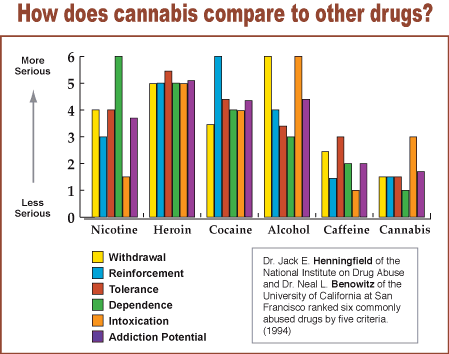
There you have it, evidence that cannabis is not a cause of other drug use, that it is not a gateway drug, and that, given the evidence that cannabis is not more harmful than caffeine, it is a safe drug.
It was originally because of racism that marijuana was made illegal in Canada.
Thus the law is inherently racist but currentlyt targets a benign drug culture of whose members, very few of them have acted harmfully towards themselves and/or others.
At the very least, given evidence that alcohol and tobacco are many times more harmful, why are they not also included in any drug law nationally? Why are they treated separately? Because they are legal and any addiction to them is treated as a health problem.
Indeed, it is because both alcohol and tobacco have been regulated by the government. Consequently the media has "hidden" alcohol and tobacco from public scrutiny, and thus downplays their role in violence and/or death in Canada?
If so, then it may be possible that marijuana is demonized by media and by legal enforcement agencies for moral reasons unrelated to whatever potential harm this drug may cause. Essentially then, mass media has practiced propaganda against marijuana first by targeting an ethnic group and later by doing the following: associated early use in grade school with symptoms associated with idiopathic schizophrenia, used hyperbole to exaggerate the risk of lung disease caused by smoking marijuana, and used ad hominem attacks against regular marijuana users.
As well, the aggressive methods used by police to regulate marijuana use is a significent contributor to the rise in other drug use including methamphetamine, cocaine, and other stimulants.
If anything then the real gateway is the drug law, since it is because the law makes drugs illegal that criminals manufacture drugs for profit.
For legalization of all drugs would reduce the harm caused by such drugs.
20070401
'Moral panic' of drug laws isolates users and fuels crime
MOST people who take illegal drugs do not cause any harm to themselves or anyone else, according to a study which calls for the current "crude" ABC classification system be abandoned.
The two-year RSA Commission on Illegal Drugs argued that Britain's drug laws should be replaced by a system which recognises that drinking and smoking can cause more harm.
Advert for SuperScotCasino
Current laws are "driven by a moral panic" and a more effective drug policy would focus on harm reduction rather than cutting crime, the commission's report concluded.
The report said: "The use of illegal drugs is by no means always harmful any more than alcohol use is always harmful. The evidence suggests that a majority of people who use drugs are able to use them without harming themselves or others."
The flaws in drug policy are demonstrated, it claimed, by the categorisation of ecstasy along with heroin and cocaine as a Class A drug. Such a classification "probably does most to undermine the credibility of our drug laws in the eyes of that section of the population that is most likely to use drugs: namely, the hundreds of thousands of people for whom 'dance drugs' are a routine feature of a good night out," the report said. - The Scotsman, March 9, 2007
Substance use is not solved by criminalizing use based on morals, but based on education and harm reduction.
By using moral panic, drug laws criminalize drug users as traffickers, and the way laws are written, serve to manufacture drug criminals.
Thus drug war policies only cause harm and worsen drug use.
Only education and harm reduction are necessary, not draconian drug laws.
The Occasional Drug User's Manifesto
- I will research any drug, its side effects, pharmacology, and toxicology before procuring any such drug.
- I will take 25% of the minimum dose to feel a noticeable effect.
- I will not take more if I feel no reaction to prevent intoxication.
- I will urge at all times moderation in use of any substance
- I will report my experiences after use including how others could benefit from the experience.
- Less is more. Therefore I will advocate against drug binges or swift reaction to stress with a drug.
Subscribe to:
Posts (Atom)