You gave two people $100 and told them to profit from it.
One guy puts $100 in savings bonds which will net him $11.59 a year from now. The other guy buys 10 grams of pot at $8/gram. and $20 worth of roling paper. He makes 40 1/4 gram spliffs and sells each spliff for $5, making himself $200. However, an undercover cop busts him for selling pot and is fined $150. With the $50, he buys $10 worth of dime bags and $40 worth of meth (about 5 grams). Each dime bag is worth $10 and contains 1/10 gram of meth. He makes $500 but is busted for selling meth and pays at $250 fine. He also gets a year probation for selling drugs.
Most definitely, the drug dealer profits the most. However, most of us would condemn how he made in total $450 but lost $200 due to fines and is on probation for a year. Instead, we would applaud the other guy who has savings bonds that will mature at $11.59 a year from now over the $100 he started with.
However, making $250 a year from selling drugs only nets you probation.
Think about that the next time you read of a drug dealer getting busted. Economics means he makes over 20 times as much money as the saving bonds guy.
Do you think he is going to sit around waiting for 11.59% profit when he can make 450% or more in profit from $100? Fuck no.
Legalize drugs now. Otherwise, once the sociopaths figure it out, there will be more drug dealers who profit because drugs are illegal.
Though 95% of people would rather invest in savings bonds.
Showing posts with label drugs. Show all posts
Showing posts with label drugs. Show all posts

20140911
Drugs are Bad (satire)
I remember this mvie about the two girls in Indianopolis in the 1950s who wer abused by a single mother with four kids (2 girls, 2 boys). She took in these girls because the parents were carnies and the carnie life is not for kids.
One girl was lame.
The other girl, the oldest, was physically abused until she died of a severe beating. The younger one was abused but not as much.
This happened because the mother belied her own kids, even when the oldest daughter lied about her having sex, which started it all.
Ultimately the mom went to prison for manslaughter and was let out after 10 years for good behavior. She blamed the barbituates.
It killed Marilyn Monroe. Other celebrities did weird stuff while high on barbituates. Then they banned the sale of it. Nobody did stupid stuff like this since then, except until tranquilizers started causing problems.
As did Ambien.
MMMmmmmm pharmaceutical are bad. Illegal drugs, no so bad, except for crystal meth and crack.
We should ban drugs for mental problems.
However, people would panic because they think drugs "cure" mental illness. Actually Abilify causes schizophrenia in people misdiagnosed with the disease.
I bet antidepressant cause anxiety or what looks like anxiety but is akathasia. Doctors who mistake akathasia for anxiety up the dose, causing suicide bids. Some people died cos of that mistake.
Therefore antidepressant are dangerous when used as directed.
Drugs are bad, especially the ones you get by prescription.
Illegal ones aren't because only stupid people use drugs, stupid people like Steve Jobs. :)I remember this mvie about the two girls in Indianopolis in the 1950s who wer abused by a single mother with four kids (2 girls, 2 boys). She took in these girls because the parents were carnies and the carnie life is not for kids.
One girl was lame.
The other girl, the oldest, was physically abused until she died of a severe beating. The younger one was abused but not as much.
This happened because the mother belied her own kids, even when the oldest daughter lied about her having sex, which started it all.
Ultimately the mom went to prison for manslaughter and was let out after 10 years for good behavior. She blamed the barbituates.
It killed Marilyn Monroe. Other celebrities did weird stuff while high on barbituates. Then they banned the sale of it. Nobody did stupid stuff like this since then, except until tranquilizers started causing problems.
As did Ambien.
MMMmmmmm pharmaceutical are bad. Illegal drugs, no so bad, except for crystal meth and crack.
We should ban drugs for mental problems.
However, people would panic because they think drugs "cure" mental illness. Actually Abilify causes schizophrenia in people misdiagnosed with the disease.
I bet antidepressant cause anxiety or what looks like anxiety but is akathasia. Doctors who mistake akathasia for anxiety up the dose, causing suicide bids. Some people died cos of that mistake.
Therefore antidepressant are dangerous when used as directed.
Drugs are bad, especially the ones you get by prescription.
Illegal ones aren't because only stupid people use drugs, stupid people like Steve Jobs. :)
One girl was lame.
The other girl, the oldest, was physically abused until she died of a severe beating. The younger one was abused but not as much.
This happened because the mother belied her own kids, even when the oldest daughter lied about her having sex, which started it all.
Ultimately the mom went to prison for manslaughter and was let out after 10 years for good behavior. She blamed the barbituates.
It killed Marilyn Monroe. Other celebrities did weird stuff while high on barbituates. Then they banned the sale of it. Nobody did stupid stuff like this since then, except until tranquilizers started causing problems.
As did Ambien.
MMMmmmmm pharmaceutical are bad. Illegal drugs, no so bad, except for crystal meth and crack.
We should ban drugs for mental problems.
However, people would panic because they think drugs "cure" mental illness. Actually Abilify causes schizophrenia in people misdiagnosed with the disease.
I bet antidepressant cause anxiety or what looks like anxiety but is akathasia. Doctors who mistake akathasia for anxiety up the dose, causing suicide bids. Some people died cos of that mistake.
Therefore antidepressant are dangerous when used as directed.
Drugs are bad, especially the ones you get by prescription.
Illegal ones aren't because only stupid people use drugs, stupid people like Steve Jobs. :)I remember this mvie about the two girls in Indianopolis in the 1950s who wer abused by a single mother with four kids (2 girls, 2 boys). She took in these girls because the parents were carnies and the carnie life is not for kids.
One girl was lame.
The other girl, the oldest, was physically abused until she died of a severe beating. The younger one was abused but not as much.
This happened because the mother belied her own kids, even when the oldest daughter lied about her having sex, which started it all.
Ultimately the mom went to prison for manslaughter and was let out after 10 years for good behavior. She blamed the barbituates.
It killed Marilyn Monroe. Other celebrities did weird stuff while high on barbituates. Then they banned the sale of it. Nobody did stupid stuff like this since then, except until tranquilizers started causing problems.
As did Ambien.
MMMmmmmm pharmaceutical are bad. Illegal drugs, no so bad, except for crystal meth and crack.
We should ban drugs for mental problems.
However, people would panic because they think drugs "cure" mental illness. Actually Abilify causes schizophrenia in people misdiagnosed with the disease.
I bet antidepressant cause anxiety or what looks like anxiety but is akathasia. Doctors who mistake akathasia for anxiety up the dose, causing suicide bids. Some people died cos of that mistake.
Therefore antidepressant are dangerous when used as directed.
Drugs are bad, especially the ones you get by prescription.
Illegal ones aren't because only stupid people use drugs, stupid people like Steve Jobs. :)
20140816
Curing Lust (satire)
Imagine the flesh of someone you lust rotting away, turning into a rotting corpse, and decaying until all that's left is a skeleton of a human being.
Bring this to mind every time you lust for that person until you do not even think of the object of your desire, lest you conjure of that horrible vision of a person dying and rotting, and becoming bone.
I'm pretty sure that such an extreme meditation practice would ruin your libido for good. Indeed, it is a meditation practice for Buddhist monks and nuns. They who faithfully practice this meditation never experience sexual misconduct within a Buddhist monastery.
In a worst case scenario, this practice might be the Buddhist cure for sex addiction, except Westerners mistake meditation practice for religion & mdash; as opposed to Christianity, where a sinner may be shamed and made to feel guilty for natural sexual behavior, which purportedly causes psychological hang-ups and manufactures from one of out of every twenty-five church members a sociopath who might work his way up in the religious hierarchy.
A priest becomes a sociopath when he breaks his celibacy vows, and lies to his bishop. A bishop becomes a sociopath when he turns church bingo into a multimillion-dollar business. A Pope becomes a sociopath when he hides being a soldier in a war in his youth.
However, being gay does not stop a man from becoming a priest. It might cause him to fight for the rights of all living beings on this earth. It all depends on the man.
Perhaps this meditation could be modified for drug addiction: just imagine the worst-case scenario where you take your drugs in a homeless shelter and are prey to black boys speaking Haitian Creole.
Sure, like that's going to work.
If you believe in the fallacy that "all sociopaths are evil" when the truth is, only unsuccessful sociopaths are deemed evil by Western society when they get caught. Once caught, these people might be thrown under the bus by a few mainstream media journalists who promote a moral panic about sociopaths under the guise of responsible journalism.
Sometimes, karma is a bitch when you let lust control your life, be it for sex, drugs, and even money. Most of the time, we think the libido is normal and natural, and that repressive means of controlling it is tantamount to the abuse of a person's individual human rights.
It is not psychological abuse for Buddhist monks and nuns to practice this kind of meditation, because they do so willingly. Yet it would be abuse if such meditation practices were mandatory for unprepared people, even in a clinical setting.
This is why no Buddhist organization endorses such a practice, and rely only on the Five Precepts of the Buddhist code of ethics (abstain from killing, abstain from theft, avoid sexual misconduct, abstain from false speech, and abstain from consuming alcohol and drugs).
For this meditation practice is not for laypeople, and could potentially harm any Buddhist who practices it outside of a monastery. I do not endorse its practice, but mentioned it here to show how preposterous it would be to serve as the cure for lust.
It is safer for the Buddhist practitioner to practice the Five Precepts than to become a monk or nun in a Buddhist monastery. Indeed, it is harmless, provided the practitioner keep all the precepts and practice them diligently while repenting from minor infractions (lying, gossipping, and consuming alcohol and drugs).
Perhaps this explains the practice of Pure Land Buddhist practitioners who chant the Buddha's name (Nianfo or Nembutsu) to burn off the evil karma of past wrongful actions. In this way do they purify their mind. For this is a path of easy practice that helps them achieve peace of mind.
In my opinion, these diverse Buddhist practices of chanting and meditation are examples of sexual sublimation, and positive expressions of libido.
YMMV
References:
Five Precepts: http://en.wikipedia.org/wiki/Five_Precepts
Bring this to mind every time you lust for that person until you do not even think of the object of your desire, lest you conjure of that horrible vision of a person dying and rotting, and becoming bone.
I'm pretty sure that such an extreme meditation practice would ruin your libido for good. Indeed, it is a meditation practice for Buddhist monks and nuns. They who faithfully practice this meditation never experience sexual misconduct within a Buddhist monastery.
In a worst case scenario, this practice might be the Buddhist cure for sex addiction, except Westerners mistake meditation practice for religion & mdash; as opposed to Christianity, where a sinner may be shamed and made to feel guilty for natural sexual behavior, which purportedly causes psychological hang-ups and manufactures from one of out of every twenty-five church members a sociopath who might work his way up in the religious hierarchy.
A priest becomes a sociopath when he breaks his celibacy vows, and lies to his bishop. A bishop becomes a sociopath when he turns church bingo into a multimillion-dollar business. A Pope becomes a sociopath when he hides being a soldier in a war in his youth.
However, being gay does not stop a man from becoming a priest. It might cause him to fight for the rights of all living beings on this earth. It all depends on the man.
Perhaps this meditation could be modified for drug addiction: just imagine the worst-case scenario where you take your drugs in a homeless shelter and are prey to black boys speaking Haitian Creole.
Sure, like that's going to work.
If you believe in the fallacy that "all sociopaths are evil" when the truth is, only unsuccessful sociopaths are deemed evil by Western society when they get caught. Once caught, these people might be thrown under the bus by a few mainstream media journalists who promote a moral panic about sociopaths under the guise of responsible journalism.
Sometimes, karma is a bitch when you let lust control your life, be it for sex, drugs, and even money. Most of the time, we think the libido is normal and natural, and that repressive means of controlling it is tantamount to the abuse of a person's individual human rights.
It is not psychological abuse for Buddhist monks and nuns to practice this kind of meditation, because they do so willingly. Yet it would be abuse if such meditation practices were mandatory for unprepared people, even in a clinical setting.
This is why no Buddhist organization endorses such a practice, and rely only on the Five Precepts of the Buddhist code of ethics (abstain from killing, abstain from theft, avoid sexual misconduct, abstain from false speech, and abstain from consuming alcohol and drugs).
For this meditation practice is not for laypeople, and could potentially harm any Buddhist who practices it outside of a monastery. I do not endorse its practice, but mentioned it here to show how preposterous it would be to serve as the cure for lust.
It is safer for the Buddhist practitioner to practice the Five Precepts than to become a monk or nun in a Buddhist monastery. Indeed, it is harmless, provided the practitioner keep all the precepts and practice them diligently while repenting from minor infractions (lying, gossipping, and consuming alcohol and drugs).
Perhaps this explains the practice of Pure Land Buddhist practitioners who chant the Buddha's name (Nianfo or Nembutsu) to burn off the evil karma of past wrongful actions. In this way do they purify their mind. For this is a path of easy practice that helps them achieve peace of mind.
In my opinion, these diverse Buddhist practices of chanting and meditation are examples of sexual sublimation, and positive expressions of libido.
YMMV
References:
Five Precepts: http://en.wikipedia.org/wiki/Five_Precepts
20140206
Insomnia (satire)
Since childhood I have been an insomniac. I can remember my first adventure with insomnia when I hid in the living room while my dad prepare to go to work. After he left, I sneaked back into my room to crash just the rest of my family was getting up. I was probably about 10 at the time.
I am sure that my insomnia was due to pseudo-ephedrine in a prescribe medication for hay fever. This was my first exposure to stimulants, since I never drank coffee or tea until I was a teenager. Though it may have been Salbutamol in an inhaler.
Though, green tea is great for meditation. However, I recommend just going to the health food store and buying theanine. It's a great sedative that is better than tranquilizers because it's non-habit-forming. Of course, I recommend against its use to treat childhood ADHD which probably could be cure by removing all processed foods from the diet and raising children on organic foods.
I admit to recently abusing 4 mg tablets of nicotine, which led to staying up two days and blowing $150 at the casino.
If nicotine can cause insomnia for me, then why would I even consider meth? It's bad enough that even Internet addiction could lead me to stay up two days.
So it's not stimulants that cause insomnia. It's the lack of impulse control that their use might influence. If even the Internet can be so fun I'd stay up two day in a roll, then drugs are for pussies.
You heard me right: drugs are for pussies who need a crutch. They might even cry about a bad life to excuse their bad choice of using drugs to overcome their past issues.
However, I am not going to preach about weak-willed pussies. Rather, I use the term "pussies" as the cat-like ability to sleep all day and roam all night while high.
Furthermore, it is a fallacy that drug addicts are weak-willed. Rather, drugs addicts have a strong will to abuse drugs for their own personal reasons.
As for insomnia, my herbal supplements are helping me here, especially the lysine and arginine.
Sabutamol: https://en.wikipedia.org/wiki/Albuterol
I am sure that my insomnia was due to pseudo-ephedrine in a prescribe medication for hay fever. This was my first exposure to stimulants, since I never drank coffee or tea until I was a teenager. Though it may have been Salbutamol in an inhaler.
Though, green tea is great for meditation. However, I recommend just going to the health food store and buying theanine. It's a great sedative that is better than tranquilizers because it's non-habit-forming. Of course, I recommend against its use to treat childhood ADHD which probably could be cure by removing all processed foods from the diet and raising children on organic foods.
I admit to recently abusing 4 mg tablets of nicotine, which led to staying up two days and blowing $150 at the casino.
If nicotine can cause insomnia for me, then why would I even consider meth? It's bad enough that even Internet addiction could lead me to stay up two days.
So it's not stimulants that cause insomnia. It's the lack of impulse control that their use might influence. If even the Internet can be so fun I'd stay up two day in a roll, then drugs are for pussies.
You heard me right: drugs are for pussies who need a crutch. They might even cry about a bad life to excuse their bad choice of using drugs to overcome their past issues.
However, I am not going to preach about weak-willed pussies. Rather, I use the term "pussies" as the cat-like ability to sleep all day and roam all night while high.
Furthermore, it is a fallacy that drug addicts are weak-willed. Rather, drugs addicts have a strong will to abuse drugs for their own personal reasons.
As for insomnia, my herbal supplements are helping me here, especially the lysine and arginine.
Sabutamol: https://en.wikipedia.org/wiki/Albuterol
20140203
Lindsay Lohan: Alcohol Was a Gateway (to Other Drugs) (satire)
Lindsay Lohan's candidness proves alcohol to be a gateway drug, but brewing companies keep brewing more of the harmful and life-threatening drug.
Most lives have been ruined by alcohol and prescription drugs. Yet the mainstream media is mum about this fact while showing alcohol advertising in some regions of the US and other parts of the world.
As for cocaine, it leads most recreational users believing it is harmless and not addictive, until they met someone who believes otherwise. Then their addiction gets worse because of their drug-induced delusion that cocaine is safer than a 26oz bottle of Scotch.
Of course, it is worse to binge on either drug alone instead of sharing it with the whole dance floor. Though, it is legal to serve alcohol to young adults over the age of 21 in most parts of the US, a holdover from prohibition days.
When American youths under 21 but over 18 get thirsty, they usually cross the border into Canada to party, sometimes with tragic results due to being in an alcoholic blackout in Canada where a lot of the street people won't put up with American bravado.
Sadly though the Border patrol never catch the partiers, because a breathalyzer is not standard issue.
Anyway, it is possible Lindsay Lohan might have partied hardy in the UK. When I was looking for pictures of Scots lassies, I happened across a picture of one who had LiLo's hair color and freckles, though the lass whose picture I closely perused appeared to be clean-shaven and pleasingly plump.
Perhaps some Scots with mad computer skills Photoshopped LiLo's head on this Scots wrench.
Though, the fact that some rich Arab prince paid for her to come to one of his big parties in the UK makes me wonder if Lindsay had an alcoholic blackout and some cocaine and entered a temporary psychotic delusion in which she fancied herself to be a model.
Nah, that couldn't have happened because there's been nary a peep from the Daily Mail and other trashy tabloids like the Sun. Maybe that Arab prince likes snapping pictures of pretty starlets like Lindsay.
Who knows?
Anyway, I have been searching high and low for the incriminating picture in my photo stream. Maybe one day I'll find it, crop a closeup of the Scots lassy's face, and ask if it looks like Lindsay.
Anyway, I refer any interested reader to Google Tallulah Bankhead to give you an idea of the role model for scandalous behavior among a certain group of young celebrities. Tallulah makes Lindsay seem like an innocent choir girl, but she kept her coke binges under control in the 1930s-1950s, and managed to become a talk show host in her prime in the 1960s.
So if Tallulah can handle her drinking and drugs, then I can't see why Lindsay can't.
Reference:
Lindsay Lohan's interview with Oprah: http://www.nationalpost.com/m/wp/arts/scene/blog.html?b=arts.nationalpost.com/2013/08/19/it-was-a-gateway-to-other-things-lindsay-lohan-admits-to-alcohol-addiction-discusses-cocaine-use-in-oprah-winfrey-interview
Most lives have been ruined by alcohol and prescription drugs. Yet the mainstream media is mum about this fact while showing alcohol advertising in some regions of the US and other parts of the world.
As for cocaine, it leads most recreational users believing it is harmless and not addictive, until they met someone who believes otherwise. Then their addiction gets worse because of their drug-induced delusion that cocaine is safer than a 26oz bottle of Scotch.
Of course, it is worse to binge on either drug alone instead of sharing it with the whole dance floor. Though, it is legal to serve alcohol to young adults over the age of 21 in most parts of the US, a holdover from prohibition days.
When American youths under 21 but over 18 get thirsty, they usually cross the border into Canada to party, sometimes with tragic results due to being in an alcoholic blackout in Canada where a lot of the street people won't put up with American bravado.
Sadly though the Border patrol never catch the partiers, because a breathalyzer is not standard issue.
Anyway, it is possible Lindsay Lohan might have partied hardy in the UK. When I was looking for pictures of Scots lassies, I happened across a picture of one who had LiLo's hair color and freckles, though the lass whose picture I closely perused appeared to be clean-shaven and pleasingly plump.
Perhaps some Scots with mad computer skills Photoshopped LiLo's head on this Scots wrench.
Though, the fact that some rich Arab prince paid for her to come to one of his big parties in the UK makes me wonder if Lindsay had an alcoholic blackout and some cocaine and entered a temporary psychotic delusion in which she fancied herself to be a model.
Nah, that couldn't have happened because there's been nary a peep from the Daily Mail and other trashy tabloids like the Sun. Maybe that Arab prince likes snapping pictures of pretty starlets like Lindsay.
Who knows?
Anyway, I have been searching high and low for the incriminating picture in my photo stream. Maybe one day I'll find it, crop a closeup of the Scots lassy's face, and ask if it looks like Lindsay.
Anyway, I refer any interested reader to Google Tallulah Bankhead to give you an idea of the role model for scandalous behavior among a certain group of young celebrities. Tallulah makes Lindsay seem like an innocent choir girl, but she kept her coke binges under control in the 1930s-1950s, and managed to become a talk show host in her prime in the 1960s.
So if Tallulah can handle her drinking and drugs, then I can't see why Lindsay can't.
Reference:
Lindsay Lohan's interview with Oprah: http://www.nationalpost.com/m/wp/arts/scene/blog.html?b=arts.nationalpost.com/2013/08/19/it-was-a-gateway-to-other-things-lindsay-lohan-admits-to-alcohol-addiction-discusses-cocaine-use-in-oprah-winfrey-interview
20110112
A Sane Solution to the Drug Problem
'Many thought Prohibition was working when it first became law in the early 1920s.
Alcohol consumption did indeed drop in the first few years. When organized crime realized the profits that would be made by illegally supplying alcohol to customers, alcohol consumption increased, as did crime and corruption in high places.
"Prohibition removed a significant source of tax revenue and greatly increased government spending," wrote Thornton, the economics professor at Auburn University. "It led many drinkers to switch to opium, marijuana, patent medicines, cocaine, and other dangerous substances that they would have been unlikely to encounter in the absence of Prohibition."
If Toronto Mayor Mel Lastman could bring in the army to clear snow from Toronto streets in 1999, can't we expect at least as much effort to clean up an illegal operation that is raging out of control and growing exponentially across the country?' — Martin O'Malley, "Let the army bust the grow-ops", CBC News Viewpoint | March 04, 2005
...
'The Canadian establishment should do more to end economic inequality between immigrants and mainstream society. It should spend more money on universities to make higher education affordable to youngsters.
The government should legalize the drug trade to end the profit that motivates the violence. And finally, the government should provide extra money for rehabilitation and de-addiction programs, rather than ripping away the social safety net in the name of ruthless economic reform.' — South Asian Post: Out Loud! With Gurpreet Singh - Wednesday, February 25, 2009
Once people in positions of power stop pointing their fingers at immigrants, university students, polydrug abusers, and other targets they attack through laws meant to protect their assets, it is up to charities to get the philanthropists out to help society at large.
For the gang problem is not addressed by strong enforcement of drug laws, but by their repeal!
Indeed, laws regarding criminal entrapment and undue search and seizure should be revised to better protect the rights of innocent parties.
This includes the use of the military only in relation to the sources of drug crime i.e. importation and trafficking, but not its use. For drug use is a health issue.
With regard to use, preventative measures should involve a gradual movement towards decriminalization with a strong incentive to introduce less harmful alternatives to illegal drugs.
The regular education campaigns against drug abuse and psychosis should be continued.
For drug addiction is a health issue.
Originally posted: 07/07/09 1:04 PM
Revised: 12/01/11 4:01 PM
20090322
Entheogenic Psychotherapy
Introduction: definition and origins
Before going into depth about entheogenic psychotherapy, I will define the root word of entheogenic, "entheogen", as being derived from the Latin: "en" means "within, inside"; "theo" is from "theos" or "God, the divine"; and "gen" is originally derived from Indo-European "gen-", "to give birth, beget - referring to procreation, the family and the tribe."
However, within the context of entheogenic psychotherapy, based on their original use as agents to talk to God and to reach a higher spiritual consciousness, the meaning is clear: entheogens help one reach a higher level of conscious, possibly moral development and to pass from a lower stage of moral development into a higher one.
Before the moralistic teetotaller seeks to condemn me for what amounts to pushing illegal drugs on psychiatric patients, I will point out that prior to the 19th century and the reforms made in regard to mental illness since then, along with the development of psychotropic pharmaceutical drug to relieve the symptoms of such illnesses, the attendant medical opinion that such illnesses are incurable, and, like legislated poverty, the establishment of legislated mental illness, mentally ill people who were originally highly esteemed as shamans and visionaries, are today relegated to the same status as the poor by citizens of the State who consider themselves to be normal.
Indeed, the mentally ill had an integral part in proto-historical communities as figurehead of pagan cults. In those unsophisticated days, the shaman would become possessed by spirits, often by ingesting entheogens. While under possession, they would help in diagnosing illness, find game, and predict where to hunt best.
Thus, entheogens were used to alter consciousness in the shaman so s/he could become a passive agent for a spiritual deity whose presence could effect a change in illness, access information based on life experience whose content would not normally be relied upon by the tribe, and bring spiritual meaning to the lives of her/his tribe.
It wasn't until the establishment of the Church in the 4th century CE that the mentally ill were demonized as agents of Satan, when in actual fact, their bizarre behavior may be due to disease, injury, or malnutrition.
After 1500 years of marginalization, human civilization degraded to the point where the mentally ill were treated as though they were subhuman.
Proposal of the Term Entheogenic Psychotherapy Based on Interest by Neurologists and Psychiatrists
According to the New York Times ("Scientists Test Hallucinogens for Mental Ills", Tue, 13 Mar 2001), correspondent Sandra Blakeslee wrote that:
"Hallucinogenic drugs like LSD and peyote - derided as toys of the hippie generation - are
increasingly drawing the interest of neurologists and psychiatrists who want to test the
idea that they may be valuable tools in treating a range of mental disorders.
"Although there are anecdotal reports that psychedelic drugs can help some people with mental illness, the idea has never been substantiated by mainstream psychiatry and remains highly controversial -- some would say outlandish.
"And even the researchers involved in the new work are not suggesting that people start medicating themselves with hallucinogens..."
If you substitute "entheogen" for "hallucinogen", then psychotherapy that substitutes often dangerous psychoactive pharmaceutical drugs with entheogens may augment, or replace when necessary, faiths, philosophies and religions that provide relief from boredom, pain, and stresses of modern life.
If this therapy made exclusive use of entheogens, then I would call this kind of psychotherapy entheogenic.
However, just as orthomolecular therapy is considered by orthodox medical doctors and associations as quackery, it is possible that without a change in the public's awareness of the safety issues involved with entheogens, entheogenic psychotherapy will not go beyond what I will try to expound in this article.
Get Back... to the Psychedelic Era: Recreational Use Versus Sacred Use
It should be noted that quite possibly, the neurologists and psychiatrists quoted in Blakeslee's article may have grown up in the Psychedelic era (1969-1979), after the Beatles blew the minds of Americans through John Lennon's flip remark that they're "just as popular as Jesus."
It is ironic that the same era saw the disintegration of major rock bands and the tragedy of rock stars fighting substance abuse from Jerry Lee Lewis' battle with the bottle and other illegal drugs, Janis Joplin's death due to heroin overdose, John and Yoko's week-long drug binges, Paul McCartney's bust for marijuana in Japan, Ringo Starr's ill-advised Hollywood days, the Who losing band members due to drug overdoses, and other musical legends like Elvis dying from an aneurysm due top being constipated from pharmaceutical drug abuse.
Obviously, such celebrities, treated like new gods, are as human as their adoring fans, many of whom also may suffer from lack of self-esteem and quite possibly, a mild to incapacitating inability to handle stress well in their mundane lives.
Celebrity Excesses, Recreational Abuse
Likewise, the typical celebrity, once a nobody, may undergo plenty of stress from the pressures attendant to success. As a result of such stress, it is possible that family issues that were never properly resolved with closure may come back to haunt them. They may choose alcoholic beverages on the mistaken belief that the intoxication helps them to decompress from stress, and thus begin the spiral into substance abuse, buoyed by the delusion that "everybody does it."
When any drug abused, and used with the intent to make oneself happy and to please others, it's like looking for the Buddha in a temple in Dharamsala rather than seeing God in the beauty in the world as the result of self-reflection. Even if the intent of drug use is as simplistic as "having fun" or "a night out with the girls", then its potential for abuse is present.
For what happens when life is no longer fun? Does one drink more? And, does one go on to try another drug at a party because, so far, no one has died or "freaked out?"
I am not saying all of this to rant about substance abuse, but to demonstrate that the abuse of controlled substances, namely illegal drugs, is a maladaptive way of coping with stress and the attendant loss of self-esteem.
Usually, the user has exhibited maladaptive behavior prior to drug use and his/her behavior has either attracted her/him (to) "the wrong crowd." In the end, substance abuse becomes a daily ritual done alone by a lonely person lost in his/her world, a delusion of her/his own making, made of choices that will never guarantee any long-lasting success based on the depth of his/her happiness.
Country and Rock Music: Recreational Use Figures Prominently
Just as Elvis is an example of such a person, so too is Elvis' early life an example of the kind of upbringing that would lead to such a tragic end. For the King of Rock and Roll loved his mother dearly, and missed his other half as dearly, the twin that died at his birth. One could imagine what it was like growing up wondering what might have happened if one's twin lived and one was dead. Being from a multiracial family, humbled by poverty, may have also played a minor role in Elvis Aaron Priesley's life. However, the largest influence on his life was his mother as nurturer and reflection of his self-image growing up around Memphis, Tennessee - the Deep South, home of country music, and jazz and its brother, blues.
It is interesting that, since its popularization in the 1920s, country music tends to create a world of broken hearts and broken homes in its lyrics, the bitter-sweetness that may drive the foolish to a lifetime battle with "booze." In contrast, jazz was hated by the director of the Narcotics Control Bureau (now Drug Enforcement Agency) who demonized marijuana, Mr. Anslinger.
Elvis' choice of combining elements from blues with antics that rivaled Jerry Lee Lewis' certainly legitimized rock music since he represented the status quo where alcoholic beverages, tobacco and firearms were considered necessary to "the pursuit of happiness" and "the right to bear arms" as protected by the First Amendment.
Punk, Grunge and Today's New Music Fueled by Recreational Drug Abuse
In contrast, the woman who became Wendy O Williams, of the Plasmatics, grew up on the East Coast and while she certainly exercised her First Amendment right to free speech, she did so to shock her audience's parents. A mother of all American punk bands to come, Wendy had also starred in pornography as part of being a performance artist.
Punk music is anti-music in the sense that the artist does not sing so much as scream, and the musical instrument is a tool of subverting the mind through a full-frontal assault of the ear. This should explain why Wendy once sported a Mohawk haircut and often performed with her breasts exposed by ripping out holes in her black T-shirt with electrician's tape obscuring her nipples. Often she paraded around topless on stage, tape still in place with the lights shining hotly on her as she stood there screaming profanities into the microphone while sweating profusely. At one concert that I saw on TV, she took a chainsaw and sawed a television in half, an anti-consumerist act that probably scared a lot of TV executives when they got wind of it.
Courtney Love of Hole is another performance artist who went from stripper at the Number Five Orange in Vancouver to rock musician. She hooked up with grunge rock musician Kurt Cobain of the now-defunct band Nirvana and began a love-hate relationship that ended with Kurt's brains splattered on a wall in their bedroom in the suburbs of Seattle. At the time, Courtney was on tour with her band, which was getting rave reviews while Nirvana's fame was overshadowed by often violent antics on the stage. Sometimes fights would break out between band members onstage, with Cobain aggravating retaliatory assaults from them. At a recent girls only festival put on by Sarah McLachlan's company in Vancouver, Courtney Love punched out a rival girl band member for critiquing her performance.
My purpose for relating all this dysfunctional behavior exhibited by rock music celebrities is to demonstrate how even celebrities (the new gods of consumer culture) sometimes may become psychologically unstable pursuing game as they risk death by using recreational drugs. Their success often leads to risk-taking behavior that could expose them to cancer, heart attacks, strokes and even death.
You would think that for the amount of money rock musicians could make today at a five thousand person concert at $50 a head, 104 cities a year for a total of $26,000,000 gross that they would have a street-smart manager to keep them on the straight and narrow away from the gritty underbelly of society.
Guess again!
Few rock musicians and performance artists have resisted the temptation to drown their sorrows in booze, only to freebase or light up, toke up, toot up, or what have you, often blowing ten grand in a day to escape the boredom and chase away the ghosts of their misspent youths.
Thus, regarding recreational use of drugs, the user's aim is to "get high", usually as quickly and as often as possible. What usually begins as a tradition of like-minded people communing, and "having fun", soon degenerates into wild parties.
Sacred Use of Drugs: the Key to Entheogenic Psychotherapy
On the other hand, the sacred use of entheogens requires a less hedonistic game plan with a greater emphasis on social responsibility for the participant. The following entheogenic ethical code of conduct carefully outlines such responsibilities:
Individual Code of Conduct for Primary Religious Practices
* DRAFT *
When I engage in spiritual practices designed to bring about profound changes in
consciousness, I will consider my intentions and will choose carefully the occasion
and location for the practice.
I will be well informed about the mental and physical effects, anticipate reasonably
foreseeable risks to myself and others, and employ safeguards to minimize these risks.
Safeguards may include:
Ensuring that my setting is reasonably free of hazards.
Ensuring that I will not operate automobiles or other potentially dangerous machinery.
Taking myself `off duty' from responsibilities.
Arranging for someone to be `on duty' (a `guide' or `sitter') to keep the session safe
and respond appropriately to any exigencies that might arise.
(from http://www.erowid.org/entheogens/entheogens_ethics.shtml)
Any user of entheogens who ignores the spirit contained in this code of conduct is not a serious practitioner. Consequently, recreational use that violates the spirit of this code should be discouraged since its aftermath in the community may be linked to the breakup of the family and the stresses that places on the community itself. Thus, having read the above code of conduct, practitioners are encouraged to incorporate its spirit into their entheogenic activities along with any positive results from such sacred activity.
Of course, the code of conduct for primary religious practices implies by its very nature that recreational drug use be considered a religious activity, despite its secular component and its implicit denial that recreational use is indeed religious. One should not assume that religion is a bad thing, save in excess particularly of the fundamentalism that leads to intolerance and prejudice. However, the code of conduct previously mentioned is necessary to promote a responsible state of mind that balances the hedonism inherent in recreational drug use.
For when one uses drugs for religious practices, the profound changes in consciousness are apt to likewise profoundly transform one's religious life, perhaps one's whole life. Knowing that the set and setting greatly influence by the outcome of a mystical and spiritual trip aided by entheogens, one should prepare the setting so no danger presents itself during such a journey.
Likewise, the consensual use of entheogens in group ritual practice in a religious setting requires the participants to be ever conscious of their obligations to each other. Thus, entheogens can augment a religious experience for the benefit of all people within the religious group.
The Religious Context
Although religion has been superseded by a secular humanism where consumerism is endorsed by commercial media and corporate giants, all catering to the needs of free-market capitalism and endemic globalism with all the suffering that such a crazy lifestyle brings into our lives, it has greater value than what money can buy.
Humanity is not yet so dehumanized that it cannot instinctively feel an echo of spirituality. Given the wide variety of faiths and religions, some very popular and fewer still that are nameless yet deeply spiritual, one is free in most Western nations to worship as one pleases. Even in countries where freedom of worship is severely limited, the people still find religion to be a comfort from abject poverty.
Out in the desert of southwest America and in north-central Mexico, the peyote culture thrives, both within the new Native American Church tradition as rehabilitation from alcoholism and within the web of shamanism in Mexico. Meanwhile, the ayuhuasca culture of Brazil has also reached the shores of America, only to be restricted in use, not so much due to the risk of abuse as due to the militancy of a few of its members. Despite all of this, entheogens have an important part to play in invigorating religious worship.
It has been suspected that entheogens played an important part in ancient religious worship, but became banned by the Catholic Church, in order to keep power within church hierarchy. If each person was responsible for her individual rapport with Jesus, and could immediately worship God, developing an individual oneness with Him, then the Church could not control how the spiritual insights developed during entheogenic rituals. Thus, entheogens stopped being religious sacrament, as various religions cautioned against intoxicating drugs and the abuse of alcohol, tobacco, and even coffee!
Cannabis too, was demonized - at first to consolidate religious power and then later corporate power. In today's post-modern world, the corporate power of the Church has been transferred to multinational corporations. Yet the control over so-called "dangerous" drugs continues. This is also seen in the way the drug industry gets their petrochemical-based pharmaceuticals into market, while natural herbs and alternative therapies are ignored in medical literature. Though, the antipathy towards alternative therapies is now decreasing.
While medical marijuana is being dispensed in Canada, it is subject to restrictions. In contrast, the entheogenic use of marijuana is discouraged with the legal community not distinguishing between religious and recreational use. Indeed, they cannot make any discrimination at all between them, due to the drugs laws in Canada regarding marijuana. The law courts will throw out any challenges to the Canadian Charter of Right and Freedoms that attempt to define the entheogenic use of marijuana, despite the right to freedom of religion.
Thus, the State has control over just what is religious practice, and restricts religious practice to rituals that do not involve entheogens. It is quite possible that there is an overwhelming fear that entheogenic use, by cutting out a human intercessor such as a priest to communicate with God, will place control over religious practice in the hands of the people. A people-centred religious practice that encourages the use of entheogens is a threat to people in control of many religions today because they are not in control of that process. It could lead to less money into the church coffers, and more money into the illegal network of marijuana cultivation, a network that was forced underground by draconian drug laws which are destroying a culture.
Before going into depth about entheogenic psychotherapy, I will define the root word of entheogenic, "entheogen", as being derived from the Latin: "en" means "within, inside"; "theo" is from "theos" or "God, the divine"; and "gen" is originally derived from Indo-European "gen-", "to give birth, beget - referring to procreation, the family and the tribe."
However, within the context of entheogenic psychotherapy, based on their original use as agents to talk to God and to reach a higher spiritual consciousness, the meaning is clear: entheogens help one reach a higher level of conscious, possibly moral development and to pass from a lower stage of moral development into a higher one.
Before the moralistic teetotaller seeks to condemn me for what amounts to pushing illegal drugs on psychiatric patients, I will point out that prior to the 19th century and the reforms made in regard to mental illness since then, along with the development of psychotropic pharmaceutical drug to relieve the symptoms of such illnesses, the attendant medical opinion that such illnesses are incurable, and, like legislated poverty, the establishment of legislated mental illness, mentally ill people who were originally highly esteemed as shamans and visionaries, are today relegated to the same status as the poor by citizens of the State who consider themselves to be normal.
Indeed, the mentally ill had an integral part in proto-historical communities as figurehead of pagan cults. In those unsophisticated days, the shaman would become possessed by spirits, often by ingesting entheogens. While under possession, they would help in diagnosing illness, find game, and predict where to hunt best.
Thus, entheogens were used to alter consciousness in the shaman so s/he could become a passive agent for a spiritual deity whose presence could effect a change in illness, access information based on life experience whose content would not normally be relied upon by the tribe, and bring spiritual meaning to the lives of her/his tribe.
It wasn't until the establishment of the Church in the 4th century CE that the mentally ill were demonized as agents of Satan, when in actual fact, their bizarre behavior may be due to disease, injury, or malnutrition.
After 1500 years of marginalization, human civilization degraded to the point where the mentally ill were treated as though they were subhuman.
Proposal of the Term Entheogenic Psychotherapy Based on Interest by Neurologists and Psychiatrists
According to the New York Times ("Scientists Test Hallucinogens for Mental Ills", Tue, 13 Mar 2001), correspondent Sandra Blakeslee wrote that:
"Hallucinogenic drugs like LSD and peyote - derided as toys of the hippie generation - are
increasingly drawing the interest of neurologists and psychiatrists who want to test the
idea that they may be valuable tools in treating a range of mental disorders.
"Although there are anecdotal reports that psychedelic drugs can help some people with mental illness, the idea has never been substantiated by mainstream psychiatry and remains highly controversial -- some would say outlandish.
"And even the researchers involved in the new work are not suggesting that people start medicating themselves with hallucinogens..."
If you substitute "entheogen" for "hallucinogen", then psychotherapy that substitutes often dangerous psychoactive pharmaceutical drugs with entheogens may augment, or replace when necessary, faiths, philosophies and religions that provide relief from boredom, pain, and stresses of modern life.
If this therapy made exclusive use of entheogens, then I would call this kind of psychotherapy entheogenic.
However, just as orthomolecular therapy is considered by orthodox medical doctors and associations as quackery, it is possible that without a change in the public's awareness of the safety issues involved with entheogens, entheogenic psychotherapy will not go beyond what I will try to expound in this article.
Get Back... to the Psychedelic Era: Recreational Use Versus Sacred Use
It should be noted that quite possibly, the neurologists and psychiatrists quoted in Blakeslee's article may have grown up in the Psychedelic era (1969-1979), after the Beatles blew the minds of Americans through John Lennon's flip remark that they're "just as popular as Jesus."
It is ironic that the same era saw the disintegration of major rock bands and the tragedy of rock stars fighting substance abuse from Jerry Lee Lewis' battle with the bottle and other illegal drugs, Janis Joplin's death due to heroin overdose, John and Yoko's week-long drug binges, Paul McCartney's bust for marijuana in Japan, Ringo Starr's ill-advised Hollywood days, the Who losing band members due to drug overdoses, and other musical legends like Elvis dying from an aneurysm due top being constipated from pharmaceutical drug abuse.
Obviously, such celebrities, treated like new gods, are as human as their adoring fans, many of whom also may suffer from lack of self-esteem and quite possibly, a mild to incapacitating inability to handle stress well in their mundane lives.
Celebrity Excesses, Recreational Abuse
Likewise, the typical celebrity, once a nobody, may undergo plenty of stress from the pressures attendant to success. As a result of such stress, it is possible that family issues that were never properly resolved with closure may come back to haunt them. They may choose alcoholic beverages on the mistaken belief that the intoxication helps them to decompress from stress, and thus begin the spiral into substance abuse, buoyed by the delusion that "everybody does it."
When any drug abused, and used with the intent to make oneself happy and to please others, it's like looking for the Buddha in a temple in Dharamsala rather than seeing God in the beauty in the world as the result of self-reflection. Even if the intent of drug use is as simplistic as "having fun" or "a night out with the girls", then its potential for abuse is present.
For what happens when life is no longer fun? Does one drink more? And, does one go on to try another drug at a party because, so far, no one has died or "freaked out?"
I am not saying all of this to rant about substance abuse, but to demonstrate that the abuse of controlled substances, namely illegal drugs, is a maladaptive way of coping with stress and the attendant loss of self-esteem.
Usually, the user has exhibited maladaptive behavior prior to drug use and his/her behavior has either attracted her/him (to) "the wrong crowd." In the end, substance abuse becomes a daily ritual done alone by a lonely person lost in his/her world, a delusion of her/his own making, made of choices that will never guarantee any long-lasting success based on the depth of his/her happiness.
Country and Rock Music: Recreational Use Figures Prominently
Just as Elvis is an example of such a person, so too is Elvis' early life an example of the kind of upbringing that would lead to such a tragic end. For the King of Rock and Roll loved his mother dearly, and missed his other half as dearly, the twin that died at his birth. One could imagine what it was like growing up wondering what might have happened if one's twin lived and one was dead. Being from a multiracial family, humbled by poverty, may have also played a minor role in Elvis Aaron Priesley's life. However, the largest influence on his life was his mother as nurturer and reflection of his self-image growing up around Memphis, Tennessee - the Deep South, home of country music, and jazz and its brother, blues.
It is interesting that, since its popularization in the 1920s, country music tends to create a world of broken hearts and broken homes in its lyrics, the bitter-sweetness that may drive the foolish to a lifetime battle with "booze." In contrast, jazz was hated by the director of the Narcotics Control Bureau (now Drug Enforcement Agency) who demonized marijuana, Mr. Anslinger.
Elvis' choice of combining elements from blues with antics that rivaled Jerry Lee Lewis' certainly legitimized rock music since he represented the status quo where alcoholic beverages, tobacco and firearms were considered necessary to "the pursuit of happiness" and "the right to bear arms" as protected by the First Amendment.
Punk, Grunge and Today's New Music Fueled by Recreational Drug Abuse
In contrast, the woman who became Wendy O Williams, of the Plasmatics, grew up on the East Coast and while she certainly exercised her First Amendment right to free speech, she did so to shock her audience's parents. A mother of all American punk bands to come, Wendy had also starred in pornography as part of being a performance artist.
Punk music is anti-music in the sense that the artist does not sing so much as scream, and the musical instrument is a tool of subverting the mind through a full-frontal assault of the ear. This should explain why Wendy once sported a Mohawk haircut and often performed with her breasts exposed by ripping out holes in her black T-shirt with electrician's tape obscuring her nipples. Often she paraded around topless on stage, tape still in place with the lights shining hotly on her as she stood there screaming profanities into the microphone while sweating profusely. At one concert that I saw on TV, she took a chainsaw and sawed a television in half, an anti-consumerist act that probably scared a lot of TV executives when they got wind of it.
Courtney Love of Hole is another performance artist who went from stripper at the Number Five Orange in Vancouver to rock musician. She hooked up with grunge rock musician Kurt Cobain of the now-defunct band Nirvana and began a love-hate relationship that ended with Kurt's brains splattered on a wall in their bedroom in the suburbs of Seattle. At the time, Courtney was on tour with her band, which was getting rave reviews while Nirvana's fame was overshadowed by often violent antics on the stage. Sometimes fights would break out between band members onstage, with Cobain aggravating retaliatory assaults from them. At a recent girls only festival put on by Sarah McLachlan's company in Vancouver, Courtney Love punched out a rival girl band member for critiquing her performance.
My purpose for relating all this dysfunctional behavior exhibited by rock music celebrities is to demonstrate how even celebrities (the new gods of consumer culture) sometimes may become psychologically unstable pursuing game as they risk death by using recreational drugs. Their success often leads to risk-taking behavior that could expose them to cancer, heart attacks, strokes and even death.
You would think that for the amount of money rock musicians could make today at a five thousand person concert at $50 a head, 104 cities a year for a total of $26,000,000 gross that they would have a street-smart manager to keep them on the straight and narrow away from the gritty underbelly of society.
Guess again!
Few rock musicians and performance artists have resisted the temptation to drown their sorrows in booze, only to freebase or light up, toke up, toot up, or what have you, often blowing ten grand in a day to escape the boredom and chase away the ghosts of their misspent youths.
Thus, regarding recreational use of drugs, the user's aim is to "get high", usually as quickly and as often as possible. What usually begins as a tradition of like-minded people communing, and "having fun", soon degenerates into wild parties.
Sacred Use of Drugs: the Key to Entheogenic Psychotherapy
On the other hand, the sacred use of entheogens requires a less hedonistic game plan with a greater emphasis on social responsibility for the participant. The following entheogenic ethical code of conduct carefully outlines such responsibilities:
Individual Code of Conduct for Primary Religious Practices
* DRAFT *
When I engage in spiritual practices designed to bring about profound changes in
consciousness, I will consider my intentions and will choose carefully the occasion
and location for the practice.
I will be well informed about the mental and physical effects, anticipate reasonably
foreseeable risks to myself and others, and employ safeguards to minimize these risks.
Safeguards may include:
Ensuring that my setting is reasonably free of hazards.
Ensuring that I will not operate automobiles or other potentially dangerous machinery.
Taking myself `off duty' from responsibilities.
Arranging for someone to be `on duty' (a `guide' or `sitter') to keep the session safe
and respond appropriately to any exigencies that might arise.
(from http://www.erowid.org/entheogens/entheogens_ethics.shtml)
Any user of entheogens who ignores the spirit contained in this code of conduct is not a serious practitioner. Consequently, recreational use that violates the spirit of this code should be discouraged since its aftermath in the community may be linked to the breakup of the family and the stresses that places on the community itself. Thus, having read the above code of conduct, practitioners are encouraged to incorporate its spirit into their entheogenic activities along with any positive results from such sacred activity.
Of course, the code of conduct for primary religious practices implies by its very nature that recreational drug use be considered a religious activity, despite its secular component and its implicit denial that recreational use is indeed religious. One should not assume that religion is a bad thing, save in excess particularly of the fundamentalism that leads to intolerance and prejudice. However, the code of conduct previously mentioned is necessary to promote a responsible state of mind that balances the hedonism inherent in recreational drug use.
For when one uses drugs for religious practices, the profound changes in consciousness are apt to likewise profoundly transform one's religious life, perhaps one's whole life. Knowing that the set and setting greatly influence by the outcome of a mystical and spiritual trip aided by entheogens, one should prepare the setting so no danger presents itself during such a journey.
Likewise, the consensual use of entheogens in group ritual practice in a religious setting requires the participants to be ever conscious of their obligations to each other. Thus, entheogens can augment a religious experience for the benefit of all people within the religious group.
The Religious Context
Although religion has been superseded by a secular humanism where consumerism is endorsed by commercial media and corporate giants, all catering to the needs of free-market capitalism and endemic globalism with all the suffering that such a crazy lifestyle brings into our lives, it has greater value than what money can buy.
Humanity is not yet so dehumanized that it cannot instinctively feel an echo of spirituality. Given the wide variety of faiths and religions, some very popular and fewer still that are nameless yet deeply spiritual, one is free in most Western nations to worship as one pleases. Even in countries where freedom of worship is severely limited, the people still find religion to be a comfort from abject poverty.
Out in the desert of southwest America and in north-central Mexico, the peyote culture thrives, both within the new Native American Church tradition as rehabilitation from alcoholism and within the web of shamanism in Mexico. Meanwhile, the ayuhuasca culture of Brazil has also reached the shores of America, only to be restricted in use, not so much due to the risk of abuse as due to the militancy of a few of its members. Despite all of this, entheogens have an important part to play in invigorating religious worship.
It has been suspected that entheogens played an important part in ancient religious worship, but became banned by the Catholic Church, in order to keep power within church hierarchy. If each person was responsible for her individual rapport with Jesus, and could immediately worship God, developing an individual oneness with Him, then the Church could not control how the spiritual insights developed during entheogenic rituals. Thus, entheogens stopped being religious sacrament, as various religions cautioned against intoxicating drugs and the abuse of alcohol, tobacco, and even coffee!
Cannabis too, was demonized - at first to consolidate religious power and then later corporate power. In today's post-modern world, the corporate power of the Church has been transferred to multinational corporations. Yet the control over so-called "dangerous" drugs continues. This is also seen in the way the drug industry gets their petrochemical-based pharmaceuticals into market, while natural herbs and alternative therapies are ignored in medical literature. Though, the antipathy towards alternative therapies is now decreasing.
While medical marijuana is being dispensed in Canada, it is subject to restrictions. In contrast, the entheogenic use of marijuana is discouraged with the legal community not distinguishing between religious and recreational use. Indeed, they cannot make any discrimination at all between them, due to the drugs laws in Canada regarding marijuana. The law courts will throw out any challenges to the Canadian Charter of Right and Freedoms that attempt to define the entheogenic use of marijuana, despite the right to freedom of religion.
Thus, the State has control over just what is religious practice, and restricts religious practice to rituals that do not involve entheogens. It is quite possible that there is an overwhelming fear that entheogenic use, by cutting out a human intercessor such as a priest to communicate with God, will place control over religious practice in the hands of the people. A people-centred religious practice that encourages the use of entheogens is a threat to people in control of many religions today because they are not in control of that process. It could lead to less money into the church coffers, and more money into the illegal network of marijuana cultivation, a network that was forced underground by draconian drug laws which are destroying a culture.
20070507
Less is More: The Sane Harm Reduction
With regard especially to marijuana and all recreational drugs, LESS IS MORE.
In short, do enough to be happy not delirious, psychotic, or out of your mind.
If you haven't the willpower to have fun on one drink, one puff, one hit, one line, or one pill, then you have no concept of the word MODERATION.
And yes, when your substance use becomes abuse, I hope you find it in yourself to check yourself into the nearest mental health & addictions centre.
This goes for cigarette smokers and hungry people too.
Doing anything to excess is almost a form of mental illness.
In short, do enough to be happy not delirious, psychotic, or out of your mind.
If you haven't the willpower to have fun on one drink, one puff, one hit, one line, or one pill, then you have no concept of the word MODERATION.
And yes, when your substance use becomes abuse, I hope you find it in yourself to check yourself into the nearest mental health & addictions centre.
This goes for cigarette smokers and hungry people too.
Doing anything to excess is almost a form of mental illness.
20070430
My First and Last Experience With Codeine
After I was healing from an operation, I was prescribed Tylenol-3s but never took them for the pain.
So I endured painful urination for about a week before I popped one T-3.
Within 15 minutes, I was actually high. Seriously, I felt as though the observer part of me was on the ceiling.
Sadly though, every pill after the first never got me that high again.
That's because I develop a rapid tolerance to most psychoactive medication and alcohol. This is even occurs with healthfood supplements such as theanine, melatonin, valerian, etc.
I bet if I took at T-3 again, then the worst that would happen is I'd feel a little mellow and get constipated.
However, I will stick to healthfood supplements in moderation.
So I endured painful urination for about a week before I popped one T-3.
Within 15 minutes, I was actually high. Seriously, I felt as though the observer part of me was on the ceiling.
Sadly though, every pill after the first never got me that high again.
That's because I develop a rapid tolerance to most psychoactive medication and alcohol. This is even occurs with healthfood supplements such as theanine, melatonin, valerian, etc.
I bet if I took at T-3 again, then the worst that would happen is I'd feel a little mellow and get constipated.
However, I will stick to healthfood supplements in moderation.
The Utopia called "Drug Legalization"
"The goal of legalizing drugs is to bring them under effective legal control. If it were legal to produce and distribute drugs, legitimate businessmen would enter the business. There would be less need for violence and corruption since the industry would have access to the courts. And, instead of absorbing tax dollars as targets of expensive enforcement efforts, the drug sellers might begin to pay taxes. So, legalization might well solve the organized crime aspects of the drug trafficking problem. On average, drug use under legalization might not be as destructive to users and to society as under the current prohibition, because drugs would be less expensive, purer, and more conveniently available." -- National Institute of Justice
With legalization would come reduced violence and corruption. Expensive enforcement would vanish. Finally, the manufacturers of drugs would pay taxes, as would the drug dealer.
With drugs less expensive, purer and conveniently available, maybe users would moderate their habits and not be given to excess by also going into therapy to treat the tendency of some addicts to go to excess due to psychosocial issues which precipitated their substance abuse.
If America was so enlightened, then the State's experience with pushing alcohol, tobacco and pharmaceutical drugs could be applied with gusto to recreational drugs; but the only reason why drugs will remain illegal is because media hype would die down and moral reprehension would cease.
Yes, the only reason why drugs are illegal are to sell product. In this case, it is the demon called "drug addiction" which barely accounts for 10% of users of any drug.
And, contrary to the hype, when 100 people take a drug, about 10 will get hooked, depending on their background, motivation, and peers.
Alas, this utopia of drug legalization will never come to pass because neither statistics nor medicine enlighten the voter. Only education of the harm of drug prohibition will do so.
So in essence, harm reduction implies eventual drug legalization. For that would reduce the stigma and the costs of a senseless and stupid war.
With legalization would come reduced violence and corruption. Expensive enforcement would vanish. Finally, the manufacturers of drugs would pay taxes, as would the drug dealer.
With drugs less expensive, purer and conveniently available, maybe users would moderate their habits and not be given to excess by also going into therapy to treat the tendency of some addicts to go to excess due to psychosocial issues which precipitated their substance abuse.
If America was so enlightened, then the State's experience with pushing alcohol, tobacco and pharmaceutical drugs could be applied with gusto to recreational drugs; but the only reason why drugs will remain illegal is because media hype would die down and moral reprehension would cease.
Yes, the only reason why drugs are illegal are to sell product. In this case, it is the demon called "drug addiction" which barely accounts for 10% of users of any drug.
And, contrary to the hype, when 100 people take a drug, about 10 will get hooked, depending on their background, motivation, and peers.
Alas, this utopia of drug legalization will never come to pass because neither statistics nor medicine enlighten the voter. Only education of the harm of drug prohibition will do so.
So in essence, harm reduction implies eventual drug legalization. For that would reduce the stigma and the costs of a senseless and stupid war.
20070429
The Propaganda of Drug Prohibition
"The propaganda that caused people to believe that Germans were a master race and Jews were an inferior race and needed to be exterminated has an exact parallel in the war on marijuana. You create false evils, create fear and hatred for a certain class of people and proceed to inflict horrific punishment on the targets of your lies. All the while seizing totalitarian power for yourself and your cronies based on the need for people to abandon their normal concepts of right and wrong and leave those decisions entirely to the propagandists." -- Daryl Verville, in his documentary The Naked Queen
In a recent example, the US FDA indicates it has bought the propaganda about medical marijuana which it claims has no benefits. At the same time, the FDA has historically allowed SSRI anti-depressants go on the market while pharmaceutical companies have hidden data which shows risk of suicide amongst patients, especially teenagers.
Meanwhile, marijuana has been considered a dangerous narcotic which causes anxiety and paranoia, but only among one out of four people who have used it since they were teens. This means that among people who use it occasionally (less than once a week) as adults, more than 75% of them will experience no ill effects, apart from mild intoxication, increased ability to get to sleep at night and associated changes in sleep patterns. In short, for the majority of users, marijuana is a non-addictive alternative to habit-forming benzodiazepines, used by consumers by prescription as sleep aids and sedatives.
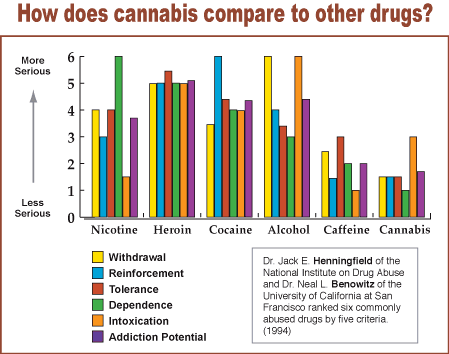
Does the propaganda against marijuana indicate the relative harmlessness of the drug when compared to cigarettes (nicotine) and alcohol? No, most anti-marijuana literature addresses the health risks, including cognitive deficits and especially high use side effects, and claims marijuana is addictive. Indeed, most anti-marijuana literature uses subtle scare tactics and promotes abstinence.
However, neither the pro-marijuana nor the anti-marijuana proponents advocate moderation of use. It is barely brought up in debates for or against the drug.
Quite possibly, moderation of use may be covered under harm reduction. If moderation works for some alcoholics, it can work for marijuana users.
"Because let's face it: there's no bigger pusher than the state. There are far more dangerous and mind-altering drugs than marijuana being pushed on us every day by huge pharmaceutical companies, with the blessings of our doctors and the government. And no one's raiding the drug companies." -- Bonnie Burstow, senior lecturer at the Ontario Institute for Studies in Education
20070420
In Moderation Marijuana Beats Alcohol
420 beats alcohol. Here's how:
Alcohol, when consumed during binge drinking - the pastime of today's youth - can lead to violence. It is also a dangerous gateway drug, like tobacco!
Pot, when consumed in moderate amounts - two puffs - leads to the typical stoned feeling with momentary lapses of consciousness.
Only in people who associate violence with getting drunk or stoned, and binge drink and/or smoke too much pot, may become violent.
Please pass it on! Puff puff!
Alcohol, when consumed during binge drinking - the pastime of today's youth - can lead to violence. It is also a dangerous gateway drug, like tobacco!
Pot, when consumed in moderate amounts - two puffs - leads to the typical stoned feeling with momentary lapses of consciousness.
Only in people who associate violence with getting drunk or stoned, and binge drink and/or smoke too much pot, may become violent.
Please pass it on! Puff puff!
20070401
Dangerous Drugs Decriminalization/Legalization
Rates for people with substance abuse would be 2-6%.
With drug education, including information regarding risk of mania and/or psychosis and to reinforce that substance use is not "getting high" or "having fun" but "entering a probably manic and/or psychotic state of mind through the use of intoxicating drugs", potential users have the choice between entering a potentially harmful state of mind or not.
This also includes recreational use of pharmaceutical drugs which may induce hypomania e.g. benzodiazepines, anti-depressants, and neuroleptics.
However, emphasis must be made on increased drug education to replace the deceptive use of euphemisms for substance use i.e. "getting high", "having fun" and street slang for substance use with the correct terms i.e. "substance use which causes transient states of mind which may induce behavior consistent with hypomania, mania and/or psychosis".
It is drugs laws that make recreational substance use harmful and such drugs dangerous.
This article promotes substance use with informed consent within the context of safe set and setting. It does not promote the current circumstances as criminalized by current local and State laws.
20070331
Real Dangerous Drugs
In order of danger to life based on statistics:
alcohol
tobacco
pharmaceuticals
stimulants (meth, etc)
opioids (heroin, morphine, methadone, fentanyl)
entheogens (LSD. MDMA)
caffeine
marijuana
Yep, the three legal drugs cause more deaths than the three illegal ones (stimulants, opioids, and entheogens (originally known as hallucinogens).
Alcohol is known to cause health and social problems, and much of its overuse leads to psychiatric symptoms similar to mental illness (violence, psychosis).
Only tobacco's method of ingestion is unhealthy. Nicotine is useful when taking the third most dangerous drug, pharmaceuticals, mainly the psychotropic ones such as seroquel, Prozac, or benadryl. However, even NSAIDs are dangerous.
Indeed, the drugs for mental illness may also cause and/or worsen behavior which is objectionable to everyone who thinks they aren't mentally ill. Most psychopharmaceuticals are prescribed not so much to make people mentally healthy, but to relieve the anxiety and/or fear experienced by people who think they are mentally healthy, especially professionals.
This makes me wonder, if people are so anxious around the so-called mentally ill, why don't they pop an Ativan and/or make use of coping skills instead of getting a person exhibiting annoying behavior to go on Seroquel? Unless a psychosis is harmful to the person, then let's not medicate her. However if a healthy person is anxious around a psychotic person living in dreamtime, then I would urge the anxious to go take a pill and/or choose an alternative coping skill.
"Hey, doc, let's you and I drop prozac together, mmkay?"
Sadly though, some people on psychopharmaceuticals tend to get worse. So overall, psychopharmaceuticals are used to manufacture mental illness in some people whose behavior other people (in control) object to. Thus, this makes such drugs the most dangerous drugs of all.
Caffeine is only dangerous in large amounts. Drinking 10 cups of coffee will supply a person with about 1 gram of caffeine. 50 cups will kill a person, usually in the bathroom peeing it out.
Marijuana has never killed a person. Doing dumb things while high on THC does not count.
alcohol
tobacco
pharmaceuticals
stimulants (meth, etc)
opioids (heroin, morphine, methadone, fentanyl)
entheogens (LSD. MDMA)
caffeine
marijuana
Yep, the three legal drugs cause more deaths than the three illegal ones (stimulants, opioids, and entheogens (originally known as hallucinogens).
Alcohol is known to cause health and social problems, and much of its overuse leads to psychiatric symptoms similar to mental illness (violence, psychosis).
Only tobacco's method of ingestion is unhealthy. Nicotine is useful when taking the third most dangerous drug, pharmaceuticals, mainly the psychotropic ones such as seroquel, Prozac, or benadryl. However, even NSAIDs are dangerous.
Indeed, the drugs for mental illness may also cause and/or worsen behavior which is objectionable to everyone who thinks they aren't mentally ill. Most psychopharmaceuticals are prescribed not so much to make people mentally healthy, but to relieve the anxiety and/or fear experienced by people who think they are mentally healthy, especially professionals.
This makes me wonder, if people are so anxious around the so-called mentally ill, why don't they pop an Ativan and/or make use of coping skills instead of getting a person exhibiting annoying behavior to go on Seroquel? Unless a psychosis is harmful to the person, then let's not medicate her. However if a healthy person is anxious around a psychotic person living in dreamtime, then I would urge the anxious to go take a pill and/or choose an alternative coping skill.
"Hey, doc, let's you and I drop prozac together, mmkay?"
Sadly though, some people on psychopharmaceuticals tend to get worse. So overall, psychopharmaceuticals are used to manufacture mental illness in some people whose behavior other people (in control) object to. Thus, this makes such drugs the most dangerous drugs of all.
Caffeine is only dangerous in large amounts. Drinking 10 cups of coffee will supply a person with about 1 gram of caffeine. 50 cups will kill a person, usually in the bathroom peeing it out.
Marijuana has never killed a person. Doing dumb things while high on THC does not count.
20070320
Portugal in 2001: Decriminalizes Drugs
In 2001 Portugal made drug abuse a medical and social problem rather than a legal one.
Portugal has forced back the frontiers of drug liberalization in Europe with a law which, at a stroke, decriminalizes the use of all previously banned narcotics, from cannabis to crack cocaine.
The new law, which came into effect on 1 July, takes a socially conservative country with traditional Catholic values far ahead of much of northern Europe, including Britain, in treating drug abuse as a social and health problem rather than a criminal one.
Vitalino Canas, the drug tsar appointed by the Socialist prime minister, Antonio Guterres, to steer the law into place, said yesterday that it made more sense to change the law than ignore it, as police forces do in Holland, parts of Swizerland, and now experimentally in the Brixton area of London.
"Why not be clear about this, and change the law to recognize that consuming drugs can be an illness or the route to illness?" he said. "America has spent billions on enforcement but it has got nowhere. We view drug users as people who need help and care."
He admitted that Mr Guterres was taking a risk, but said Portugal had no real choice. The police had stopped arresting suspects and the courts were throwing out cases against users rather than apply legislation which sent them to prison for up to three years.
Margarida Costa, 35, a skeletal addict who has found a home at a drug treatment hostel, said prison had never helped her. "In fact, I started taking drugs in jail," she said. "You could get everything you wanted in there, every day."
Still emaciated from 10 years of heroin abuse and living rough, she is on methadone and preparing to return to living with her mother. -- http://opioids.com/legal/index.html
Stop the Drug War reports:
In the latest sign of European rejection of US and UN-sponsored repressive anti-drug strategies, Portugal's new drug laws went into effect on July 1. Under the laws, debated last summer and finalized in November, possession of personal amounts of any drug is no longer a crime. Instead, possession of up to a ten-day supply of any drug will be treated as an administrative matter rather than a criminal offence. Persons caught possessing drugs will have their stashes confiscated and be referred to a commission of doctors, lawyers, and social workers who will decide if they need counselling or treatment. Previously, persons caught with drugs faced up to a year in jail.
Drug trafficking remains a crime, although dealing to pay for a drug habit will be considered a mitigating factor.
United Nations International Drug Control Board (INCB) officials immediately lashed out at the new law. INCB Deputy Head Akira Fujino told the Swedish newspaper Svenska Dagbladet: "There is a clear trend in Western Europe to decriminalize use and possession of narcotics and to view addicts as patients. But that seldom solves the addict's personal problems nor reduces the demand for narcotics," complained the prohibition bureaucrat. "Other countries that have chosen a liberal approach such as special injection rooms, are Switzerland, Germany, Spain and Holland, and we are deeply concerned over this trend."
Citing the possibility of a spill-over effect for the rest of the European Union, Fujino warned that: "The Portugese law can trap more 'at risk' into dependency as well as increase the misery of those already addicted. The law, in effect, says that it's OK to consume narcotics."
Portuguese officials have more concrete concerns. The number of hard drug addicts has escalated over the past decade, and Portugal has Europe's highest HIV infection rate. According to the European Monitoring Center for Drugs and Drug Addiction (http://www.emcdda.europe.eu), Portugal, with a population of ten million, has between 50,000 and 200,000 drug addicts. By contrast, the Netherlands, with 16 million inhabitants and a liberal drug policy, has an estimated 25,000 addicts.
The new law reflects Portugal's turn to harm reduction and away from repression in an effort to blunt the damage from drug prohibition. "The idea is to get away from punishment and move toward care," Portuguese government spokesman Carlos Borges told Reuters.
That Portugal has decriminalized the possession of drugs is apparently not newsworthy in the US. DRCNet has been unable to find any mention of this story in mainstream media outlets in this country.
-- http://stopthedrugwar.org/chronicle-old/193/portugalpossession.shtml
Portugal has forced back the frontiers of drug liberalization in Europe with a law which, at a stroke, decriminalizes the use of all previously banned narcotics, from cannabis to crack cocaine.
The new law, which came into effect on 1 July, takes a socially conservative country with traditional Catholic values far ahead of much of northern Europe, including Britain, in treating drug abuse as a social and health problem rather than a criminal one.
Vitalino Canas, the drug tsar appointed by the Socialist prime minister, Antonio Guterres, to steer the law into place, said yesterday that it made more sense to change the law than ignore it, as police forces do in Holland, parts of Swizerland, and now experimentally in the Brixton area of London.
"Why not be clear about this, and change the law to recognize that consuming drugs can be an illness or the route to illness?" he said. "America has spent billions on enforcement but it has got nowhere. We view drug users as people who need help and care."
He admitted that Mr Guterres was taking a risk, but said Portugal had no real choice. The police had stopped arresting suspects and the courts were throwing out cases against users rather than apply legislation which sent them to prison for up to three years.
Margarida Costa, 35, a skeletal addict who has found a home at a drug treatment hostel, said prison had never helped her. "In fact, I started taking drugs in jail," she said. "You could get everything you wanted in there, every day."
Still emaciated from 10 years of heroin abuse and living rough, she is on methadone and preparing to return to living with her mother. -- http://opioids.com/legal/index.html
Stop the Drug War reports:
In the latest sign of European rejection of US and UN-sponsored repressive anti-drug strategies, Portugal's new drug laws went into effect on July 1. Under the laws, debated last summer and finalized in November, possession of personal amounts of any drug is no longer a crime. Instead, possession of up to a ten-day supply of any drug will be treated as an administrative matter rather than a criminal offence. Persons caught possessing drugs will have their stashes confiscated and be referred to a commission of doctors, lawyers, and social workers who will decide if they need counselling or treatment. Previously, persons caught with drugs faced up to a year in jail.
Drug trafficking remains a crime, although dealing to pay for a drug habit will be considered a mitigating factor.
United Nations International Drug Control Board (INCB) officials immediately lashed out at the new law. INCB Deputy Head Akira Fujino told the Swedish newspaper Svenska Dagbladet: "There is a clear trend in Western Europe to decriminalize use and possession of narcotics and to view addicts as patients. But that seldom solves the addict's personal problems nor reduces the demand for narcotics," complained the prohibition bureaucrat. "Other countries that have chosen a liberal approach such as special injection rooms, are Switzerland, Germany, Spain and Holland, and we are deeply concerned over this trend."
Citing the possibility of a spill-over effect for the rest of the European Union, Fujino warned that: "The Portugese law can trap more 'at risk' into dependency as well as increase the misery of those already addicted. The law, in effect, says that it's OK to consume narcotics."
Portuguese officials have more concrete concerns. The number of hard drug addicts has escalated over the past decade, and Portugal has Europe's highest HIV infection rate. According to the European Monitoring Center for Drugs and Drug Addiction (http://www.emcdda.europe.eu), Portugal, with a population of ten million, has between 50,000 and 200,000 drug addicts. By contrast, the Netherlands, with 16 million inhabitants and a liberal drug policy, has an estimated 25,000 addicts.
The new law reflects Portugal's turn to harm reduction and away from repression in an effort to blunt the damage from drug prohibition. "The idea is to get away from punishment and move toward care," Portuguese government spokesman Carlos Borges told Reuters.
That Portugal has decriminalized the possession of drugs is apparently not newsworthy in the US. DRCNet has been unable to find any mention of this story in mainstream media outlets in this country.
-- http://stopthedrugwar.org/chronicle-old/193/portugalpossession.shtml
20070319
Drug Decriminalization Reduces Drug usage and Crime Rates
Statistics don't lie.
Cannabis use
1.NZ 22.23%
2.Aus 17.93%
3.US 12.30%
Portugal where all drugs have been decriminalized for six years...3.86%
Crime Rate.. Drug Offences
1.Norway 987.1 per 100,000 people
2.Switizerland 648.4
3.NZ 641.6
4.USA 560.1
no stats on Australia
and Portugal where all drugs are decriminalized... 59.6 per 100,000 people
Decriminalization reduces drug usage and crime rates.
Cannabis use
1.NZ 22.23%
2.Aus 17.93%
3.US 12.30%
Portugal where all drugs have been decriminalized for six years...3.86%
Crime Rate.. Drug Offences
1.Norway 987.1 per 100,000 people
2.Switizerland 648.4
3.NZ 641.6
4.USA 560.1
no stats on Australia
and Portugal where all drugs are decriminalized... 59.6 per 100,000 people
Decriminalization reduces drug usage and crime rates.
20070227
Why Marijuana is Still Criminalized In Canada
According to Canadian mass media, it may appear that the only reason marijuana is kept illegal is so that grow-ops can pop up in suburban neighbourhoods for concerned citizens to find and report to the police, all to justify the "war on Drugs" mentality.
For the Canadian national drug policy criminalizes marijuana manufacture and limits the amount a person can possess before possession charges may be applied.
By making illegal the possession of marijuana and by criminalizing its manufacture, Canada can justify a war-on-drugs mentality with stronger laws regarding marijuana.
In essence, the law makes marijuana valuable to criminals who then can create demand.
Grow-ops flourish specifically because marijuana is illegal. If it were legal and regulated by government, illegal grow-ops would case to exist.
Consequently, if marijuana were legal, then the danger associated with manufacture would be eliminated.
Between 1999 and 2003, the decriminalization of marijuana was debated in Ottawa.
Because of strong pressure by the US, much of the recommendations made by Canadian senators were quietly ignored by Ottawa.
Additionally, the national Green Team was too lucrative for the RCMP to agree to changes in the law that would impact their public service.
Thus, criminalizing marijuana profits both the criminals and the police.
And that's what makes marijuana dangerous, not the plant itself.
For the Canadian national drug policy criminalizes marijuana manufacture and limits the amount a person can possess before possession charges may be applied.
By making illegal the possession of marijuana and by criminalizing its manufacture, Canada can justify a war-on-drugs mentality with stronger laws regarding marijuana.
In essence, the law makes marijuana valuable to criminals who then can create demand.
Grow-ops flourish specifically because marijuana is illegal. If it were legal and regulated by government, illegal grow-ops would case to exist.
Consequently, if marijuana were legal, then the danger associated with manufacture would be eliminated.
Between 1999 and 2003, the decriminalization of marijuana was debated in Ottawa.
Because of strong pressure by the US, much of the recommendations made by Canadian senators were quietly ignored by Ottawa.
Additionally, the national Green Team was too lucrative for the RCMP to agree to changes in the law that would impact their public service.
Thus, criminalizing marijuana profits both the criminals and the police.
And that's what makes marijuana dangerous, not the plant itself.
20070216
Should Governments Legalize and Tax Marijuana?
The war on drugs is an expensive battle, as a great deal of resources go into catching those who buy or sell illegal drugs on the black market, prosecuting them in court, and housing them in jail. These costs seem particularly exorbitant when dealing with the drug marijuana, as it is widely used, and is likely no more harmful than currently legal drugs such as tobacco and alcohol. There's another cost to the war on drugs, however, which is the revenue lost by governments who cannot collect taxes on illegal drugs. In a recent study for the Fraser Institute, Economist Stephen T. Easton attempted to calculate how much tax revenue the Canadian government could gain by legalizing marijuana.
Legalization of marijuana would bring tax dollars of $2 billion to Canada. The only benefit of marijuana criminalization would be to the underground economy, of which Canada is contributing to.
Yes, the Canadian government is responsible for crime gangs deriving profits from illegal grow-op across Canada by keeping cannabis criminalized.
After all, the government keeps the herb illegal.
Thus, it is because of the law that marijuana is a dangerous drug, not because of the drug itself.
Legalization of marijuana would bring tax dollars of $2 billion to Canada. The only benefit of marijuana criminalization would be to the underground economy, of which Canada is contributing to.
Yes, the Canadian government is responsible for crime gangs deriving profits from illegal grow-op across Canada by keeping cannabis criminalized.
After all, the government keeps the herb illegal.
Thus, it is because of the law that marijuana is a dangerous drug, not because of the drug itself.
20070210
LSD use never leads to suicide, but may be "one straw too many."
I was musing about a question posted by a certain Psychfo contributer, one of many members of Craigslist. She asked about a friend who died after taking LSD. I denied that LSD contributed to that kid committing suicide.
However LSD could have indirectly led to him accidentally killing himself by being a dumbass. LSD appears to open one up to the concept of non-self i.e. that we're not narcissistic individuals trying to look out for number one, ME. This appears to cause an LSD user to question his or her meaning of existence. As a result of indiscriminate drug use, this existential challenge may lead to one straw too many on the camel's back for the user, regardless of her age.
Sometimes, the ravages of teenage hormones might end up with the kid psychotic, but LSD is not the cause of the ensuing diagnosis, be it schizophrenia or a mood disorder. Rather, LSD, like other recreational drugs, are tools put into the wrong hands. Such drugs are neither harmful nor deadly except to an ignorant kid who has no clue about the pharmacology and toxicology of illegal substance use.
How the Tibetan Book of the Dead fits into this is that prior to DEA's demonization of entheogens such as LSD and MDMA, they were used therapeutically by shrinks and therapists. The near-death experience provided by LSD, peyote, MDMA and even GHB is a powerful therapeutic tool. By making such entheogens illegal, the DEA has turned such tools into another way to uncover probable mental illness in children.
Then they are given potentially dangerous psychoactive drugs such as Prozac, which might result in a neuroleptic malignacy(sp?) syndrome and might even cause a worsening of symptoms including the rise of another disorder such as OCD. In truth, illegal drugs do not make kids crazy.
IMHO They'd be crazy soon enough from working crazy hours full-time once they turn 18. :p
What might make kids crazy is being given powerful psychoactive meds in an attempt to manufacture another schizophrenic, another MDD case, another OCD hand-wringer, another ODD-CD delinquent.
IMHO Meds and kids don't mix. YMMV
However LSD could have indirectly led to him accidentally killing himself by being a dumbass. LSD appears to open one up to the concept of non-self i.e. that we're not narcissistic individuals trying to look out for number one, ME. This appears to cause an LSD user to question his or her meaning of existence. As a result of indiscriminate drug use, this existential challenge may lead to one straw too many on the camel's back for the user, regardless of her age.
Sometimes, the ravages of teenage hormones might end up with the kid psychotic, but LSD is not the cause of the ensuing diagnosis, be it schizophrenia or a mood disorder. Rather, LSD, like other recreational drugs, are tools put into the wrong hands. Such drugs are neither harmful nor deadly except to an ignorant kid who has no clue about the pharmacology and toxicology of illegal substance use.
How the Tibetan Book of the Dead fits into this is that prior to DEA's demonization of entheogens such as LSD and MDMA, they were used therapeutically by shrinks and therapists. The near-death experience provided by LSD, peyote, MDMA and even GHB is a powerful therapeutic tool. By making such entheogens illegal, the DEA has turned such tools into another way to uncover probable mental illness in children.
Then they are given potentially dangerous psychoactive drugs such as Prozac, which might result in a neuroleptic malignacy(sp?) syndrome and might even cause a worsening of symptoms including the rise of another disorder such as OCD. In truth, illegal drugs do not make kids crazy.
IMHO They'd be crazy soon enough from working crazy hours full-time once they turn 18. :p
What might make kids crazy is being given powerful psychoactive meds in an attempt to manufacture another schizophrenic, another MDD case, another OCD hand-wringer, another ODD-CD delinquent.
IMHO Meds and kids don't mix. YMMV
20070208
Anna Nicole Smith dies after collapsing at hotel: lawyer
Anna Nicole Smith dies after collapsing at hotel: lawyer: "Canadian Press
Published: Thursday, February 08, 2007 Article tools
Printer friendly
E-mail
Font: * * * * HOLLYWOOD, Fla. - Anna Nicole Smith died Thursday after collapsing at a hotel and being rushed to the hospital, one of her lawyers said.
Her son Daniel died of a drug overdose last September just three days after Smith gave birth to a baby girl, Dannielynn
Smith was embroiled in a bitter paternity case with former boyfriend Larry Birkhead.
Born Vickie Lynn Hogan, she was married to Billy Smith for two years in the mid-'80s and then to billionnaire J. Howard Marshall II for just over a year before he passed away in 1995. Following the death of her son Daniel, Smith married her longtime lawyer Howard K. Stern."
Published: Thursday, February 08, 2007 Article tools
Printer friendly
Font: * * * * HOLLYWOOD, Fla. - Anna Nicole Smith died Thursday after collapsing at a hotel and being rushed to the hospital, one of her lawyers said.
Her son Daniel died of a drug overdose last September just three days after Smith gave birth to a baby girl, Dannielynn
Smith was embroiled in a bitter paternity case with former boyfriend Larry Birkhead.
Born Vickie Lynn Hogan, she was married to Billy Smith for two years in the mid-'80s and then to billionnaire J. Howard Marshall II for just over a year before he passed away in 1995. Following the death of her son Daniel, Smith married her longtime lawyer Howard K. Stern."
Subscribe to:
Posts (Atom)