Search This Blog

Showing posts with label Heaven. Show all posts

20141002

Amida Buddha Versus God: Neither Buddhist nor Christian Yet Both Buddhist and Christian (satire)

Amida Buddha is not a god, and the Pure Land is not a heaven. This is the difference between Buddhism and monotheism.

For a Buddhist can believe in the Primal Vow, and have faith that the Pure Land of Bliss exists, precisely because Amida Buddha was but a mortal who after many eons became a Buddha who awakened and is reborn in his Pure Land.

No one can say the same about God and heaven without sounding like he is babbling about a New Age cult or folk Christianity.

Though one American folk Christianity almost fits the bill: Mormonism when the Christology is overlooked for the esoterism inherent in Latter-Day Saint cosmology (premortal existence and the afterlife).

However, it takes a great leap of faith to see echoes of the Pure Land in the Three Glories of the Mormon Afterlife, namely the Celestial Kingdom, the Terrestrial Kingdom and the Telestial Kingdom.

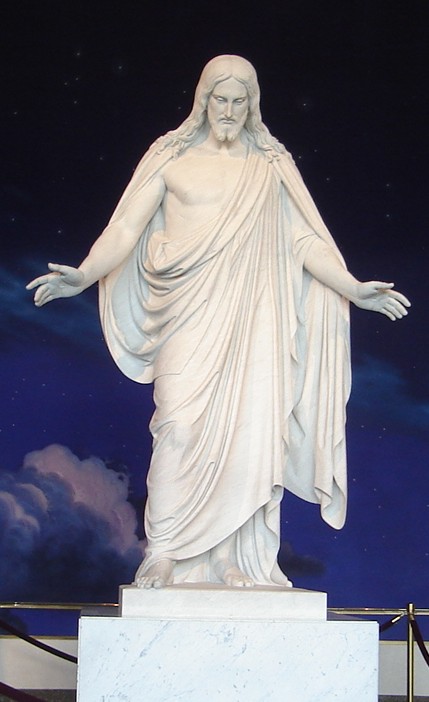
Since Christianity is exclusive of other religions, the way I overcome the false dilemma of "serving two masters" is to consider LDS to be a materialist Christianity, as evidenced by the angel Moroni, the appearance of God and Jesus to Joseph Smith, and even the statue of Jesus Christ. In contrast, Pure Land Buddhism is a Buddhism that transcends materialism yet is like a diamond of the mind which reflects the spirit of Christianity.

Is not the Holy Ghost an echo of Buddha Nature? Cannot Buddha Nature cut through infinity to embrace the Holy Ghost?

Only those people of the LDS faith who are strict on the Christology would call this syncretism and object to it, due to their lack of insight about Pure Land Buddhism and possible rejection of religious pluralism.

For Christology is religiously exclusive to Christianity, and has rejected the metaphors and symbolism of Buddhism, while subtly accepting the syncretism from neo-Platonism and Roman mystical sources - especially the concept of an immortal soul, which is not what is meant by "immortal life".

Indeed, the immortal life as mentioned in the New Testament refers solely to the the state of being of the soul in the afterlife. For in this reality, the soul is mortal and begins at birth only to end at death until End of Days.

Then it arises and takes on a new body in the afterlife in one of the Three Glories.

In contrast, Pure Land Buddhism rejects the concept of immortality, and posits that each being's life is finite but rejects totally the concept of an immortal soul. For it is consciousness which lives on after death, yet this consciousness is not an immortal soul. The closest analogue in LDS cosmology is "intelligence."

Within context of Buddhism, immortality means the state of being which lasts for a very long but finite time. Even "forever" too is an exceeding long but finite period of time, too. Therefore, an immortal life is still a very long life which has an end in the indefinite future.
Thus, strict Christology is composed of magical thinking about time and is simplistic about premortal life and the afterlife.

Yet LDS Cosmology is merely the wire frame upon which the tenets of other religions may be placed until they fit right for each LDS member, no matter what their religious background is.

Although there is no Amida Buddha in LDS cosmology, the faint echoes of Buddhism do exist. Even so, this is a heterodox view which tries to synthesize LDS cosmology with Pure Land cosmology. Thus, it is neither Buddhist nor Christian yet both Buddhist and Christian. Overall, though, it would still take a leap of faith to view it as such.


"If you have faith, nothing shall be impossible" — Matthew 17:20


Originally posted on Jun 25, 2013 at 6:51 PM

20140805

Who is God? (poem)

God rules none.
Each of us is but God
in his many disguises,
each of us, hiding, seeking,
in a game of hide and seek.
Only the awakened
understand this divine truth.
Everyone else will remain
asleep in their madness,
having forgotten the Godhead.
I know myself, and you yourself;
but who is God?
Indeed, you and I are
God who rules none.

Originally posted on April 24, 2005 at 2:04 AM

20140414

I Believe in a God Unlike the Christian, Jewish and Muslim God

I believe in a God devoid of anthropomorphic qualities that is called the Absolute.

If we have souls, then after death no soul is turned away from return to the Godhead.

For the universe has infinite capacity for these souls because they pass on to another dimension where no soul is limited physically.

Though no soul can have sex because souls can not get pregnant. There is also no need to eat because you are never hungry for physical sustenance.

However, you have to listen to a sermon until God calls to you, "Time to be reborn, pilgrim!"

This dimension is known as a Pure Land but is separate from the many other Buddha worlds called Pure Land of Bliss and their respective Buddhas.

On death, everything will be explained to you: the fallacy of good and evil is merely a tool to separate the monotheistic people who practice dualism from the believers in the Absolute who strive for the non-duality called Shunyata.

Indeed, the Christian Heaven is the closest monotheistic equivalent of the Absolute. For all Buddhists, the Absolute is the closest to God that the faithful attain.

Though Amida Buddha would urge the bodhisattvas reborn in the Pure Land in his sermon to return to the earthly plane to help other lost souls find their way to his Pure Land.

Note too that all souls are finite aspects of the Godhead which itself is almost infinite.

YMMV

Originally posted: October 26, 2012 1256H PDT

20140128

Why I Turn Back to Reflect on God (satire)

My reason for reflecting on God was due to the early influence of a spiritual yearning sparked by a Mennonite youth fellowship group. I remember the reason for falling out with the Christians was due to the error a few young men have with self-will. This led me to make statements which led me astray. As well, there was influence from my parents to choose them over the youth group.

I am attracted to Christianity because that community is sometimes outside of the mainstream of society, due to group dynamics motivated by aversion to "worldliness".

Worldliness means knowing the ways of the world. In contrast, godliness is living a God-centered life. This is a life-long quest, yet few people know of it.

Of the people who know of it, only a few of them dare follow it, for it is a strait path i.e. each and everyone of them who enter heaven pass through a narrow door that represents the Christ.

Even though I am a human being, subject to error, my belief in God does not mean I am perfect or holy, only that my actions sometimes center around God and other times, around the world.

Thus this is a personal conviction which is based on a spiritual belief in God, tempered by my Buddhist upbringing. For the Buddhist concept of the Absolute closely resembles the Christian Heaven, which the closest the faithful gets to God that any person can imagine.

Although God has no physical form, my faith in a high power helps rationalize the Godhead thusly:

"I fear God out of respect for all sentient beings. Therefore I am fearless before the world."

Recently edited: January 28, 2014 0727H
Originally posted: January 12, 2011 0140H

20130210

When you're done (poem)

When you're done
with just sitting,
and have augmented
your meditation sessions
with Buddha Recitation,
Buddhist mindful practice
helps you confront the Truth
with eyes open —
it grants you the courage
not to look away to wonder
if Heaven or Hell surely
is a place on Earth.

20121201

What The Absolute Is (poem)

Love as limited as human love is
needs inspiration to grow
into something so pure and fresh
it's called loving-kindness.
It's the closest to heaven on earth.

20101222

Heaven does not have any phones... (satire)

It'd be wonderful if Heaven had a helpline to call.

Yet the graves of loved ones sometimes go unseen by surviving members of the family and close friends.

Why? Because in Western society, we've been inculcated with a strong tabu against death, and a sometimes stronger motivation to seek eternal life.

Hence the intensive marketing and subversive propaganda by the media to embrace the youth culture.

In exchange for this, we have been socially conditioned to abhor religion, yet our spiritual needs are subverted to embrace secular consumerism with its risks (shopping, addictions) and benefits (instant gratification, closer communication with friends and loved ones).

Heaven has a more private and efficient communication system. Only, we have forgotten how to use it through social conditioning. And any suggestion to use that free system results in derision from the average consumer.

Indeed, prayer and meditation is that private personal way of calling heaven. It only takes an hour a week to develop the social network to help you to use this free system and to develop the skills to see your calls answered all the time in ways that not even a cellphone could do.

So try a prayer out, and have it answered immediately. All you would have to do is suspend disbelief during that call.

20070828

A Sacred Love (poem)

She rained on me,
but kept me warm.
He shone on me,
and tussled my hair
in the wind.

Together heaven and earth,
and I have this
wild and crazy oneness.

We have this love,
a sacred love
that few mortals
dare comprehend.

20050704

Homage to Earth (poem)

O Mother Goddess! You are the earth,
and I am of the heaven,
my essence the stuff of stars.
Humbled by my fellow man,
humility leaves me;
Mother embraces me --
we dance in joy to celebrate
Her majesty on the good earth.

A Deistic Critique of Eschatology

Eschatology is useful for the study of how human cultures have envisioned life after death.

When it involves judgment, eschatology violates the principle that only God may judge us.

Thus, depictions of heaven and hell are sacrilege used to control, influence and motivate people who may be led to believe their lives are more worth living when they follow the doctrines of cultures whose religions make strong use of such motifs.

If a person's life is worth more because the fear of hell and the desire for heaven after death motivates her to choose God, then such a person's motivation is based on spiritual ignorance about the purpose of heaven and hell.

However, if the fear of hell and desire for heaven leads her to become one with God, and let Him into her heart, so that she realizes how worthy to God she is from her birth until this moment in time, then her motivation is based on spiritual awareness.

The purpose of heaven and hell is to instruct us about how cultural beliefs about life after death reflect our fears about what we have done in life, and whether that would affect our spiritual life after death.

This forms much of what eschatology is.

How close a person has gotten to God that he knows Him to be in his heart, from birth to death, helps by using eschatology in a manner that respects God's role in life after death.

For eschatology only depicts the spiritual life after death, not the corporeal life before death.

If God created me from birth, and my soul, then the cruelties depicted in the various hells are sacrilege because I cannot see why God would require what he has made to be harmed repeatedly as punishment for not believing in Him.

Why should God harm a piece of Himself?

Likewise, if God should give me a new body and put me in a place where I live forever when originally I was a part of Him, I do not see why I must remain separate from Him when He is always as close to me as my heart.

Would it not just be easier for me to let my soul become one with God through meditation and be done with it?

Thus heaven and hell are merely states of mind created by careful examination of eschatological works of various religions.

They distract us from the spiritual truth that each of us is created by God, that the soul is "God in the heart", and that we return to God at death.

Think of God as the ocean. Each soul, a drop of water. Many drops become a trickle, a stream, a river. And to the ocean all rivers flow. Likewise, all life flows on that endless cycle of birth, living and death.

Are not then heaven and hell metaphors to describe that journey?

Perhaps each drop of water returning to the ocean is heaven. The mind boggles at the possibilities of ascribing different points of life's journey as hell.

In any case, eschatology only works in religions with a strong sense of good versus evil.

Yet it fails to work when the spiritual truth about man's existence and the soul as the creation of God is revealed.