Search This Blog

Showing posts with label Buddhism. Show all posts

20150713

The Light Outside of the Bushel

In Christianity Jesus is sometimes called the Light of Christendom. Similarly Amida Buddha is the Light of Buddhism wisdom.

Just as Jesus is the Light of the West, so too is Amida Buddha the light of the East. Though it is said that east is east, and west is west, but never in between do they meet, solely in the name of religious pluralism do I find that both Amida and the Christ symbolize the divine in the East and in the West, respectively.

Figuratively speaking, the Light of the West shines brightly in my heart while the Light of the East shines within the bushel of my life before being born again as a Mormon.

And in my heart, I am made whole as a spiritual being due to my faith in Jesus, and my subtle reverence for Amida. This is not a case of serving two masters but the affirmation of the spirit of religious pluralism.

For I serve only the Light, and have a deep spiritual connexion both with the East and the West, due to being born Japanese in Canada.

20150126

Konkeri la Mem / Conquer the Self (poem)

N'estas mi kaj ne mia,
nei la permanenta memo.
Konkeros la mem
Vi majstri mem.
Farante tiel, vi estas
Sur via vojo al libereco.
—English translation—
Not me nor mine,
deny the permanent self.
By conquering the self
You master yourself.
By doing so, you are
On your way to freedom.

20150117

The Myth of Mind Control

Brainwashing was invented during the Cold War era to explain why US soldiers captured during the Korean War were so willing to denounce the US.

However, brainwashing and mind control are actually inventions of mass media to perpetuate hysteria amongst the masses, and do not exist in the real world.

In most cases of brainwashing, the person subject to "brainwashing" consciously make the decision to align themselves with the ideology of their captors or handler.

Likewise, mind control as described in the media is a myth.

The only valid form of mind control is practiced willingly by people who practice meditation both within Buddhism and various psychotherapies (cognitive behavioral therapy and dialectic behavioral therapy).

Thus brainwashing and mind control are artifacts of mass media used by political forces to frighten the masses.

As well, conspiracy theorists who focus on brainwashing and mind control are themselves "victims" of political elites who have influenced mass media.

How else is the State to control the people except through fear and awe?


Originally posted September 18, 2011 13:24PM

References:

Articles found by Googling "Our son was brainwashed by ISIS": https://www.google.ca/search?q=our+son+was+brainwashed+by+isi&ie=utf-8&oe=utf-8&rls=org.mozilla:en-US:unofficial&client=iceweasel-a&channel=fflb&gws_rd=cr&ei=yWW6VKrtK9G3yASq9YDADQ#q=our+son+was+brainwashed+by+isis&rls=org.mozilla:en-US:unofficial&channel=fflb&start=10

How Brainwashing Works: http://science.howstuffworks.com/life/inside-the-mind/human-brain/brainwashing.htm

Mind control: https://en.wikipedia.org/wiki/Mind_control

20150107

The Many Faces of God (satire)

"God is like three-in-one oil." — Eldridge Cleaver

Unlike trinitarianism, modalism is a complex way of saying that the Godhead has three faces (guises?): God, the Christ and the Holy Spirit.

Consider God to be an actor.

As a deity, He is. As the Christ, he is Messiah and all that implies. Yet as the Holy Spirit, we get into the supernatural since he is also known as the Holy Ghost.

After much thought on this topic, I asked myself: "What is God when he's not acting as a deity or as the Christ or as the Holy Spirit, remote from humanity?" To me the answer is obviously: God is the Absolute.

It serves no purpose for God to exist as a physical being in the physical world when the supernatural world is his domain.

Yet God is on the minds of his believers since it is through belief of his existence that he exists. Outside of that context, and for most people who don't believe in him, he does not exist.

As for his pre-existence, that is a wholly monotheistic supposition and may lead to endless debate on his existence.

If God exists as a belief, then the Buddha exists as fact. For the Buddha's existence is verifiable while God's existence is based on faith in the Bible alone. In contrast, the Buddha's existence is not only based on the sutras but also on historical records.

Though, no one can compare a man known as the Buddha, formerly the prince Siddhartha Gotama, to God, a monotheistic deity, since the Buddha is not a deity.

Yet Amida Buddha is almost a deity, though he exists as a metaphor for the boundless life of compassion and the boundless light of wisdom. In this context "boundless" means "transcending human limitations" and especially, "beyond mere sentience."

Because of the limitations that monotheism places on such philosophy, the discussion of God becomes moot in light of Buddhism. In some ways it is like comparing apples to oranges. For the Buddha is not another face of God. Rather, Buddhism is outside the realm of monotheism.

Even so, there are elements of modalism in the many Buddhas and bodhisattvas in Buddhism. In the example of Amida Buddha, it is said there was a prince named Dharmakara who meditated for a long time and envisioned the Pure Land. After making a series of 48 vows, he fulfilled them all and was reborn in the Pure Land of Bliss as Amida Buddha.

In the case of Amida, the Absolute is the refined essence of Buddha Nature. Indeed, the Pure Land is a reflection of the Absolute. As well, Dharmakara might be considered the incarnate form of the Absolute as a human of high standing (a bodhisattva) who was reborn as Amida Buddha.

Such an interpretation regarding Amida Buddha stretches the truth that Buddhism cannot be seen through the filter of Christian philosophy because the divine is viewed differently within Buddhist philosophy. For the deities of the God Realm are limited beings who live long lives but eventually die.

Indeed, the God Realm is one of the Six Realms of Desire. Thus the gods of Buddhism suffer.

Hence the birth of Siddhartha was the birth of the future Buddha who even the Hindu gods and goddesses would adore because he transcended the cycle of rebirth and became the Buddha.

My interpretation of the Christ story is that the Absolute relieves the sufferings of a Hellenized Jewish people subject to the laws of Judaism by having the deity known as God reborn as a mortal named Jesus, son of Mary and Joseph. This is revealed to her in a vision in which an angel named Gabriel tells her she shall conceive the Messiah through action of the Holy Spirit. After Jesus is born, he exposes Jewish ritualism as a fraud, makes enemies among the Jewish leaders, and is betrayed by one of the twelve of his beloved disciples. Then he is crucified, only to "die" and awaken as the Christ. Later he show himself to his disciples, and ascends to Heaven.

Thus, the story of the Christ is of God begetting the Christ in human form who is born to an unmarried woman named Mary as Jesus with his mortal father Joseph marrying her to legitimize his birth as "Son of Man". After his Crucifixion he arises as the Christ and eventually rises to Heaven. Thus he fulfills prophecy about himself.

In contrast, the Buddha's story begins with the dream by his mother of an elephant entering her womb. She dies shortly after childbirth, and Siddhartha is raised by his aunt. He is born into royalty. His father the King consults soothsayers, one of whom predicts that Siddhartha will either be a great king or a great wise man. Although his father tries to raise him as a prince, he learns all about suffering, abandons his royal status, and becomes the Buddha.

After his Enlightenment, he teaches not only his fellow seekers about the Four Noble Truths of Suffering, but also forms a religious order that challenges the ritualism of early Hinduism. He helps change Indian life in the process, and lives a long life, only to die due to an unspecified illness. After his death, the blooming of flowers on a tree out of season in the midst of the winter monsoons leads to other stories of miracles. However, the evolution of the Buddhist society that follows helps transform Indian society in a positive way.

Thus the story of the Buddha only vaguely echoes the Christ story. The ritual of law in Hebrew society of Jesus' time contrasts with the ritualism in Hindu society where the priestly caste has become intercessor between the people and the Indian gods.

Additionally the Hindu gods and goddesses may be seen as a complex form of modalism. In the case of Hinduism, each and every god and goddess represents the different faces of God but are aspects of the Godhead so complex making a single deity the only god to worship seem restrictive and thus oppressive to freedom of worship. Thus, the gods and goddesses of Hinduism might be considered as a gem with many facets, each one representing the bright and shining qualities of their worshipers in their perfect form.

In this way are the many faces of God revealed as aspects of human qualities of good called virtues. When I compare this to the qualities often ascribed to God, it becomes apparent to me that it is the good of humanity that is reflected in God. Though, it could also be said that it is the good qualities of a patriarchal society is emphasized by God. This is also true of the Hinduism but Buddhism critiques this truth while acknowledging that for that period of time, speculation about God was moot.

Indeed, the legacy of monotheism is a history of warfare by his chosen ones. Great suffering came at the cost of plagues and other miseries, as depicted in the Bible. in contrast, the story of Hinduism is not all peace and love for one's fellow man either.

It is not until the Indian king Ashoka that we see Hinduism being given sway to Buddhism. Ashoka wins a great battle but sees the truth about suffering revealed to him after being advised by a Buddhist monk about his responsibility regarding the war in which he lost friends. In response, he becomes a Buddhist king who spreads the message of Buddhism far and wide.  As a Buddhist, he spread peace throughout India.

It isn't until the modern era that organized religion caused Buddhism to affect Sri Lanka and Burma, although in different ways. This is due to organized religion not Buddhism and it is not restricted to Buddhism either. It is because of organized religion that warfare has been the legacy of monotheism, be it Christian, Judaism or Islam.

Perhaps few people are patient enough to reflect on the deep spiritual meaning of their faith due to their belief in a higher power than themselves. Such humility has lost the respect of many people in the face of the distractions of every day life in the postmodern world. So many people have no time to consider the many faces of God for many reasons, be it a matter of convenience or an overall disbelief in God.

I as a Buddhist know that the belief in God and the associated faith in his existence should be tempered by knowledge. However, the limited knowledge of Christians is focused on the Bible. Thus the faces of God are limited to God, the Son and the Holy Ghost.  In a way, each part of the Trinity are merely the many faces of God, limited and simplified by Christian dogma.

It's simpler to consider three aspects of God than a handful of gods and goddesses of Hinduism, even though the Godhead of both Christianity and Hinduism are roughly the same.

Though the Christian will dispute this, the Hindu might agree.

As a Buddhist, I lean towards a nondual concept of God as the Absolute, the closest of which is the Pure Land of Bliss. In my eyes, Heaven and the Pure Land are similar in that they are ideals of their respective faiths. However, I prefer Buddhism over Christianity mainly because I prefer not to stay ignorant about other faiths.

For knowledge is only dangerous when the little that you know leads you to ignore the consequences of your ignorance.

YMMV

Originally posted on February 28, 2014 at 02:02 AM

References:

Modalism - Wikipedia:
https://en.wikipedia.org/wiki/Modalism

The Absolute - Wikipedia:
https://en.wikipedia.org/wiki/Absolute_(philosophy)

20141118

Meditation of a Buddhist Mormon (satire)

This morning I thought about anjin and shinjin, two terms from Jodo Shinshu Buddhism.

Anjin is a Japanese Buddhist term that means peace of mind due to shinjin, a mind truly assured of rebirth in the Pure Land of Bliss.

This is not unlike the peace of mind of a righteous person who truly believes that he will go to a greater glory in the afterlife.

For Amida promised rebirth to those whose peace of mind (anjin) is due to shinjin, the true mind arising from trusting in his promise of rebirth in his Pure Land.

Even though Buddhism and Christianity have sometimes opposing views on life, I truly believe that faith in the Christ is similar yet different from faith in the promise of Amida Buddha. It certainly helps to suspend disbelief when reconciling Buddhism and Christianity in my mind.

Rather than solely relying on his own power, a Buddhist puts his faith in the Buddha, the Christian puts his faith in God.

Additionally, Jesus promised eternal life in the New Heaven and Earth after a Millennium spend under His reign. For the peace of mind gained from belief that the promise of eternal life is true arises from being truly assured of rebirth in the Kingdom of God.

Even though our present life is limited in length, the Christian promise of eternal life appears at odds with the Buddhist concept of no-self, which claims life is impermanent (limited). This is because Buddhism accepts the truth that life is full of suffering, short as it is.

Indeed, Buddhism accepts life has it is.

In contrast, Christianity has the Christ promise eternal life for us in the afterlife. While Buddhism helps me to accept life as it is, I have also allowed for the Christian concept of the afterlife.

From my point of view, there is no conflict between the Buddhist concept of no-self (life is impermanent) and the Christ's promise of eternal life in Afterlife. For this present existence is impermanent, yet the Afterlife is no less impermanent.

Even so, the Buddhist concept of the consciousness stream allows for impermanence to be transcended.

Thus that which eternal in the Afterlife is viewed as existing for an exceedingly long time, and that which is impermanent in this life is viewed as existing for a limited time.

Therefore both Buddhism and Christianity are in some ways compatible because they meet my spiritual needs in this life and they also help settle my mind about the Afterlife. This helps to redefine my concept of eternity and immortality to reconcile the transient nature of life with the apparent permanence of the Afterlife.

Yet life is a place where anything can happen.

Though this life is truly precious, I have faith that the Afterlife will be glorious. Indeed, I treasure my life because of its limitations. When it ends one day, the Afterlife awaits.

For my mind is at peace, and I am truly willing to live each day to the fullest.

Reference:

Anjin and shinjin: http://www.trueshinbuddhism.com/content/view/36/61/
Anjin: http://diamondlikeshinjin.blogspot.ca/2010/10/anjin.html
Impermanence: https://en.wikipedia.org/wiki/Impermanence
Afterlife: http://en.wikipedia.org/wiki/Afterlife


posted from Bloggeroid

20141013

Buddha Nature, Buddha Love

>Love unconditional originates with the Buddha in the form of Buddha Nature, which is the essence of his Boundless Life of Compassion and his Boundless Light of Wisdom.

Like the sunlight reflected off the moon, the Buddha's Compassion is realized through the wisdom of the Four Noble Truths.

Although life may be full of suffering, its cause is endless craving; its end, ceasing vain grasping at everything we crave; and the solution, the Noble Eightfold Path. This is the essence of the Four Noble Truths.

In the Noble Eightfold Path are the Threefold Division of wisdom, ethical conduct and concentration. Of the Eightfold Path factors, Right view and Right intention make up wisdom; Right speech, Right action, and Right livelihood make up ethical conduct; and Right effort, Right mindfulness and Right concentration make up Concentration.

Due to the effects of the samatha and vipassanā meditation practices, the Buddhist practitioner acquires the calm mind of clarity through samatha practice which accumulates the two acquired factors of Superior right knowledge and Superior right liberation through vipassanā practice.

In Mahayana Buddhism, the Threefold Divisions are known as the Three Higher Trainings, which consist of higher wisdom, higher moral discipline and higher concentration. These trainings lead to liberation and enlightenment through engagement with the motivation of renunciation (bodhicitta).

How does unconditional love originate with the Buddha? His compassion for the suffering of endless number of human beings led him to achieve Nirvana. After his death, his followers passed on the meditative practices of samatha-vipassanā to laypeople and Buddhist clergy. For his love for future generations led to the concept of Buddha Nature arising among his many practitioners.

Buddha Nature is the divine nature of the spiritually awakened mind, which is planted like a seed in the mind of a Buddhist follower through the careful and patient instruction of Zen masters, Buddhist practitioners and clergy, working together to carry on the legacy of Gautama Buddha.

Indeed, Buddha Nature inspires the sincere desire to develop the mind spiritually so that the Buddhist practitioner is able to handle the challenges of life courageously and nobly.

How compassionate is the Buddha that he had foreseen our need to realize the spiritual purpose of life, which is to encourage spiritual development through meditative practice!

For Buddha Nature inspires love unconditioned by human suffering to relieve all practitioners of endless craving.


References:

Noble eightfold Path: http://en.wikipedia.org/wiki/Noble_Eightfold_Path
Samatha and Vipassanā meditation: http://en.wikipedia.org/wiki/Vipassan%C4%81#Relation_with_samatha
Samatha: http://en.wikipedia.org/wiki/Samatha
Mahayana Buddhism: http://en.wikipedia.org/wiki/Mahayana
Nirvana: http://en.wikipedia.org/wiki/Nirvana
Buddha Nature: http://buddhism.about.com/od/mahayanabuddhism/a/Buddha-Nature.htm
Amida Buddha, Lord of Boundless Light and Boundless Life: http://en.wikipedia.org/wiki/Amitābha

20141005

Worshipping God as a Buddhist Mormon

In Article of Faith 11, it is written: "We claim the privilege of worshiping Almighty God according to the dictates of our own conscience, and allow all men the same privilege, let them worship how, where, or what they may."

This article of faith guarantees me the privilege to be a Buddhist Mormon, even though the Christian faithful who are deep in Christology claim that such syncretism is anathema to Christianity.

For myself as a Mormon, my Buddhist roots help me to clear my mind so that I am able to worship God according to the dictates of my own conscience.

Most of my worship consists of reading Mormon literature, and understanding various aspects of the LDS faith.

Additionally, the dictates of my own conscience is greatly influenced by religious pluralism, which helps to inspire a Christology that is further illumined by my Pure Land Buddhist origins.

Amida Buddha of Pure Land is defined as the boundless light of wisdom and the boundless life of compassion.

In Christianity, the light of Christ is akin to the spirit of Christ, and thus is closely identified with the Holy Ghost (Holy Spirit). As well, the Christ is referred to as the Word. Thus, the Word symbolizes the spiritual wisdom derived from the truth of Atonement i.e. that Jesus Christ sacrificed his life for the sins of mankind and God's Mercy is a free gift to all Christians whose sins are washed away in baptism.

Thus the Holy Ghost is the agent by which spiritual wisdom is derived by acting on the Christian through prayer and meditation inspired by scripture.

Likewise, compassion is symbolized by God's Mercy for all Christians who repent of their sins by following the articles of their faith.

Thus, much of my Buddhist practice of meditation helps me in my study of the Book of Mormon and related LDS scripture, which is vital to the greater understanding of LDS ideology.

Indeed, I am thankful to God for the privilege of his worship according to the dictates of my own conscience.

References:

20141003

The Diamond Mind of Religious Pluralism (satire)


In the crystal clear diamond mind, the many faces of God are revealed, be it Mohammed, the Christ, Abraham, Zoroaster, Lao Tze, the Dalai Lama, and all prophets and sages throughout history.

For the diamond mind begins with the Buddha.

Each of these prophets are but lights Of the divine life whose message of unconditional love echoes throughout the ages as the Name-that-calls among Pure Land Buddhists, Kyrie Eleison among Christians, and many other chants and prayers of Buddhists, Jews, Muslims, Neo-Pagans, Taoists and all clergy, priests and shamans of all faiths.

When humanity worships in celebration of the spiritual, their religions reflect on the divine nature beyond the material world as though the whole world is in God's hands.

When each religion takes the unconditional love of a higher power and promotes peace on earth and good will to everyone, the mind of each of us is like the diamond mind of the Buddha, shining bright and clear with the radiant light of wisdom.


20141002

Amida Buddha Versus God: Neither Buddhist nor Christian Yet Both Buddhist and Christian (satire)

Amida Buddha is not a god, and the Pure Land is not a heaven. This is the difference between Buddhism and monotheism.

For a Buddhist can believe in the Primal Vow, and have faith that the Pure Land of Bliss exists, precisely because Amida Buddha was but a mortal who after many eons became a Buddha who awakened and is reborn in his Pure Land.

No one can say the same about God and heaven without sounding like he is babbling about a New Age cult or folk Christianity.

Though one American folk Christianity almost fits the bill: Mormonism when the Christology is overlooked for the esoterism inherent in Latter-Day Saint cosmology (premortal existence and the afterlife).

However, it takes a great leap of faith to see echoes of the Pure Land in the Three Glories of the Mormon Afterlife, namely the Celestial Kingdom, the Terrestrial Kingdom and the Telestial Kingdom.

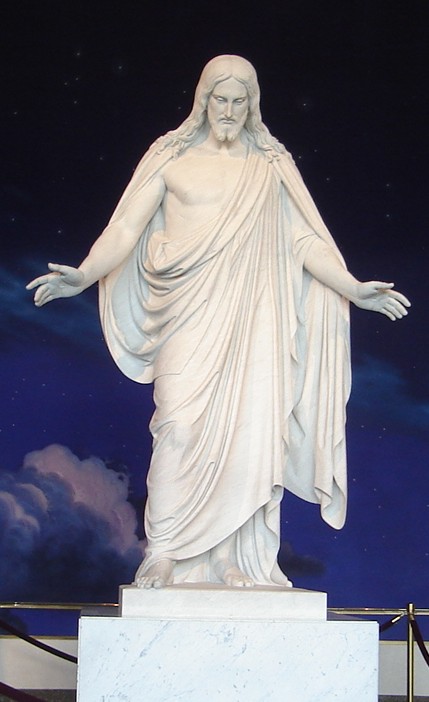
Since Christianity is exclusive of other religions, the way I overcome the false dilemma of "serving two masters" is to consider LDS to be a materialist Christianity, as evidenced by the angel Moroni, the appearance of God and Jesus to Joseph Smith, and even the statue of Jesus Christ. In contrast, Pure Land Buddhism is a Buddhism that transcends materialism yet is like a diamond of the mind which reflects the spirit of Christianity.

Is not the Holy Ghost an echo of Buddha Nature? Cannot Buddha Nature cut through infinity to embrace the Holy Ghost?

Only those people of the LDS faith who are strict on the Christology would call this syncretism and object to it, due to their lack of insight about Pure Land Buddhism and possible rejection of religious pluralism.

For Christology is religiously exclusive to Christianity, and has rejected the metaphors and symbolism of Buddhism, while subtly accepting the syncretism from neo-Platonism and Roman mystical sources - especially the concept of an immortal soul, which is not what is meant by "immortal life".

Indeed, the immortal life as mentioned in the New Testament refers solely to the the state of being of the soul in the afterlife. For in this reality, the soul is mortal and begins at birth only to end at death until End of Days.

Then it arises and takes on a new body in the afterlife in one of the Three Glories.

In contrast, Pure Land Buddhism rejects the concept of immortality, and posits that each being's life is finite but rejects totally the concept of an immortal soul. For it is consciousness which lives on after death, yet this consciousness is not an immortal soul. The closest analogue in LDS cosmology is "intelligence."

Within context of Buddhism, immortality means the state of being which lasts for a very long but finite time. Even "forever" too is an exceeding long but finite period of time, too. Therefore, an immortal life is still a very long life which has an end in the indefinite future.

Thus, strict Christology is composed of magical thinking about time and is simplistic about premortal life and the afterlife.

Yet LDS Cosmology is merely the wire frame upon which the tenets of other religions may be placed until they fit right for each LDS member, no matter what their religious background is.

Although there is no Amida Buddha in LDS cosmology, the faint echoes of Buddhism do exist. Even so, this is a heterodox view which tries to synthesize LDS cosmology with Pure Land cosmology. Thus, it is neither Buddhist nor Christian yet both Buddhist and Christian. Overall, though, it would still take a leap of faith to view it as such.


"If you have faith, nothing shall be impossible" — Matthew 17:20


Originally posted on Jun 25, 2013 at 6:51 PM

20140719

Evolution of Race Relations in Mormonism (satire)

In 1954 Mark Petersen, a Mormon apostle, supported racial segregation in America at the Convention of Teachers of Religion on the College Level.

He had been influenced by the racial superiority myth popular in America at the time, saying in a speech at the conference, "What is our advice with respect to intermarriage with Chinese, Japanese, Hawaiians and so on? I will tell you what advice I give personally. If a boy or girl comes to me claiming to be in love with a Chinese or Japanese or a Hawaiian or a person of any other dark race, I do my best to talk them out of it. I tell them that I think the Hawaiians should marry Hawaiians, the Japanese ought to marry the Japanese, and the Chinese ought to marry Chinese, and the Caucasians should marry Caucasians, just exactly as I tell them that Latter-day Saints ought to marry Latter-day Saints."

This kind of attitude made it hard on Mormon converts in Africa and Asia before the change that happened within the past 30 years.

Nobody in the Mormon church believes in this kind of racist rhetoric, especially have the civil rights movement of the 1960s.

Most of Petersen's writing are less obnoxious than this speech was, but those times are over. Since 1978, when the first black Mormon became a bishop, Mormonism has grown to endorse a meeting of minds with Buddhists, Hinduism, Islam and other faiths.

This makes it possible for my path to becoming a Buddhist Mormon, though I reject Petersen's words because they segregate humanity by race. It reminds me of the time when I sent away for information for a US dating club and received material that endorsed racial segregation in dating. In response, I demanded and received a refund from that dating club and vowed never to request such material from the US ever again.

I believe that the reason why the Mormon church chose to consecrate bishops of any race after 1978 because the racial superiority ideology was turning off visible minorities who were Mormons and slowing conversion efforts in Japan and in Asia.

As well, it was hard to sell Mormonism in Japan because of unscrupulous practises like allowing a Japanese convert pressure members into buying a cookware product offered by a company that was a multilevel marketing promoter of that cookware.

It was only until after 1978 that Mormons in Japan became more culturally sensitive to Asians and other races all thanks to the success of Martin Luther King Jr's civil rights movement in the 1960s.

Today, nobody endorses the racial superiority policy publicly in the Mormon church because it would be detrimental to gaining converts.

Reference:

The Untold History of Mormons in Japan: http://elderkikuchi.blogspot.ca/2010/05/heading-another-heading-row-1-cell-1.html

Mark E Petersen: http://en.wikipedia.org/wiki/Mark_E._Petersen

Black People and Mormonism: http://en.wikipedia.org/wiki/Black_people_and_Mormonism

20140717

The Buddha is My Christ (satire)

It is a flawed theology to fear a non-Christian would go to Hell practising their own faith, be it Buddhist, Islam, Judaism or any religion other than Christianity that promote moral conduct.

In assuming that if I don't believe in Jesus, then I'll go to Hell, the conservative Christian is endorsing a religious opinion that is based on flawed logic.

In my opinion, this is the devilish nature of that assumption: condemnation of non-believers and fear of non-Christian faiths.

Whether or not I go to Hell is not determined by what I believe, but by how I conduct myself. This too is true in Buddhism. Indeed, both faiths require their members to repent from immoral conduct.

Therefore, the religiously faithful of any religion who follow the tenets of their religion will not go to Hell by practising their faith.

Thus I question the condemnation of unbelievers by any religion. Though, Buddhism endorses us to not to blindly accept what the Buddha said but to test everything that is Buddhist.

Perhaps this is why I like Mormonism. While the history of the Mormon is complex, the willingness of Mormons to be open to limited religious pluralism is a good sign. It shows the ability to adapt to the influence of post-modern eucheminism on Mormon thought.

Because I know that unconditional love is the root of Buddhism and Mormonism, I am sure that it will be possible for me to moderate my Buddhist ideals with Mormon ideals. Yet it is unlikely that the mixing of the different flavors of both faiths will lead to strengthening of my core belief about unconditional love.

For that Love empowers both Mormons and Buddhists to improve their lives for the better.

As I grow in my experience as a neophyte Buddhist Mormon, I hope to disprove the assumption by naïve conservative Christians that the syncretism of Buddhism and Mormonism will condemn me to Hell.

In Mormonism, a member eventually will be reborn in one of three kingdoms, the Celestial, the terrestrial and the telestial. Yet the afterlife is not of this world. Even so, the metaphor of the Mormon afterlife can be applied to this life.

If you follow the moral code of Mormonism, then it is possible to achieve the glory of the Celestial kingdom. If you follow the moral code of a non-Mormon religion, then you may achieve the glory of the terrestrial kingdom. If you follow your own moral code, then the telestial kingdom is for you.

In contrast, if you slip up but stay faithful to the Buddhist precepts of moral conduct, then you may achieve Nirvana, which is freedom from the cycle of birth and death in the Six Realms of Desire. If you just follow your own moral code, then you will live your own life.

Whatever my destiny is as a Buddhist Mormon, my depth of faith in unconditional love determines the strength of my moral code which determines my moral conduct. Through meditation and prayer, it is possible to live by my moral code and improve my moral conduct.

Although I am not perfect, I hope to improve my life by abstaining from caffeine, nicotine, alcohol, and dangerous drugs. By doing so I plan on improving my health so that I may live long enough to be of service to other people, which is a core Buddhist tenet.

Since Mormonism is dedicated to service to other people, I find that it is amenable to my core Buddhist beliefs.

In Jodo Shinshu, the Japanese Buddhism that is the faith that I was born in, it is said that its founder Shinran Shonin once said, "I gladly will follow my master Honen to hell."

If conservative Christians might condemn me to Hell for "serving two masters", then that is based cherry picking Biblical quotes to support their religious opinion.

So, I certainly do not believe I am going to Hell. Although I have once stated that the Buddha is my Christ in jest, in all seriousness it is the foundation of the spiritual aspects of my life.

By declaring that "the Buddha is my Christ", I am only confirming the influence of the Buddha and the Christ on inspiring my life as a Buddhist Mormon.

The Buddhist Mormon (satire)

Today, I Googled "Buddhist Mormon", and discover this gem called Mormons and Buddhists: Overcoming the Language Barrier, which is one of three articles that inspires me to write this blog entry.

In both Buddhism and Mormonism, unconditional love is their common ground. For unconditional love is another word for charity and loving-kindness, which is known in Buddhist as metta.

As the basis of all forms of charity and loving-kindness, it could be said that unconditional love is the spiritual language that both Buddhists and Mormons speak. They just say it in different ways.

Therefore, it is possible to be both a Buddhist and Mormon.

As the author of the Mormon Matters article How Mormons Are Buddhist and Vice Versa writes, "the beauty of true Mormonism is that when we find truth in another religion, we have no obligation to reject it, but rather, are encouraged to embrace it."

Indeed, the religious pluralism of Japanese people who are spiritually inclined is why they are "born Shinto, marry Christian and die Buddhists."

At the root of all of this is unconditional love.

There is so much that Mormonism and Buddhism have in common that dialogue between a Buddhist and a Mormon is enlightening.

Here is the passage in the article that impressed me a lot:

The Rev. Hirano explained that one of the ideas he wants to change is about mourning in Buddhist funerals. “We want to be sad, we want to feel the pain of the loss of that person. That’s why we wear black. I know that we will be together again in one place, that I will be together with them again, but I’m still here and it hurts.”

Sister Takasaki remarked that she had never heard it put that way and concurred about acknowledging the pain of loss.


Through dialogue and study of both Buddhism and Mormonism, it is possible to realize that both faiths share in their common root in unconditional love.

References:

How Mormons Are Buddhist and Vice Versa: http://mormonmatters.org/2008/03/12/why-mormons-are-buddhists-vice-versa/

Mormons and Buddhists: Overcoming the Language Barrier: http://thebuddhistmormon.wordpress.com/2012/10/05/hello-world/

Mormonism and Buddhism in dialogue: http://www.deseretnews.com/article/865599471/Mormonism-and-Buddhism-in-dialogue.html?pg=all

20140713

Happiness is Peace of Mind (satire)

It is said in Buddhism that seeking happiness, which comes and goes with a person's mood, is desire which may distract the devout from Nirvana and thus lead to rebirth in the Six Realms of Desire.

In order to escape suffering in the Six Realms, I would need to extinguish the desire to be happy so that true happiness arises.

True happiness is found in the freedom from desire itself. This implies mastering my passions by behaving more compassionately towards other people who have grown to care for.

Buddhism does not advocate the neglect of family life. Rather, Buddhists are urged to act mindfully while keeping the Five Precepts (no killing, no stealing, no sexual misconduct, no false speech and no intoxicants such as coffee, tea, alcohol, dangerous drugs, and tobacco).

Even so, I like feeling happy once in a while, and associate that feeling with peace of mind. Deep down though, such fleeting happiness is due to the work of unconditional love.

However, the pursuit of happiness is indeed potentially the pursuit of suffering when a person desires to sustain it to the exclusion of the main goal in life, which is to fulfill your spiritual journey through life.

In escaping suffering, the Buddhist does so by reflecting on the Four Noble Truths (life is suffering, suffering is due to endless craving (desire), relieve desire, and embark on the Eightfold Path to aid in that relief).

It is through meditation that the spiritual journey begins by first relieving suffering by accepting the Four Noble Truths.

When my mind is calmed, I go on to meditate more deeply on the fleetingness of happiness. With my desire thus quenched, it is possible to develop peace of mind so that true happiness may arise.

Happiness is indeed peace of mind. Be ever watchful and strive for it!

20140707

The Essence of Buddhism Reincarnation (satire)

In essence, the consciousness-stream is an evolving consciousness which on death, becomes one of the causes that contribute to the arising of a new aggregation.

Death is known as dissolution of the aggregates.

At the death of the previous personality, a new personality is born, like the flame of a dying candle used to light the flame of another. The new person's consciousness is neither identical to nor entirely different from that of the deceased but the two form a causal continuum or stream.

Transmigration is due to karma or volitional action and its basic cause is the abiding of consciousness in spiritual ignorance. When ignorance is uprooted, rebirth ends.

However, this consciousness-stream is not a soul and has no permanent existence apart from the body.

Since transmigration is due to karma (action), the stream is actually of a temporary spiritual nature. It is not the primary reason for meditation. Hence not all schools of Buddhism promote reincarnation.

As for spiritual ignorance, this consists of ignorance of the first Buddhist truth that life is full of suffering. Denial of this basic truth is what leads to ignorance. Acceptance of this truth leads to the second truth, that suffering is due to ignorant craving. Knowing that ignorant craving leads to suffering results in realization of the third truth, that suffering can be ended. In the fourth truth are the Eightfold Path in ending suffering. These truths are known as the Four Noble Truths.

In the Eightfold Path are the following divided into three parts, consisting of Wisdom (right view and right intention), and Ethical conduct (right speech, right action, right livelihood) and Concentration (right effort, right mindfulness, tight concentration).

Meditation is said to aid in ending spiritual ignorance.

Reference:

Reincarnation: Buddhism: http://en.wikipedia.org/wiki/Reincarnation#Buddhism
Four Noble Truths: http://en.wikipedia.org/wiki/Four_Noble_Truths
Eightfold Path: http://en.wikipedia.org/wiki/Eightfold_Path

20140706

Neuroses: When the Protection is Effective (satire)

From what I've been able to figure out, the Buddha's job was not to save the earth but the human mind.

After all, meditation is less costly than a pill, and cannot be patented. For Buddhism does not work well if treated like a religion.

Though it relieves neuroses when meditation is regularly practiced with sincerity.

Neuroses are what the doctors have omitted when they updated their mental health "bible" to the Fourth version. This is because a neurosis is actually based on protective defense mechanisms.

Meditation helps the meditator to examine these defense mechanisms in detail.

Originally posted April 22, 2013 at 2:37 AM


20140625

Without a Soul to Save, Only the Good Life Awaits (satire)

I'm pretty sure the fact that The Book of Mormon is in the English of King James version makes it a difficult read for me.

What if, instead of the Celestial Kingdom, I'm fine with rebirth in the Terrestrial Kingdom?

I'm not sure if a Mormon can understand that. In Buddhism, the reason why there is no baptism is because the metaphors about water refer to how the multitude of Buddhists are a part of mighty ocean of wisdom and love.

However, the goal of an earnest Buddhist is not to be reborn in the Six Realms of Desire but to escape rebirth itself through meditation and related acts of mindfulness.

I suppose meditation is mysterious to a Mormon who equates baptism and giving up worldliness with achieving the Celestial Kingdom in the Afterlife.

Nobody in America can really fathom how sitting on your ass achieving calmness of mind is supposed to lead to nirvana, let alone Enlightenment, except perhaps a Buddhist.

Yet that calm mind leads to the clarity of mind to realize almost the same thing that a Christian knows to be true: seeking fame and glory does not lead to a truly good life and neither does seeking riches.

In this way is Buddhism almost on the same page as Christianity. For, even without baptism, I can avoid the delusions that chasing fame may lead to, and also avoid the pitfalls of financial success.

After all, the Buddhist principle of no-self implies that there is no soul to save. Instead, there is only a good life to make my own.

20140623

Meditation Has Freed My Mind (satire)

Having meditated regularly over the past 20 years or so, I would consider meditation to be a deeper form of prayer that has cleared my mind and aided in gleaning insight from the careful introspection which has accompanied it.

However, meditation is not like addressing God, then making a request of him, and closing with an 'Amen.' Instead, it has been the way that I focus on my breathing, while letting go of clinging to the thoughts which continue on dancing in my head.

While I do not know when I realized that there is no way in the world to stop thinking, it is possible to ignore most of my thoughts, except for the thoughts which I cling to and build into prose about stuff that is very interesting to me.

By letting go of clinging to my thoughts, I arrive at what might be called "no-thought" as in "no thought do I cling to, lest I forget about meditation." Having not clung to a single thought, it is like I have been freed from thinking itself.

It is as though the freedom that meditation provides is found by rendering sedate the mind so that it can clearly see the way, rather than being distracted by the monkey mind, untrained and striving for freedom.

For freedom exists within the framework of rules. Without rules, there is only licentiousness, the mother of true chaos.

Yet that chaos can be rendered null and void through meditation, which clears the mind and helps to focus it on liberation from the very same rules that helps the devotee reach Nirvana.

Only then can the devotee let go freely without regret, knowing that all those years of sitting on his ass has paid off.

For meditation has freed my mind from thinking, so that I may think more clearly about specific thoughts such as liberation of the mind. It begins with the thought that the mind is essentially free to think, and does so almost all the time while I am awake.

Perhaps when I am asleep, the mind may think but I am not aware of those thoughts, even though they may arise during a dream.

As I mentioned at the beginning of this article, i have actively meditated for over 20 years. When once it was difficult to meditate, quite possibly because I was doing it wrong, now it is almost too easy to meditate and enter the "zone". The key to meditation is to smile with joy, and work from there.

Too often have I seen stern-faced meditators trying to achieve satori. Believe me when I tell you, a smile might make the difference between thinking and being freed of clinging to thinking.

Indeed, a smile leads to liberation.

20140622

Looks Like I'm Going to be a Dry Mormon (satire)

My desire to become a baptized Mormon died when I was told I couldn't be baptized because my roommates are "living in sin" aka in a common law relationship. That didn't make me want to take up smoking though.

Of course, I let the Mormons know I put my roommates before the Mormon church. Hopefully they'll respect that devotion to my roommates.

However, while waiting for church to start today, I happened on the Rational Wiki which had a hilarious spin on Mormons, though no True Believer Mormons would be laughing at it as much as I am.

After reading about dry Mormons, which are people who attended Mormon meetings on Sunday but aren't baptized due to complications like mine, I found the concept amusing as I did Jack Mormons, who are apostate Mormons who try to outdo the secular decadent hedonists in south Utah.

I know for myself that I don't self-identify as a cafe Christian, who is just on the edges of being a Christian. He'd give up coffee & tea, cigarettes, alcohol, and dangerous drugs, but he might come up with excuses not to attend Sunday meetings at the Mormon meetinghouse.

Just for the record, I am not disappointed at not being able to be baptized soon. However, I'm going to go out of my way to be virulently anti-Mormon, because of that one Buddhist precept that says a believer should never disrespect the Buddha. Even though a Christian prophet is nothing like a Buddha, both of them are spiritually alike.

It would be foolish of me to disrespect the Mormons in any way, and the mention of the Rational Wiki's take on Mormonism is not an attack on the Church of Jesus Christ of Latter-Day Saint. Rather, it is an amusing spin on an American folk religion that evolved into another part of the Christian mosaic in the USA.

Oh, also I'm invited to a dinner with a Mormon family later on this week. We'll see how that goes when it happens.

Mormonism - Rational Wiki: http://rationalwiki.org/wiki/Mormonism

20140616

An Otaku View of Mormon (satire)

At the temple yesterday I remember explaining the difference between -sama and -kun to a fellow Japanese Mormon, who's been a Mormon for over 40 years.

I also kidded him and said he'd be like my sempai since this is my third time at the temple.

Even so, the only thing that "got" me was Mormon cosmology, which is almost like Buddhist cosmology except it skips the Six Realms of Desire and the Pure Lands, and presents this false concept of immortality.

This is why I think of eternity as a finite time period of an exceedingly long length, and immortality as a life of an exceedingly long length that still will end when a person is reborn in a new realm --- because if God was once man in a previous life, then a person who might become a god in the next, might again be reborn in a new realm.

If the above is confusing, it appears being born again might be a part of a long cycle of rebirth.

I'm not sure if not desiring to get into the priesthood as a way to break that cycle is something I'd share with the pair of elders, though.

Sometimes I think my adventures with the Mormons would make a great manga. However, I am more interested in turning the cosmology into manga.

20140414

I Believe in a God Unlike the Christian, Jewish and Muslim God

I believe in a God devoid of anthropomorphic qualities that is called the Absolute.

If we have souls, then after death no soul is turned away from return to the Godhead.

For the universe has infinite capacity for these souls because they pass on to another dimension where no soul is limited physically.

Though no soul can have sex because souls can not get pregnant. There is also no need to eat because you are never hungry for physical sustenance.

However, you have to listen to a sermon until God calls to you, "Time to be reborn, pilgrim!"

This dimension is known as a Pure Land but is separate from the many other Buddha worlds called Pure Land of Bliss and their respective Buddhas.

On death, everything will be explained to you: the fallacy of good and evil is merely a tool to separate the monotheistic people who practice dualism from the believers in the Absolute who strive for the non-duality called Shunyata.

Indeed, the Christian Heaven is the closest monotheistic equivalent of the Absolute. For all Buddhists, the Absolute is the closest to God that the faithful attain.

Though Amida Buddha would urge the bodhisattvas reborn in the Pure Land in his sermon to return to the earthly plane to help other lost souls find their way to his Pure Land.

Note too that all souls are finite aspects of the Godhead which itself is almost infinite.

YMMV

Originally posted: October 26, 2012 1256H PDT