Search This Blog

Showing posts with label LDS. Show all posts

20150907

It's Been Awhile (satire)

To all my fans/followers:

My excuse for not regularly posting articles on my blog is this: I have been obsessed with work, mainly because my new boots allow for walking for 5.5 and 6 hours.


It is possible that I've almost walked a thousand miles. Hence my need for prescription medications such as gabapentin (relieves neuropathic pain), flexeril (relaxes the muscles in my shoulder, and recently bupropion (Zyban is said to cure cigarette smoking).

Even the Zyban had the wonderful side effect of causing me to not indulge in bad habits — mainly paying more attention to my technology than to my surroundings.

Within 15 minutes playing attention to my technology, I feel the the signs of a relapse but alcohol or drugs is not my vice. Instead, I madly type on my keyboard and create articles like this one.

Look, I have cut out coffee and tea, alcohol, masturbation, and smoking. Instead of sinning quietly, I catch myself reading the Gospel Library app. Though a few people are not clued in that when I pulled out my smart-phone or tablet, I am not about to surf to porn websites. Instead, I am searching for a quote by Joseph Smith, but came up with this quote from the New Testament:

Little children, let no man deceive you.
He who does rigorousness is righteous,
even as he is righteous.
— 1 John 3:7

To masturbate or watch porn or indulge in adultery and prostitution, or commit homosexual acts, is condemned by John when he wrote:

He who commits sin is of the devil,
for the devil sinned from the beginning.
For this purpose the Son of God was manifested,
that he might destroy the works of the devil.
— 1 John 3:8

By praying to the Lord and beseeching Jesus Christ instead of indulging in booze, cigarettes, wine, soft and hard drugs, adultery, masturbation, prostitution, coffee and tea, and homosexual acts, I shall eventually be rid of the evil that these things do to me that even comes to affect my family and friends.

Oh dear! I have become no fun anymore to the all sorts of decadent hedonists, those salt of the earth who party and stay up late at night.

All it takes is confessing your sin to someone trustworthy like a bishop, a priest, a reverend, a rabbi, a shaman or even a trusted friend, and earnestly repent. The worst that could happen to you is not taking sacrament next Sunday. In due time, by following the doctrines of your faith, you will discover that worldliness is only fun for the worldly.

Once we are baptized, the best way to renew our covenant with God is to faithfully attend sacrament meetings on Sunday, the Lord's Day. For the baptized are born of God after being dipped in the baptism fount.

Whosoever is born of God does not commit sin, for his seed remains in him and he cannot sin, because he is born of God.

For it is better to be a child of God, born of God, than to be a child of the devil. When you practice righteousness, you are of God, and so too are they who love their brothers and sisters.

For this is the message that you heard from the beginning, that we should love one another.
— I John 3:9-11

Yet the habits that you used to love, you come to detest them, not being satisfied with what you do to get relief. That love is a false love because the more you indulge yourself with a bad habit, the more you are socially isolated from the world.

For desire when indulged leaves a bitter-sweet taste in your mouth; but your love is false because desire is more likely to lead to sin when indulged. As for love, it is best to remove all conditions associated with it so that we may love unconditionally.

So, I have been praying about and meditating upon my life, only to see that Joseph Smith's words are true: each of us are free agents who can choose to do good or to do evil.

Indeed, in the heat of passion, I once blamed others for my trespasses, but no more.

Instead I enjoy giving sacrament to members who, because of illness, cannot attend church. It is also why I enjoy participating in discussions during the Elders Quorum meeting most of all.

Now that I have confessed my sin of avoiding responsibility for my actions, I shall repent and try to be the quiet silence in the aftermath of a storm.


Thanks for reading this blog entry. Please take care of yourselves lest you entertain the devil unaware. ;)

20150813

The Most Thoughtful Yet Depressing Mormon Hymn (satire)


After first hearing Hymn 197 - O Savior, Thou Who Wearest a Crown - I greatly moved by its subject.  Within context of the church, it sobers the repentant heart.

If this song is sung "thoughtfully", then its apt for Easter which fits all the Easter songs in the Hymnbook.

Even I cannot reach the lowest notes; though, being a guy, I cannot hit High C either.

Though, the music of this hymn is based on a hymn by J.S. Bach who improved on the original hymn written by Hans Leo Hassler.

Anyway, to give you an idea of what this song is like, I will quote the whole thing.

1.O Savior, thou who wearest
A crown of piercing thorn,
The pain thou meekly bearest,
Weigh'd down by grief and scorn.
The soldiers mock and flail thee;
For drink they give thee gall;
Upon the cross they nail thee
To die, O King of all.

2.No creature is so lowly,
No sinner so depraved,
But feels thy presence holy
And thru thy love is saved.
Tho craven friends betray thee,
They feel thy love's embrace;
The very foes who slay thee
Have access to thy grace.

3.Thy sacrifice transcended
The mortal law's demand;
Thy mercy is extended
To ev'ry time and land.
No more can Satan harm us,
Tho long the fight may be,
Nor fear of death alarm us;
We live, O Lord, thru thee.

4.What praises can we offer
To thank thee, Lord most high?
In our place thou didst suffer;
In our place thou didst die,
By heaven's plan appointed,
To ransom us, our King.
O Jesus, the anointed,
To thee our love we bring!

Text: Karen Lynn Davidson, b. 1943. © 1985 IRI Music: Hans Leo Hassler, 1564–1612; adapted by J. S. Bach, 1685–1750 2 Nephi 2:6–9 Matthew 27:26–31, 34–35

20150713

The Light Outside of the Bushel

In Christianity Jesus is sometimes called the Light of Christendom. Similarly Amida Buddha is the Light of Buddhism wisdom.

Just as Jesus is the Light of the West, so too is Amida Buddha the light of the East. Though it is said that east is east, and west is west, but never in between do they meet, solely in the name of religious pluralism do I find that both Amida and the Christ symbolize the divine in the East and in the West, respectively.

Figuratively speaking, the Light of the West shines brightly in my heart while the Light of the East shines within the bushel of my life before being born again as a Mormon.

And in my heart, I am made whole as a spiritual being due to my faith in Jesus, and my subtle reverence for Amida. This is not a case of serving two masters but the affirmation of the spirit of religious pluralism.

For I serve only the Light, and have a deep spiritual connexion both with the East and the West, due to being born Japanese in Canada.

20150705

Why I Don't Have Issue With the Same-Sex Marriage Decision in America

As a Mormon, I would like to say that Jesus commanded us to love one another; he also told us who are Christian to love our enemies. In short, Christendom ought to be loving toward the LGBT community on this decision, because the State has ruled for lesbian, gay, bisexual and transgender People.

Thus any hatred against the LGBT is a bigger moral sin than homosexuality itself. If a gay couple is harmed because of this decision and it is found that a Christian did it, then he is anathema to Christendom, because he violated Jesus' commandment to love one another.

However, this is merely my opinion and it is mine to maintain and treasure. While everyone quibbles about the black and white aspects of this decision, my respect for the LGBT community is colored like the rainbow.

20150313

The Restorational Faith of Leo N Tolstoy


Russia's most greatest of authors, Leon Tolstoy’s story is that of a bourgeoisie who has amassed riches but felt worthless to the point of melancholia.

Rather than ending it, all he restored a Christianity that was similar to the practices of the Doukhabors, who were Russian peasants who rejected the Orthodox Church priests, icons, and associated church ritual. As well, they rejected the tyranny and oppression of the Russian Czarist government.

Both Tolstoy and the Quakers helped pay the Doukhobors' passage across the Atlantic Ocean circa 1899. Some of them immigrated to Canada.

Sadly though, the Doukhobors ended up being persecuted by BC Premier W.A.C. Bennett, due to their unwillingness to be assimilated into Canadian culture.

Yet Leon N Tolstoy’s Christianity is also a restored Christianity that is practised without the doctrines and dogma of the Orthodox Church from which he had apostatized.

In 1882, Tolstoy first published his four-part series on his faith under the title of A Confession. Originally titled An Introduction to a Criticism of Dogmatic Theology, this series also consisted of "A Criticism of Dogmatic Theology", "The Four Gospels Harmonized and Translated" — the inspiration for "The Gospel in Brief" — and "What I Believe" which was also published in English as "My Religion" and "My Faith".

Because of the Russian Orthodox Church's censorship, the series was banned from publication, being censored in the Russian journal Russian Thought, No 5. So it was later published in Geneva in 1884, and again in Russia in 1906 in the Russian journal World Bulletin 1.

In 1887 it was translated, published and copyrighted by Thomas Y Crowell & Co.

Tolstoy’s restorational faith is expressed in the Introduction to his book, The Kingdom of God is Within You: Christianity Not as a Mystic Religion But as a New Theory of Life. Being restorational in nature, this book should be studied by intellectuals of restorational churches such as the LDS.

References:

Doukhobor: http://en.wikipedia.org/wiki/Doukhobor

Leo Tolstoy: http://en.wikipedia.org/wiki/Leo_Tolstoy

20150205

From Darkness to Light (LDS)

If I had to censor my love for dark humor just to save lives of the suicidal, I'd feel melancholic. So please bear with me.

Keeping that in mind and having saved my soul the LDS way, perhaps suicide might prepare my lost soul for a glory so dark that "Telestial" would only add to the confusion.

Although all Christendom might call it "hell", I'd rather call it a dark glory for the wicked, a murky destination interspersed with flashes of what is mistaken for lightning but is actually the arrival of missionaries sent by God to soothe my suffering in the afterlife.

While this cosmological rationalization of the fate of the suicidal in the afterlife may be considered too deep for my followers to fully comprehend, it is designed counter the idea that the least of the LDS glories is always full of gnashing of teeth.

For my understanding of the least of the three glories of the LDS afterlife is of the fitting end to a miserable life where the term "Telestial" comes to mean "the eventual destination of the unbelievers who enjoyed their descent into the darkest of glories only to endure the home visits of elders who minister to them for all eternity."

After long consideration of such a fate, I find it so ridiculous that my melancholy has left me smiling unexpectedly!

It is not schadenfreude - that joy on realizing that suffering is universal - which inspires my change of mood from melancholy to elation.

Rather, I am thankful to the elders and sister missionaries who I have met and helped guide me towards the Light that outshines mortal understanding.

In gratitude of how the Lord works in mysterious ways, I ask myself how any melancholy withstand Him?

It cannot.

For the unconditional love of God Almighty is such that his mercy brightens the lives of all of us who accept his Only Begotten into their lives.

References

Telestial Kingdom: https://en.wikipedia.org/wiki/Degrees_of_glory#Telestial_kingdom

20141221

The Prospect of Marriage Scares Me (satire)

Recently I have noticed hints by my fellow LDS leaders (a married missionary and a teacher who has the higher priesthood) about getting married to a single woman in our ward.

In the first incident, I had dinner with a Taiwanese LDS in the Melchizedek priesthood. As a part of introducing new prospects to Mormon life, I got invited to dinner with his family along with the elders who watched over my spiritual welfare.

Sometime before dinner, I accompanied Brother W to a female prospect at a house she rents with another prospect, but both women were out. Nobody was home - it was like they realized the LDS life is not right for them.

Even though I knew something might be up, I never mentioned my suspicion that he might be introducing me to a potential marriage prospect to Brother W since the LDS theology highly values traditional marriage.

In the second incident, at the Christmas dinner, the married Elder M tried get me to loosen up and stop being the quiet, shy and retiring guy that I am with a lady from Mongolia. We are having an awkward time communicating, but my observation of her behavior and the subtle hints of friendliness indicate to me that we are much alike in personality.

Even so, my aversion to finding a new mate as a new baptized member this early — my baptism was on August 29 - four months membership so far — is making me act like a man who is totally unprepared for marriage.

My income cannot support a mate - it could lead to complex financial difficulties for me, more complicated than the single life that I now live. Indeed, I know that I am not ready, so that is why I am acting like an unlikely prospect rather than like a man.

However, the life of chastity that an LDS member is supposed to follow will almost guarantee getting married if both he and the prospective wife have paid their tithes and fulfilled all their obligations regarding priesthood ordination.

Yet I know from the five failed relationships that the prime cause of their failure is premarital sex. Added to this is the realization that my sexual hangups is related to being not "marriageable" i.e. the married life is more expensive than the single life.

Overall though I shall attempt to be less aloof and unsociable as time goes by as a Mormon but for now, I have some reading to do...

TO BE CONTINUED

Ordination: http://www.linkapedia-christianity.com/digest/ordination/97407342/20d869b1c88ebc297049467acf69543d?checkLogin=1&lnkpd4f3b8=18f16

20141031

A Meditation on the Lord's Prayer

In this article I shall quote the Lord's Prayer and interpret it according to what I have learned about the Bible. If this interpretation differs from any other official interpretation, then it is to glorify God and bear witness to the return of the Messiah, the Son of God, Jesus Christ.

First let me introduce the first part of the prayer:

Our Father, who art in Heaven
Hallowéd be thine Name
Thy Kingdom come
Thy Will be done
On Earth, as it is in Heaven.

In the first five lines of the Lord's Prayer is the promise that the Kingdom of God will come upon us, though it be without warning. This is a distant reference to the Millennial Age when Christ will rule over the Earth before the End of the (Latter) Days is upon us.

These five lines have been written in my heart as the penultimate Millennial Promise of God sung by the angel of song.

In the second part of the Lord's Prayer we have:

Give us this day our daily Bread,
and forgive us our trespasses
as we forgive those
who trespass against us
and lead us not to temptation
and deliver us from evil.

Contained in the first line of this part of the Lord's Prayer is the transubstantiation of the body of Christ from the bread of sacrament. Although we as Christians have sacrament on the Sabbath — the day of rest — it represents the renewal of the covenant and reminds us to remain repentant — and thus refrain from sin.

In the third and final part of the Lord's Prayer is the acknowledgement that the Kingdom, the power and the glory is of God, which lasts for a long, long time.

For thine is thy kingdom,
the power and the glory,
Forever and ever.
Amen.

Commentary:

With respect to the history of Christianity — founded by Jesus and written by Luke, it is like the history of ancient Rome — founded by Romulus and written by the Roman historian Dionysus — and the history of the Hebrews — founded by Moses and written by the historian Josephus — with each founder being born from God.

For Romulus was born by the river Tiber, while Moses came floating down the Nile and Jesus was baptised in the River Jordan.

Over the past two thousand years his being born from God has become the literal truth in the Christ's story as an established Truth that frees all of humanity who accepts Jesus as their savior from their past sins in apostasy, now ritually cleansed away by baptism, provided that they "go and sin no more."

That provision — to go and sin no more — is the essence of repentance.

Afterwards, repentance becomes an ongoing process that is sanctified by weekly church meetings on Sunday, and by daily prayers based on scripture. Indeed, the weekly taking of sacrament of bread and water that symbolizes the body and the blood of the Christ renews their covenant with God. That covenant consists of following the commandments of their church and the observance of fasting and taboos of the respective religious denomination.

In the case of LDS theology, their taboo that addresses addiction consists of no coffee, tea, alcohol, tobacco, or illegal drugs.

Additionally, the taboo regarding the law of chastity implies no coveting of another person for immoral purposes, such as fornication, be it heterosexual or homosexual. This also includes adultery, including that of the heart e.g. looking upon another person as a sexual object. Finally, there is a taboo against masturbation and pornography.

I can see wisdom in making these things taboo: having no money to buy energy drinks prevents temptation of alcohol, tobacco and illegal drugs.

With respect to chastity, my choice of the term "coveting" means the wanton desire to use another person for sexual purposes. Fornication implies a sexual act. As for masturbation, the avoidance of pornography is the result of the taboo against it.

Indeed, the study of the Scriptures — the Bible (Old Testament and New Testament) and the LDS scriptures (Book of Mormon, Doctrine and Covenants, and the Pearl of Great Price) — is purported to be an inspiration to keep the law of chastity.

Though I prefer a cold shower now and then.

Returning to the first part of the Lord's Prayer, I still hear it being sung as though by an angel of song who clearly sings the promise of Jesus Christ to return to rule over the Kingdom of God in the Afterlife when End of Days is upon us.

Our Father, who art in Heaven
Hallowéd be thine Name
Thy Kingdom come
Thy Will be done
On Earth, as it is in Heaven.


Reference:

20141030

What's Love (and Sex) Got to Do with Agapé and Eros

In grade school, it was fun to play with the girls until the boys shamed me into playing with them.

As well, I was subtly bullied by a girl in Grade 6 when in Grade 2, due to her frustration in teaching me math that was simple for her but mysterious to me.

Though that never stopped me from excelling at math.

Then after Grade Three I spent the summer holiday with my first crush.

However, he teasing in Grade Four after my classmates found out I had a summer crush led me to realise romance has to be discreet ie not in my hometown.

The fact that my mother put a stop to it due to being late for supper makes me cautious lest I ruin my relationship with my roommates.

However, the best kind of love is between friends. This love has many names, but two of them are familiarly known as Agape and Eros.

Both Agapé and Eros are two sides of the same coin called human love.

Human love is so fickle though.

Unconditional love demands us to stop placing conditions on love. This is why friends love each other dearly: their love is unconditioned.

However, the only rule in friendship is remain loyal to each other, though it is loyalty with discretion.

Yet friendships rely on each of us to respect each other's right to be free, and to grow as individuals.

However, do not expect a friend to do anything for you, since it may lead to conflict. Such an expectation is unreasonable since it expects too much of a friend.

Do expect a close friend to be there when you need them but remember: friends are not slaves to be toyed with.

If you want anyone who is your friend to become reliable, then be reliable to them. Do anything for them as is necessary, and limit yourselves accordingly.

A good friend is a loyal helpmate. You are that friend.

My first crush was my best female friend, not a girlfriend but a friend who happened to be a girl.

I am happy that such a friend exists for me.

It can only be platonic though, for a man ought to be mature enough to call BS on the myth about platonic friendships.

Indeed it is a pernicious lie to assume a platonic relationship has a subtle sexual ambiance to it.

This lie is based on the error about the mythical libido, which is misinterpreted as the sex drive.

Libido actually is related to life and its propagation, and can be successfully sublimed into service, be it work or play.

Returning to my first crush, it was play that brought us together. Yet duty to my family nipped that in the bud.

Thus the libido must often be tamed, lest friendships be threatened by its excess.

So, my mother helped me to tame my libido by putting a curfew on me.

I suppose the cruelty such as beatings and burning moxibustion only showed the dark side of mother love - but because it was child abuse, it only served to make me fiercely independent when I was younger.

Yet here I am today realising that social isolation might be a side effect of the strong impression at a young age that I ought not associate with anyone lest they learn how dysfunctional I am.

However, the friends that I have show me that they tolerate whatever eccentricities I may have, which helps to moderate my behaviour accordingly.

For that is what unconditional love is actually about: accepting each other, warts and all.

Through daily meditation and prayer,
I daily sublimate Eros, and thus transform its motivational energy into Agapé, the vital essence of unconditional love.


Based on your life experiences, which love is the original love?

Remember: the libido is a manmade construct to explain sexuality, which too is manmade. While Eros and Agapé are two sides of love, the libido, Eros itself, is the subconscious call of the wild to propagate the species, which originates in each living being's survival mechanism.

In contrast Agapé is unconditional love which is the subconscious call from God Almighty to be of service to him by being a standing minister to worldly Gentiles and the apostates in the world today, often by being like an angel in disguise.

IMHO I feel that a healthy balance between Agapé and Eros is not often possible.

It is my contention that the gross energy of Eros (the libido) has often been sublimated and thus energizes Agapé. However sex is not love.

Therefore the sublimated libido energizes unconditional love. At the same time, that Love helps each of us through the grace of God to tame the libido.

I remember as a young boy how I was slowly growing out of control due to family strife due to my birth defects being used by my paternal grandmother shaming my mother because of those defects.

When it turned out that one of her sons, my uncle, had died of complications due to epilepsy, that foiled my grandmother. It is sad when a parent mentally abuses a daughter or son like this, and tragic especially when the same is done to an in-law.

Yet unconditional love is something we experience so little of in the world but have the opportunity to practice in the meetinghouse.

Still, it ought to be shared with the world, often without mentioning God Almighty, who made the world in six days not that we love Him only on the Sabbath, but also for the rest of the week from Monday to Saturday.

By sharing unconditional love with the world, it is then possible for standing ministers to share the Gospel with like minded Gentiles, so that they may come to know the truth about the LDS church.

For example, I have recently found Mormon cosmology to be almost like a light version of Buddhist cosmology, without the cycle of reincarnation and lacking the fullness of its Buddhist counterpart.

Of course, I attribute this to my ignorance of the richness inherent in Mormon cosmology due to my apostasy before baptism and LDS membership.

However, Buddhist cosmology contains a multitude of Buddha worlds of which the Pure Land is one.

IMHO the worlds awaiting the LDS members bound for celestial glory are like the Pure Land.

Yet the LDS literature is vague about the many worlds that those celestial latter day saints inherit.

With an understanding of Agapé and Eros, and of their respective commonplace terms, unconditional love and the libido, it is likely to help put human love into perspective.

Firstly, Agape is Love unconditioned and uncorrupted by carnal love, Eros.

Through the grace of God, after consistent prayer and meditation by a Mormon, Eros is sublimated which subtly energizes Agapé.

Thus is carnal love sublimated into unconditional love. However love is not sex.

Overall the Christ's call to love one another is tempered with his command to love your enemies and also to turn the other cheek ie accept the mental cruelty of zealous anti Mormon cultists without complaint.

20141005

Worshipping God as a Buddhist Mormon

In Article of Faith 11, it is written: "We claim the privilege of worshiping Almighty God according to the dictates of our own conscience, and allow all men the same privilege, let them worship how, where, or what they may."

This article of faith guarantees me the privilege to be a Buddhist Mormon, even though the Christian faithful who are deep in Christology claim that such syncretism is anathema to Christianity.

For myself as a Mormon, my Buddhist roots help me to clear my mind so that I am able to worship God according to the dictates of my own conscience.

Most of my worship consists of reading Mormon literature, and understanding various aspects of the LDS faith.

Additionally, the dictates of my own conscience is greatly influenced by religious pluralism, which helps to inspire a Christology that is further illumined by my Pure Land Buddhist origins.

Amida Buddha of Pure Land is defined as the boundless light of wisdom and the boundless life of compassion.

In Christianity, the light of Christ is akin to the spirit of Christ, and thus is closely identified with the Holy Ghost (Holy Spirit). As well, the Christ is referred to as the Word. Thus, the Word symbolizes the spiritual wisdom derived from the truth of Atonement i.e. that Jesus Christ sacrificed his life for the sins of mankind and God's Mercy is a free gift to all Christians whose sins are washed away in baptism.

Thus the Holy Ghost is the agent by which spiritual wisdom is derived by acting on the Christian through prayer and meditation inspired by scripture.

Likewise, compassion is symbolized by God's Mercy for all Christians who repent of their sins by following the articles of their faith.

Thus, much of my Buddhist practice of meditation helps me in my study of the Book of Mormon and related LDS scripture, which is vital to the greater understanding of LDS ideology.

Indeed, I am thankful to God for the privilege of his worship according to the dictates of my own conscience.

References:

20141002

Amida Buddha Versus God: Neither Buddhist nor Christian Yet Both Buddhist and Christian (satire)

Amida Buddha is not a god, and the Pure Land is not a heaven. This is the difference between Buddhism and monotheism.

For a Buddhist can believe in the Primal Vow, and have faith that the Pure Land of Bliss exists, precisely because Amida Buddha was but a mortal who after many eons became a Buddha who awakened and is reborn in his Pure Land.

No one can say the same about God and heaven without sounding like he is babbling about a New Age cult or folk Christianity.

Though one American folk Christianity almost fits the bill: Mormonism when the Christology is overlooked for the esoterism inherent in Latter-Day Saint cosmology (premortal existence and the afterlife).

However, it takes a great leap of faith to see echoes of the Pure Land in the Three Glories of the Mormon Afterlife, namely the Celestial Kingdom, the Terrestrial Kingdom and the Telestial Kingdom.

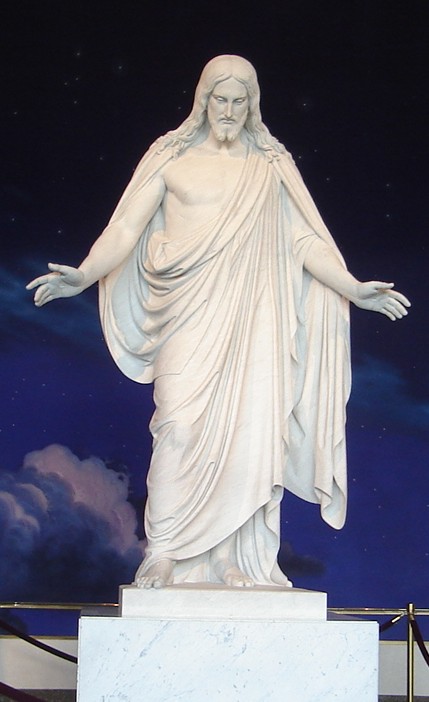
Since Christianity is exclusive of other religions, the way I overcome the false dilemma of "serving two masters" is to consider LDS to be a materialist Christianity, as evidenced by the angel Moroni, the appearance of God and Jesus to Joseph Smith, and even the statue of Jesus Christ. In contrast, Pure Land Buddhism is a Buddhism that transcends materialism yet is like a diamond of the mind which reflects the spirit of Christianity.

Is not the Holy Ghost an echo of Buddha Nature? Cannot Buddha Nature cut through infinity to embrace the Holy Ghost?

Only those people of the LDS faith who are strict on the Christology would call this syncretism and object to it, due to their lack of insight about Pure Land Buddhism and possible rejection of religious pluralism.

For Christology is religiously exclusive to Christianity, and has rejected the metaphors and symbolism of Buddhism, while subtly accepting the syncretism from neo-Platonism and Roman mystical sources - especially the concept of an immortal soul, which is not what is meant by "immortal life".

Indeed, the immortal life as mentioned in the New Testament refers solely to the the state of being of the soul in the afterlife. For in this reality, the soul is mortal and begins at birth only to end at death until End of Days.

Then it arises and takes on a new body in the afterlife in one of the Three Glories.

In contrast, Pure Land Buddhism rejects the concept of immortality, and posits that each being's life is finite but rejects totally the concept of an immortal soul. For it is consciousness which lives on after death, yet this consciousness is not an immortal soul. The closest analogue in LDS cosmology is "intelligence."

Within context of Buddhism, immortality means the state of being which lasts for a very long but finite time. Even "forever" too is an exceeding long but finite period of time, too. Therefore, an immortal life is still a very long life which has an end in the indefinite future.

Thus, strict Christology is composed of magical thinking about time and is simplistic about premortal life and the afterlife.

Yet LDS Cosmology is merely the wire frame upon which the tenets of other religions may be placed until they fit right for each LDS member, no matter what their religious background is.

Although there is no Amida Buddha in LDS cosmology, the faint echoes of Buddhism do exist. Even so, this is a heterodox view which tries to synthesize LDS cosmology with Pure Land cosmology. Thus, it is neither Buddhist nor Christian yet both Buddhist and Christian. Overall, though, it would still take a leap of faith to view it as such.


"If you have faith, nothing shall be impossible" — Matthew 17:20


Originally posted on Jun 25, 2013 at 6:51 PM

20140918

The Kingdom of God is the Pure Land

It is by being touched by suffering that one learns to understand and to be compassionate. If in the Kingdom of God there is no suffering, there will be no understanding and compassion either, and without that you cannot call it the Kingdom of God or the Pure Land of Buddhism. This is something very clear, very simple. So my definition of the Pure Land of the Buddha, the kingdom of God, is the place where there are plenty of opportunities for you to learn to be understanding and to be compassionate. When you have a lot of understanding and compassion, you are no longer afraid of suffering. — Thich Nhat Hanh, Pure Land, The Pocket Thich Nhat Hanh

Suffering thus is essential to understanding birth and death, being and nonbeing. Indeed, the nondual reality consists of suffering and not-suffering, be it among Children of Light or lost sheep or even Buddhists. Even Hasidim who are moderates know this truth called nondual reality, as do moderate Sufi mystics.

When we chose neither left nor right, we get close to the nonduality of politics. YMMV

What I am saying is that the path of moderation is the nondual path. It is not a complicated bunch of mumbo-jumbo that New Age gurus sell at fair market value. Rather, the path of nonduality is free to anyone to understand.

Even the birds and the bees know of nonduality. Even in a world of survival of the fittest, the strong may prey on the weak but the weak often escape their destiny if the strong fail to act, be it due to error or fate.

Sometimes this only proves that the universe is nondual in nature. Thus in the Kingdom of God, there is still suffering.

Without suffering there cannot be understanding and compassion. Without God to smite Sodom and Gomorrah, there can be no Israel. Without Israel there can be no Babylonian captivity. Without captivity there can be no freedom. Without freedom, the imprisoned suffer.

This is why I know that the Kingdom of God is the Pure Land, even the three kingdoms of glory of the Latter Day Saints. Indeed, the New Heaven and the New Earth is the Pure Land.