Search This Blog

Showing posts with label suffering. Show all posts

20140917

Regret (poem)

Guilt consists of painful angst
That keeps you awake
All night until sleep arrives
Like a thief at night —
Suddenly you awaken...

20140805

Desire Sublimated (poetic satire)

If we were truly satiated by desire,
then no one would make love anymore.
Thus it is because we are rarely satisfied
that desire motivates us.
For libido is a cunning beast.
She who understands the optimal way
to satisfy her desires knows how to
openly sublimate those desires and
is successful in the pursuit of true love.

Originally posted: June 16, 2010

20140713

Happiness is Peace of Mind (satire)

It is said in Buddhism that seeking happiness, which comes and goes with a person's mood, is desire which may distract the devout from Nirvana and thus lead to rebirth in the Six Realms of Desire.

In order to escape suffering in the Six Realms, I would need to extinguish the desire to be happy so that true happiness arises.

True happiness is found in the freedom from desire itself. This implies mastering my passions by behaving more compassionately towards other people who have grown to care for.

Buddhism does not advocate the neglect of family life. Rather, Buddhists are urged to act mindfully while keeping the Five Precepts (no killing, no stealing, no sexual misconduct, no false speech and no intoxicants such as coffee, tea, alcohol, dangerous drugs, and tobacco).

Even so, I like feeling happy once in a while, and associate that feeling with peace of mind. Deep down though, such fleeting happiness is due to the work of unconditional love.

However, the pursuit of happiness is indeed potentially the pursuit of suffering when a person desires to sustain it to the exclusion of the main goal in life, which is to fulfill your spiritual journey through life.

In escaping suffering, the Buddhist does so by reflecting on the Four Noble Truths (life is suffering, suffering is due to endless craving (desire), relieve desire, and embark on the Eightfold Path to aid in that relief).

It is through meditation that the spiritual journey begins by first relieving suffering by accepting the Four Noble Truths.

When my mind is calmed, I go on to meditate more deeply on the fleetingness of happiness. With my desire thus quenched, it is possible to develop peace of mind so that true happiness may arise.

Happiness is indeed peace of mind. Be ever watchful and strive for it!

20140128

The Sexism of Pure Land Ideology

Vow 35:If, when I attain Buddhahood, women in the immeasurable and inconceivable Buddha-lands of the ten quarters who, having heard my Name, rejoice in faith, awaken aspiration for the Enlightenment and wish to renounce womanhood, should after death be reborn again as women, may I not attain perfect Enlightenment. — 48 Vows of Amida Buddha


In Pure Land Buddhism, I notice women who get reborn as women cause Bodhisattva Dharmakara not to attain perfect Enlightenment. They have to renounce womanhood, and subsequently be reborn as men.

This makes me wonder where women get reborn, because it is not any of the Buddhist heavens.

It is quite possible that lust may prevent both male and female Buddhists from finding true peace of mind. Yet gender differentiation itself is an impediment to spiritual growth and the eventual enlightenment of Nirvana.

Indeed, gender differentiation may lead to sexual temptation. This explains the need for the Buddhist vow regarding sexual misconduct.

In the Soma Sutta, the bhikkhuni Soma states:
"Anyone who thinks 'I'm a woman'
or 'a man' or 'Am I anything at all?' —
that's who Mara's fit to address".

Thus, gender neutrality is linked to the Buddhist concept of no-self, which is a strategy the Buddha taught to relieve suffering.

Indeed, the Pure Land Buddhist seeks to be reborn in the Pure Land of Bliss, not as a man or woman but as a Bodhisattva.

48 Vows of Amida Buddha: http://venchinkung.com/48-vows-of-amitabha/

Women in Buddhism: http://en.wikipedia.org/wiki/Women_in_Buddhism

20130513

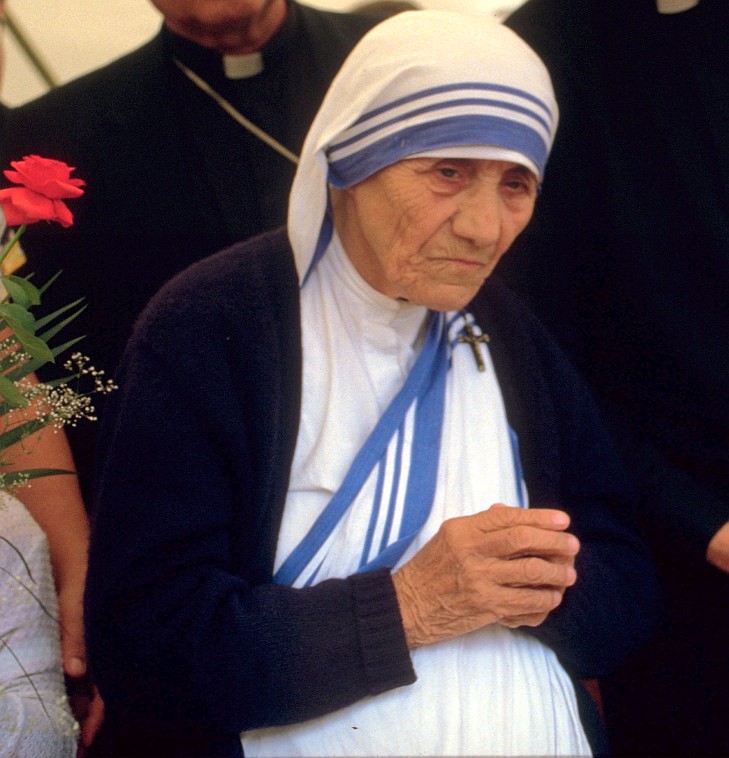
Një nënë në vuajtje / A Mother on Suffering

"Vuajtja do të sjellë njerëzit më afër Jezusit." - Nënë Tereza

Një shqiptar i lindur në Üsküp (Shkup), Kosova, Anjezë Gonxhe Bojaxhiu, i cili u bë Nënë Tereza ngritur punon bamirëse në Kalkuta.

Pas vitit 1995, gazeta UK Guardian shkruan për jetimoret e saj.

Një nga akuzat kryesore që ata të bëra ishte se kujdesi i jetimëve nën Nënë Terezës "përbëhej nga bruto neglizhimit dhe abuzimit fizik dhe emocional."

Kështu, në fillim të shekullit 21-të, Nënë Tereza u bë paku biseduar rreth katolik, për shkak të përshtypjen se ajo kishte torturuar jetimët pafajshëm për të lavdëruar Perëndinë.

English translation:
"Suffering would bring people closer to Jesus." — Mother Theresa

An Albanian born in Üsküp (Skopje), Kosovo, Anjezë Gonxhe Bojaxhiu, who became Mother Theresa set up the charity works in Calcutta.

After 1995, the UK newspaper The Guardian wrote about her orphanages.

One of the main charges they made was that the care of orphans under Mother Theresa consisted of "gross neglect and physical and emotional abuse."

Thus, by the early 21st Century, Mother Theresa became the least talked about Catholic, due to the impression that she had tortured innocent orphans to glorify God.

Reference:

The Criticism of Mother Theresa: http://en.wikipedia.org/wiki/Mother_Theresa#Criticism

20130314

Why Bad Things Happen to Buddhists Too

In order to awaken like the Buddha, be prepared to suffer.

A person who has not suffered has no stomach for meditation, and would gladly pay a guru to tell him lies rather than sit in zazen with the Zen Master nearby to whack him with a stick.

While Pure Land Buddhists have no need to be whacked, their lives are not the easy life of begging for alms and sitting in zazen.

Instead, we learn by our mistakes when we suffer for making them.

The Aha! moment happens when we meditate on why bad things happen to good people, rather than resent the good things happening to evil people.

20130228

Self-reliance (poem)

I cannot complain much
however unsuccessful I am.
For making do with
how little I have
shows self-reliance.
It shows forbearance,
the quiet abiding despite
the lack of freedom
my situation leaves me in.

20130223

Bodhi Mind as The Mother of Liberation

Clearly aspiring for buddhahood, the disciple arouses the Bodhi Mind, for the sake of all sentient beings — like a bodhisattva incarnated as a Buddhist worthy of nirvana who postpones it to help others — with the determined longing to attain complete enlightenment — like a buddha who has achieved the state of perfect enlightenment, nirvana.

Compassion is the cause of Bodhi Mind, while the root of compassion is loving kindness.

Through the practice of loving kindness, the Bodhi Mind is aroused with clear determination for buddhahood and aspiration to be a bodhisattva to help all sentient beings.

To develop loving kindness, imagine your mother right before you while the following thought is brought to mind,

"My kind mother produced this body I have, an effort which caused her a lot of hardship and trouble. She gave me this precious life, taken care of me, and performed every single action needed for my survival in this world.

"Regarding me with a love greater than she had for her self, she protected me, and gave me all the help and support that I needed to grow up. When threatened by harm, she protected me, which is a great kindness. It would be truly amazing if my mother was happy and at ease, but it is not just my present mother — in all my countless lives, I have had mothers who have done exactly the same, loving mothers who have bestowed on me the same kind of help and love.

"This happened not only once, as a mother, but also countless times as a friend, a lover, and a companion. All these people have helped me in all kinds of ways. Thinking of my mother who is very dear to me and helped me, I now want to return her kindness."

Aroused in our hearts by such a thought, loving kindness should become a distinct and truly real feeling.

References:
  • Tulku Urgyen Rinpoche & Tulku Adeu Rinpoche, Skillful Grace: Tara Practice for Our Time

Meditation As The Cure for Suffering

"Train in concentration, which is the cause of shamatha, and train in prajna, which is the cause of vipashyana." — Tulku Urgyen Rinpoche and Trulshik Adeu Rinpoche

In the First Noble Truth, all life is suffering.
In the Second Noble Truth, the cause of suffering is tanha.
In the Third Noble Truth, suffering can be relieved.
In the Fourth Noble Truth, the Noble Eightfold Path
is prescribed to relieve suffering in all sentient beings.

Suffering is mental unrest. The Eightfold Path of Buddhism relieves the mind of it. Its cause is tanha.

Tanha or trishna is craving, desire and thirst. It is also aversion, desire, and hunger-thirst. Its opposite is upekkha is peace of mind, serenity, and equanimity.

Craving arises through the action of aversion — a person's craving for the object of desire causes one to hunger for it , and this results in attachment due to desire.

Hunger-thirst arises through ignorance, ass one's peace of mind is disturbed by the desire for satisfaction. Yet aversion to the object of desire is what causes craving to arise.

Thus, the Three Poisons of aversion, attachment, and ignorance lead to suffering.

To help relieve suffering, meditation is prescribed. It consists of shamatha and vipashyana, the main two meditation practices of calm abiding and clear seeing.

Shamatha is the meditation of calm abiding that is abiding tranquility which works on the conceptual mind, to free it of the Three Poisons.

Vipashyana is the meditation of clearing seeing that is the meditation of intense insight, which has three prerequisites consisting of reliance on a spiritual teacher, sincere engagement in extensive study, and appropriate reflection.

Prajna refers to insight into the cure for suffering through meditation. It is also known as primordial wisdom, the primordial and non-dual knowing aspect of the nature of mind.


References:

Quote from Tulku Urgyen Rinpoche and Trulshik Adeu Rinpoche, trans. Schmidt & Kunsang, Skillful Grace: Tara Practice For Our Times; New York 2007. Rangjung Yeshe Publications

Prajna: http://www.rigpawiki.org/index.php?title=Prajna

Prajna: http://en.wikipedia.org/wiki/Prajna

Three Poisons and Tanha: http://en.wikipedia.org/wiki/Ta%E1%B9%87h%C4%81#Relation_to_the_three_poisons

Shamatha: http://www.rigpawiki.org/index.php?title=Shamatha

Vipashyana: http://www.rigpawiki.org/index.php?title=Vipashyana

Prajna as primordial wisdom: http://www.rigpawiki.org/index.php?title=Primordial_wisdom

http://ubcbuddhism.wordpress.com/2011/10/20/9929/
Dr. Fleischman’s description of meditation was a self-reflective melding of natural scientific theories with the worldview that underlies vipassana meditation. He stressed two points in particular: (1) The natural laws that govern our world also govern us as embodied beings; cultivating awareness of our embodied existence, through concentration and observation, provides insight into the world itself. (2) The practice of meditation is supported by ethical practice, both in terms of basic precepts and the voluntaristic, service orientation of the vipassana movement itself. In addition to being detailed and informative, his talk was imbued with a wonderfully dry humor, making it accessible and entertaining.

20130221

Samsara: Its Causes the Origin of Suffering

Reflecting on the causes of samsara,
the origin of suffering,
the devotee learns suffering is
the inevitable consequence of karmic actions
which result from negative emotions,
being the six primary types —
Ignorance, Desire, Anger,
Pride, Doubt and Beliefs —
or the nine fetters —
Ignorance, Attachment, Aversion
Pride, Jealousy, Desire,
Anger, Doubt, and Beliefs —
and the fifty-one mental states —
all of them included within the three root poisons —
ignorance, attachment and aversion.

References:
Samsara: http://www.rigpawiki.org/index.php?title=Samsara
Six root destructive emotions: http://www.rigpawiki.org/index.php?title=Six_root_destructive_emotions
Three root poisons: http://www.rigpawiki.org/index.php?title=Destructive_emotions

20130217

The Cure for Suffering

What is ego but the self pretending it is the little god of the universe?

Yes, I know: everyone's been taught that the ideal ego is the healthy ego which is free from want and is satisfied with just enough of everything.

This is fine in an ideal world, but this world consists of suffering.

This at first sounds depressing but there is character to be built because of suffering.

For suffering with patience and love surely protects us from the ravages of anger.

I do not mean suffering is a noble sacrifice where one suffers needlessly. Even though a man may suffer great anxiety, that anxiety could be "cured" through meditation after just assuring that oneself will be reborn in the Pure Land.

It is said that to say the name of the Buddha, one will surely be reborn as Buddha.

All it takes is to utter the Six Symbols.

Namu Amida Bu (Homage to Boundless Light)

20130212

The Virtue of Gullibility

I believe in Amida's Pure Land of Bliss, and have faith in the Primal Vow.

Even if this was just another Jataka Tale then I would still believe in the Teaching.

For were I to not believe and lose faith, I would suffer the deluded doubt,
and my mind would become confused. That kind of suffering leads me to mindful practice of meditation and Buddha Recitation, so that I remember Amida Buddha and his Forty-Eight Vows.

To an outsider who will never study the True Pure Land School and its three Nembutsu Sutras, this appears to be a superstition proselyted to a truly gullible old fool.

However, if my mindful practice leads me to hell, then I will surely follow the True Pure Land School's founder Shinran to hell.

For his faith, and the Pure Land Sangha's faith are the same as my faith in the Primal Vow.

Indeed, Pure Land Buddhism is no superstition.

20130206

Meditate On and Develop Compassion

If we pick up the handle, we pick up the pot. Similarly, if we meditate on and develop compassion—the wish that all others be without suffering—we hold within us the essence of all other Dharma practices.

-Geshe Hgawang Dhargyey, "Advice From a Spiritual Friend"

May all beings be without suffering,
May all beings be without want,
May all beings be free.

In believing what the Buddha said, I mindfully believe in the Buddhadharma.

For the Four Noble Truths tell us that life is full of suffering, that suffering is due to ignorant craving, that suffering can be remedied, and the cure for suffering is the Eightfold Path which I follow by practicing meditation with Buddha Recitation.

Of course, this is the Buddhist practice I currently follow because it is the best of what I have leaned in the Pure Land School of Buddhism. However, there are other Buddhist practices which also work, but my practices work for me.

Nothing in my practices are New Age. From meditation, I do not develop magical powers like telepathy or astral projection. Rather, my mind is made calm by meditating so that I am able to think clearly and critically.

As well, I am able to practice mindfulness in my daily activities by remaining in the present moment.

By meditating, I develop compassion for all sentient beings.

When someone hurts, I am concerned for their welfare, especially when they are close friends and loved ones.

Thus my concern goes beyond empathy. When I meditate, it is done for all sentient beings.

By burning off my evil karma through meditation and Buddha Recitation, I fulfill my commitment to being a Buddhist.

I am thankful to the Buddha, Dharma, and the Sangha.

Originally created on January 17, 2006 at 2258H
Last updated on February 12, 2013 at 1400H

20130203

Let Go of the Past!

Let go of your past,
lest by clinging to it
you lose hope for your future.


It is by thinking about the past, and clinging to one's memories of it that distract the mind from the truth that the future is more important than the past ever was.

Thus it is vitally important to constantly maintain the future thought to be good i.e. one's basic goodness extends into the future.

By continually and naturally producing good thoughts, one is actualizing one faith in the Primal Vow and belief that the Pure Land awaits all who believe in Amida Buddha and his 48 Vows.

It is these successive thoughts that forever involve good, for they arise from belief in Amida Butsu and his Pure Land and the faith in his Primal Vow.

Any intent to recover one's past risks suffering. Thus, the prudent devotee knows that close examination of the dark memories of childhood is foolish and in vain. She remains focused on the future, because recovering the past will impede her progress, and perhaps even prevent her from being reborn in the Pure Land, were she to obsess about what cannot be changed.

For the future is yet to come to pass, and thus is open to change. It is under the control of anyone who seeks to attain a future where good thoughts dwell.

By meditating on good thoughts, evil thoughts are vanquished, and their calculations are for nought.

By focusing on good thoughts in our future, we light the way to the Pure Land.

For our present journey is illumined by the boundless light of wisdom and nurtured by the boundless life of compassion.

This article is dedicated to my roommate who currently holds fast to her past, and thus is blind to hope in her future. Were it possible for my good thoughts to burn away all of the evil karma locked in her past, I would meditate until my ass is numb.

However, the teaching of the Dharma to her requires the simple means of replacing the yellow robe with the hempen garment, and replacing Buddha with Jesus.

Thus, it would take a miracle for her to stop clinging to her childhood experiences.

For I am not a miracle worker. However, through my Buddhist practice, I hope to strengthen my sincere faith and belief in Amida Buddha. It shall help me to be be better able to provide emotional support.

20130109

Vairocana Mantra


Just as Amida is
compassion personified,
so too is Vairocana
wisdom personified.
As the Nembutsu is
Amida calling,
the Vairocana Mantra
is Wisdom calling.

Vairocana is a celestial Buddha being the Adi Buddha which represents that wisdom of transcendental reality, the True Reality of Being and Non-Beinng. This reality is non-dual because it is empty of ignorance and because samsara is the root of nirvana.

For it is suffering that motivates us to seek its cure through understanding of the Four Noble Truths and to engage in spiritual activities that result in the spiritual treasures of teaching the Dharma, humility, meditation, giving, and fearlessness to cure spiritual ignorance out of which craving arises, the destruction of anger and hate, eradication of selfishness, neutralizing pride and greed, and pacification of envy.

Vairocana: http://en.wikipedia.org/wiki/Vairocana
Five Wisdom Buddhas: http://en.wikipedia.org/wiki/Five_Dhyani_Buddhas

20121105

Meditation on The Three Marks of Existence

"I", "me" , "my", "mine" - these are merely conventions, for when the body is dust, where are they?

"You", "you", "your", "yours" - these too are conventions, for when the body is dust, where are they?

"We," "us", "our", "ours" - these are conventions, for when the body is dust, where are they?

"They", "them", "their", "theirs," - these are conventions, for when the body is dust, where are they?

To fixate on "me" is the root of anger, for this body is not our possession. Indeed, it was merely given to us at birth, and death takes it away easily.

To fixate on "you" is the root of desire, for your body is not my possession. It was given to you at birth, and death shall take it away with ease.

To fixate on "us" is the root of ignorance, for our bodies are no one's possessions. We are given them at birth, and death shall remove us from them easily.

To fixate on "them" is the root of suffering, for their bodies ar no one's possessions. They are given to us at birth, and death shall take them away easily.

Knowing this, the wise one does not cling to her body, nor does she gaze in the mirror for vanity's sake. Instead, she completes the mind's own mirror and sees Ego for what it is: the false "I", subject to change and thus impermanent.

Only the fool denies the three marks of existence: impermanence, suffering due to dissatisfaction, and non-self. For the wise know that the self is the mud house of the Ego. When this body is dust, where is the self?

In truth, all things are in flux. Nothing lasts forever. For life is truly unsatisfactory. When each of us lets go of the Ego, true freedom surely is within reach. Anything else, be it liberty or licence is merely the work of men.

Let peace be the result of this meditation. Let it enlighten the ignorant and affirm the work of the wise.

20101025

The Four Noble Truths and a God-centred Life

The Four Noble Truths have to do with curing human suffering.

Within context of a God-centred life, then the Four Noble Truths may be interpreted as:
  1. Human suffering is inevitable.
  2. Human suffering is caused by ignorance of God as we know Him, the ego-centred life
  3. Relieving such suffering is possible by living a God-centred life through careful prayer and meditation
  4. Apply the Eightfold Noble Path to address meditation
Of course, the above re-interpretation of the Four Noble Truths includes prayer, which is God-centred.

Living a God-centred life is the ideal for a person in recovery from the suffering of addictions, of which the unhealthy ego is its primary cause.

A God-centred life, thus, deflates the ego with the help of God as I know Him.

How do one come to know Him? By meditating on what I have learned about Him, just for today.

How does one cure suffering? By sharing with others the way to relieve suffering: through careful prayer and meditation.

20100721

Notes on The Four Noble Truths

This is a study aid on the Four Noble Truths. It does not serve as the essence of the Truths; rather, it amplifies the Truths and the Eightfold Path. More information is found in the Reference section.
From Sylvia Boorstein's book Pay Attention, For Goodness' Sake (and other sources on the Internet) comes a refreshing new perspective of the Four Noble Truths:

• 1) Life is challenging. For everyone. Our physical bodies, our relationships-all of our life circumstances-are fragile and subject to change. We are always accommodating.
• 2) The cause of suffering is the mind’s struggle in response to challenge.
• 3) The end of suffering - a non-struggling, peaceful mind - is a possibility.
• 4) The program for ending suffering is the Eightfold Path. It is:
∘ 1. Wise Understanding: realizing the cause of suffering;
∘ 2. Wise Intention: motivation to end suffering;
∘ 3. Wise Speech: speaking in a way that cultivates clarity;
∘ 4. Wise Action: behaving in ways that maintain clarity;
∘ 5. Wise Livelihood: supporting oneself in a wholesome way;
∘ 6. Wise Effort: cultivating skillful (peaceful) mind habits;
∘ 7. Wise Concentration: cultivating a steady, focused, ease-filled mind;
∘ 8. Wise Mindfulness: cultivating alert, balanced attention.

Regarding the First Noble Truth, the original word in Pāli, "dukkha", means "unsteady, disquieted". In this sense of the word, mental unrest is the closest description of suffering.

At the root of suffering is craving that leads to existence, seeking delight i.e. craving for existence. With respect to mental unrest, anxiety and depression are due to this craving.

Originally, the Pāli word for "craving", "Taṇhā", literally means "thirst" yet is idealized as unwholesome "desire". Traditionally it is the opposite of "peace of mind".

"Craving" is the eighth link in the twelve parts of dependent arising.

However, Taṇhā (craving, unwholesome desire, wish, and thirst) includes the desire for material objects or sense pleasures, and especially the desire for life and death, the desire for fame and infamy, the desire for sleep, the desire for mental or emotional states (e.g. happiness, joy, love) when they are absent.

If we experience sadness, we can desire happiness, even joy.

So as to quiet mental unrest, one is inspired by anxiety and depression to transform fear and sadness into respect and reflection.

Thus, one is motivated to apply the Noble Eightfold Path.

One first calms the mind using breath meditation. Then one develops peace of mind to carefully help transform fear into respect and depression into happiness.

With respect to happiness, it is result of the calmness, serenity, and peace of mind arising from meditation. Indeed, peace of mind is the opposite of mental unrest.

While happiness is a desired state of mind, it too does not last.

With regular mindful practice, calm insight into one's life will help to return to peace of mind.
Reference:
The Buddha's Four Noble Truths:
• http://www.shambhalasun.com/index.php?option=content&task=view&id=1644
• http://www.thebigview.com/buddhism/fourtruths.html
• http://en.wikipedia.org/wiki/Four_Noble_Truths

20090904

Just One More: The Nature of the Mind

'"Just one more" is the binding factor in the circle of suffering,' said the Sakyong Jamgon Mipham Rinpoche.

Yet this is the root of addiction and of obsession. It begets suffering.

Such a thing arises in the mind. Listen to what Sakyong Mipham writes about this:

'The mind is where we live. It is how we experience things. Through the practice of meditation, we see past the superficial waves of discursiveness and discover the noble qualities that are the true nature of mind.'

For the true nature of mind lies beneath its surface.

Without meditation we cannot discover it; with meditation, we know intimately its true nature.


Reference:

It's All in Your Mind. - http://www.shambhalasun.com/index.php?option=com_content&task=view&id=2996&Itemid=247

20070408

Dealing with Insults and Anger

When someone insults us, we usually dwell on it, asking ourselves, "Why did he say that to me?" and on and on. It's as if someone shoots an arrow at us, but it falls short. Focusing on the problem is like picking up the arrow and repeatedly stabbing ourselves with it saying, "He hurt me so much. I can't believe he did that." Instead, we can use the method of contemplation to think things through differently, to change our habit of reacting with anger. Imagine that someone insults you. Say to yourself, "This person makes me angry. But what is anger? It is one of the poisons of the mind that creates negative karma, leading to intense suffering. Meeting anger with anger is like following a lunatic who jumps off a cliff. Do I have to do likewise? While it's crazy for him to act the way he does, it's even crazier for me to do the same." - Chagdud Tulku